As a B2B buyer, are you also stuck in the smart water bottle market? Is it worthwhile to give up ordinary water bottles and upgrade to this kind of technology-oriented model? Are you always wondering: what is the “smart” water bottle in 2026 and how can we ensure that it can connect with your company’s existing technical system?
This complete guide helps you clear the fog of publicity stunts, answer all the questions you are anxious to know, and takes you step by step from entry to confident purchasing decision. Let’s cut to the chase—the smart water bottle in 2026 is not a trend but a practical tool that can help you upgrade your brand, help your team to be healthy, and stand out from the fierce competition. Are you ready to bid farewell to guessing, purchase accurately, and buy more worry-free?
What is a Smart Water Bottle in 2026?
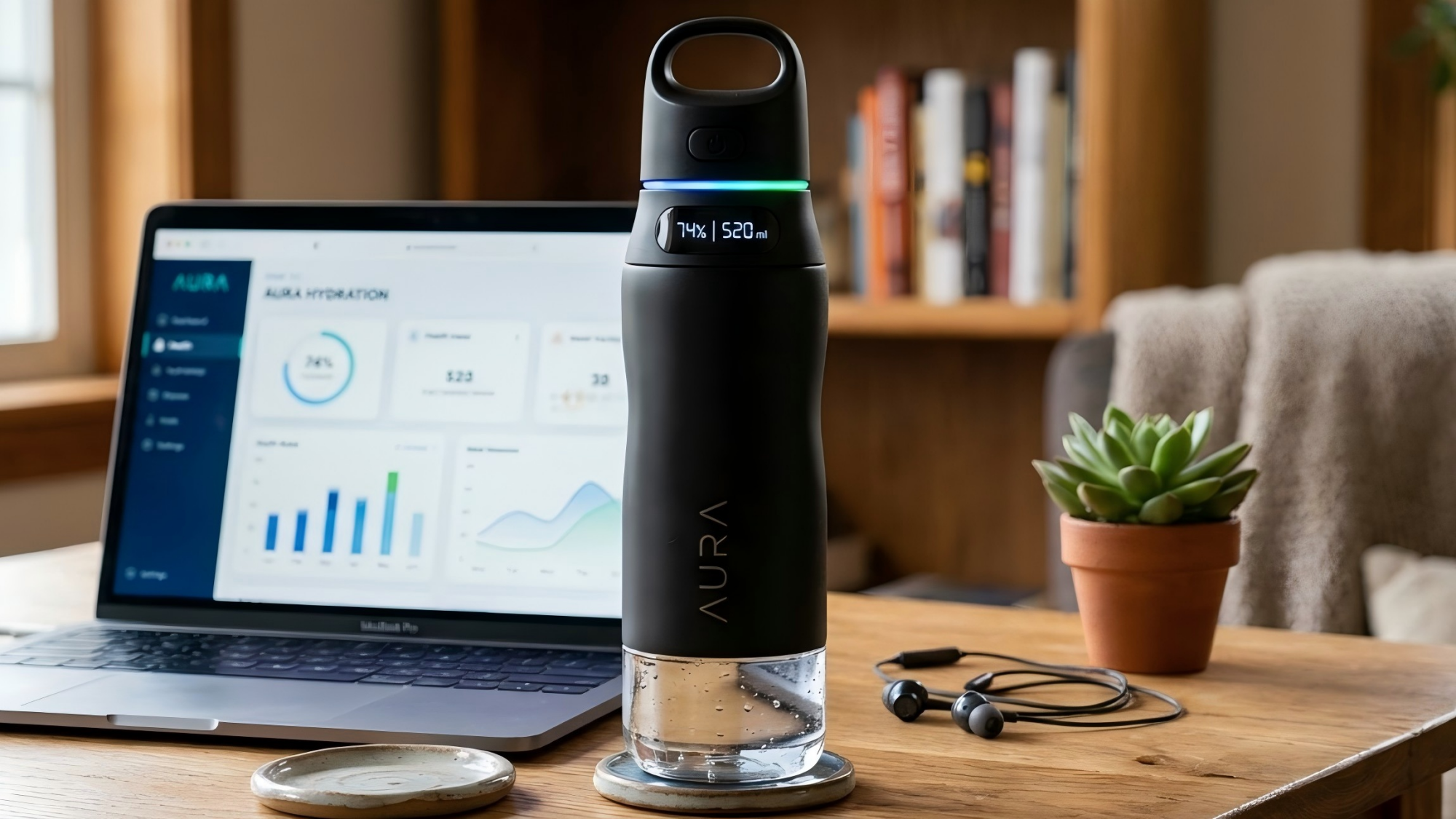
The smart water bottle in 2026 has long been more than just a container that blinks when you forget to drink water. It is already an interconnected intelligent device that can monitor, learn, predict and multi-scene linkage. For B2B buyers, it is a key step to understand this wave of product upgrades, so that it will not be a year and a half after purchasing that the styles and functions will be completely outdated.
From Pedometer to Hydration Coach: The Evolution of Smart Drinkware
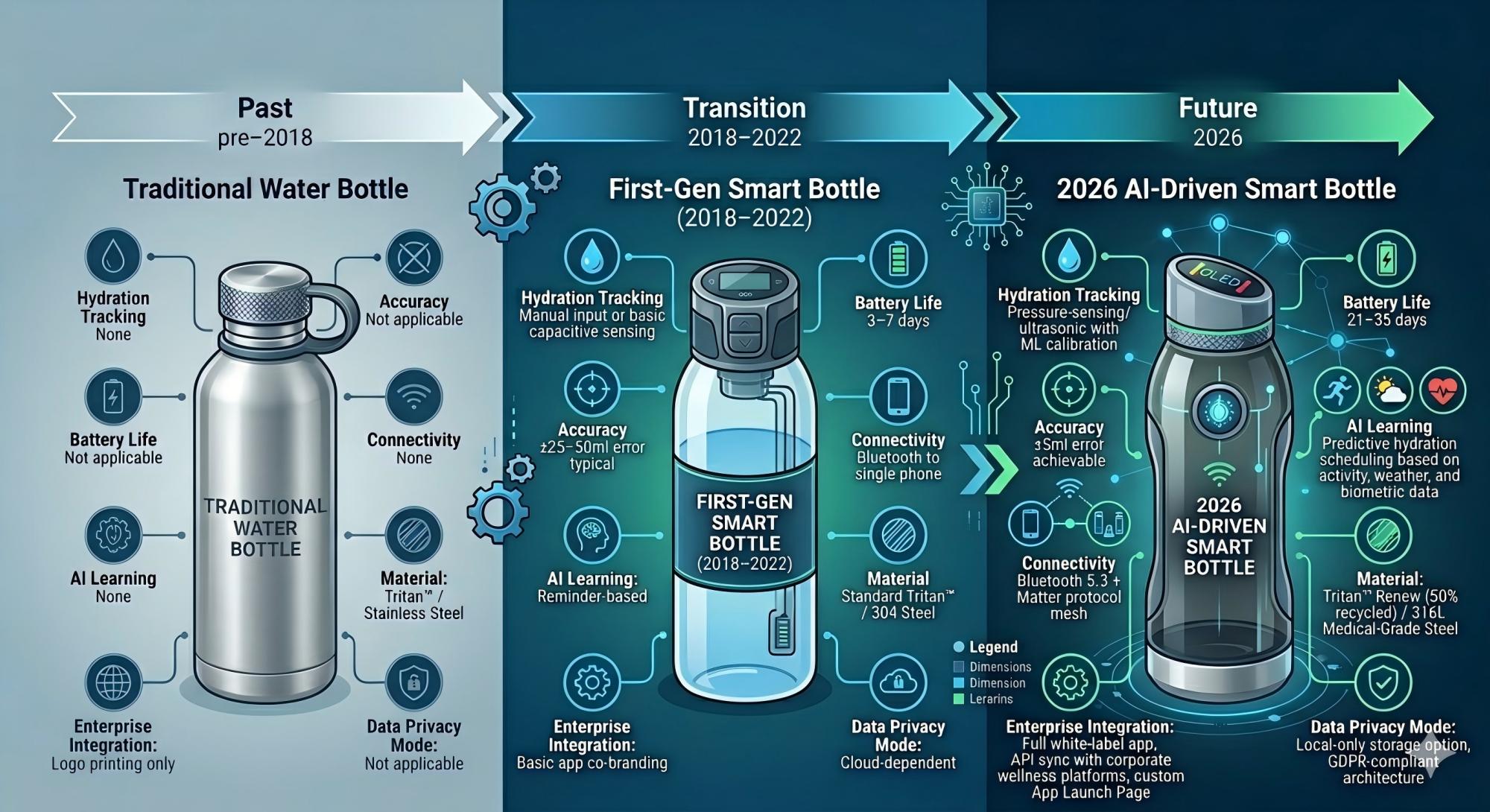
The smart water bottle has experienced three generations of product iterations. Knowing the difference between these three generations, the buyer will not step into the pit: buying outdated products that seem to be new, but in fact they are just refurbished.
| Feature Dimension | Traditional Water Bottle | First-Gen Smart Bottle (2018–2022) | 2026 AI-Driven Smart Bottle |
|---|---|---|---|
| Hydration Tracking | None | Manual input or basic capacitive sensing | Pressure-sensing/ultrasonic with ML calibration |
| Accuracy | Not applicable | ±25–50ml error typical | ±5ml error achievable |
| Battery Life | Not applicable | 3–7 days | 21–35 days |
| Connectivity | None | Bluetooth to single phone | Bluetooth 5.3 + Matter protocol mesh |
| AI Learning | None | Reminder-based | Predictive hydration scheduling based on activity, weather, and biometric data |
| Material | Tritan™ / Stainless Steel | Standard Tritan™ / 304 Steel | Tritan™ Renew (50% recycled) / 316L Medical-Grade Steel |
| Enterprise Integration | Logo printing only | Basic app co-branding | Full white-label app, API sync with corporate wellness platforms, custom App Launch Page |
| Data Privacy Mode | Not applicable | Cloud-dependent | Local-only storage option, GDPR-compliant architecture |
In general, in 2026, there are three major upgrades in smart water bottles.
Sensor Updates:
The sensor is no longer just a simple reminder trigger device but has been upgraded to a machine learning data acquisition terminal.
Networking Mode Updates:
It is upgraded from a single one-to-one connection of mobile phones to a multi-device interconnection.
Material Updates:
The material standard has advanced from simple “safety and non-toxicity” to traceable and certifiable environmentally friendly and sustainable materials—this is also the industry trend that corporate ESG social responsibility just needs to be forced out.
What Core Components Define a Smart Water Bottle in 2026?
Understanding the internal structure of smart water bottles can help B2B buyers to get to the point and be professional when screening suppliers. The whole can be evaluated from three core component levels.
| Core Component | Technology / Material | Key Advantages | Key Limitations |
|---|---|---|---|
| Sensor Module | Pressure-Sensing (Base) | High accuracy, orientation-immune | Requires flat surface |
| Ultrasonic (Lid) | Instant, non-contact | Humidity drift (±8–10ml) | |
| Connectivity Chip | Matter Protocol | Centralized visibility, future-proof, no personal phone required | Needs Matter-enabled hub |
| Material Shell | Tritan™ Renew | 50% recycled content, chemically identical to virgin | Comparable cost to standard Tritan™ |
| 316L Stainless Steel | 4–6x longer lifespan, superior corrosion resistance | Higher material cost |
How Does the “Hydration Ecosystem” Connect to Your Existing Tech Stack?
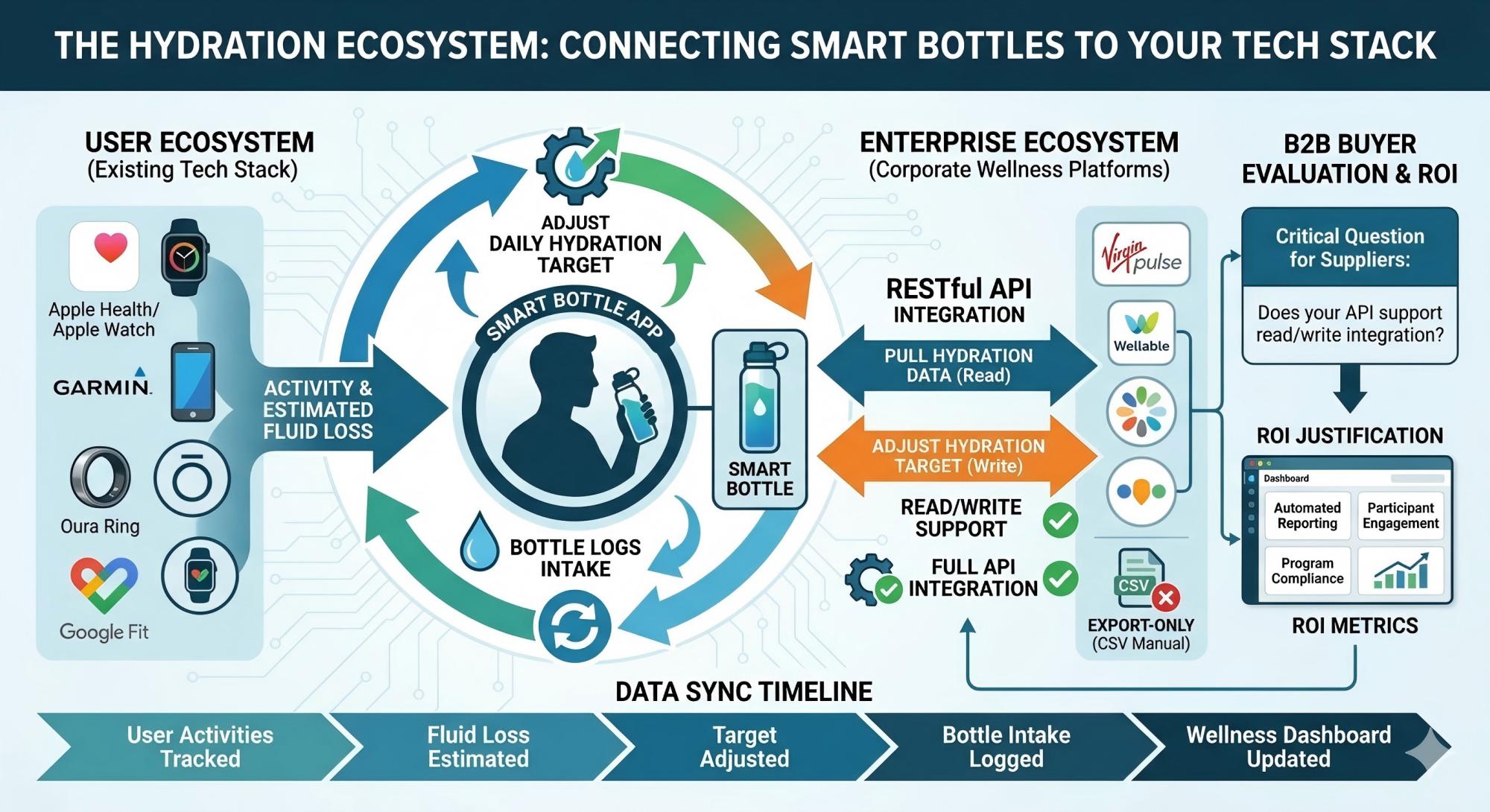
For health & tech retailers, ecological adaptability is the first threshold for product evaluation.
Smart water bottles have never been bought separately, but are used in conjunction with Apple Watch,Garmin devices, Oura Ring, and other corporate health management platforms.
By 2026, manufacturers of head smart water bottles will open the RESTful APIs, so that the enterprise health platform can directly access the drinking water data to the unified management background.
B2B buyers who make purchases for enterprise health and welfare projects must ask suppliers the key questions: Does your API support read/write integration with our platform, or is it export-only?
Only when the full API is connected in two directions can data reports be automatically generated, which can help you clearly prove the return value of this health project to the management.
Why Are Smart Water Bottles the Next Big Thing in Corporate Gifting?
Corporate gifting is quietly welcoming a change. Umbrella with logo printed on it and the same gift set are out of fashion, and now people prefer practical, customizable and technological business gifts. The smart water bottle just fits these three trends at the same time and becomes an excellent choice.
Smart vs. Regular Water Bottle: What’s the Real ROI for Businesses?
From the perspective of commercial cost, the price of traditional water bottles is relatively low, and the price of smart water bottles is often several times higher, and the retail price is generally 50-100 US dollars, which raises the procurement cost and market acceptance risk. The gross profit margin of the conventional bottled water bottle industry can reach 35%-50%, and it can be stable without additional electronic functions.
The rationality of the high price of smart water bottles is reflected in the positioning of high-end brands, the operation of APP users, and the continuous income derived from intelligent functions.
If it’s just event gifts, office benefits, and mass distribution of gifts, ordinary water bottles have obvious advantages: the cost of a single exposure is lower, the replacement is convenient, and brand promotion is realized by a wide range of logo exposure.
Only for the purpose of obtaining customers, brand impression and employee welfare, high-value regular water bottles are more cost-effective; Smart water bottles are worth investing only when they can be realized directly through technology, reduce the loss and enhance the user’s stickiness.

Click and read more about Custom Options: Custom Bottle Tumbler Decorating, Custom Logos of Water Bottles, Custom Water bottle Packaging
What Privacy and Data Security Concerns Should You Address Before Buying?
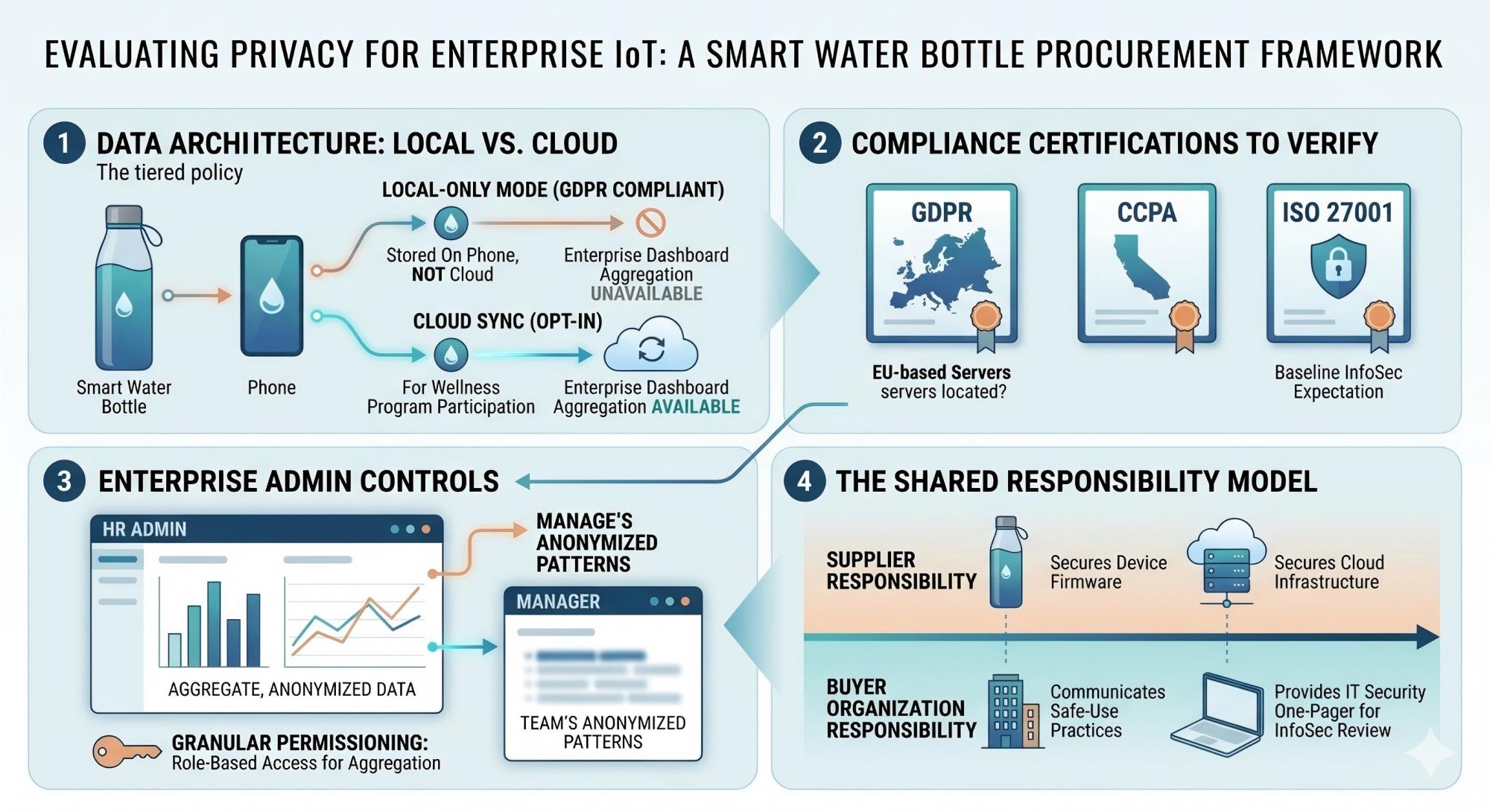
Smart water bottles will record everyone’s drinking time and quantity, which belongs to user behavior data; Once the data is not handled properly, the risk of privacy leakage will be immediately highlighted.
For large enterprise purchasers, privacy compliance assessment should start from four dimensions:
Data Architecture: Local Storage or Cloud Storage
In 2026, smart water bottles that meet GDPR EU privacy regulations will be equipped with local-only mode. After this mode is turned on, the drinking data will only be stored in the user’s mobile phone and will never be uploaded to the manufacturer’s cloud.
Some reliable suppliers will make a hierarchical permission policy: users who are willing to participate in corporate health plans can voluntarily start cloud synchronization; Users who are unwilling to authorize can also use all the core drinking water monitoring functions of the water bottle normally, and the data is only kept locally throughout.
Compliance certification that must be verified
Make sure that suppliers provide the latest and valid qualifications:
GDPR: Focus on confirming the server deployment location. European employee data, the server must be located in the EU, there is no room for discussion.
CCPA California Privacy Act: Applicable to California employees and project participants.
ISO 27001: information security management system certification is now the basic threshold for large enterprises to enter suppliers.
Enterprise Admin Controls
Does the enterprise management background support role-based permissions? Can it be done: HR can only view the summarized anonymous data, and department heads can only see the anonymous drinking behavior trend of their own team? The detailed division of authority shows that this supplier has mature service experience in large enterprises.
The shared responsibility model
Smart water bottles are Internet of Things devices, so it is inevitable to access non-dedicated secure Wi-Fi in home or office. The supplier is responsible for the security protection of equipment firmware and cloud architecture; Purchasing enterprises are responsible for popularizing safe use norms to employees. Regular suppliers will provide a one-page IT security description document, which is convenient for the enterprise information security department to directly review and verify in the procurement process.
How Long Does a Smart Water Bottle Last? Battery, Durability, and E-Waste Reality
B2B buyers who have been burned by previous electronics-in-everyday-objects purchases will press hard on this topic. Smart luggage with batteries that died in month four. Bluetooth trackers with irreplaceable cells. These experiences create skepticism that must be addressed head-on.
Battery Life: The 21-Day Industry Baseline
| Battery Performance | Duration | B2B Significance |
|---|---|---|
| 2026 Industry Baseline | Minimum 21 days | Standard expectation for premium bottles under normal use (8–12 events/day). |
| Best-in-Class | 30–35 days | Achieved via Bluetooth 5.3 chipsets and efficient ML processors. |
| Red Flag | <14 days | Indicates legacy components or poor firmware optimization; high risk for reliability. |
Durability Testing: What Happens on the Factory Floor
| Test Stage | Method | Pass Standard |
|---|---|---|
| Thermal Shock | Cycle between -20°C and 60°C | Electronic function + seal integrity maintained under extreme conditions. |
| Pressurized Seal | Submerged in varying air pressure chambers | Zero leakage at 1.5x normal atmospheric pressure change. |
| Component Cycle | Mechanical cycling 5,000+ times on ports/buttons | Failure rate <0.3% (excess triggers batch investigation). |
The E-Waste Reality: Acknowledging the Challenge
| Strategy | Mechanism | Waste Reduction Impact |
|---|---|---|
| Modular Design | Replace only the electronic lid; retain bottle body | Reduces end-of-life waste by 70% |
| Take-Back Program | Return end-of-life modules for certified recycling | Ensures responsible e-waste processing |
| Repair Program | Refurbish out-of-warranty modules | Extends product life at fraction of replacement cost |
Where Can B2B Buyers Find the Most Reliable Smart Water Bottle Manufacturers?
How to Evaluate OEM/ODM Capabilities for Custom Branding?
When bidding for proposals from corporate customers, whether the order can be won often depends on the perfection of product customization and the overall durable quality.
For a corporate gift intended to reflect brand quality, laser engraving on stainless steel or in-mold labeling on Tritan™ are the premium options. Screen printing is the workhorse for mid-volume promotional needs. B2B buyers should request accelerated wear testing samples—a supplier’s willingness to provide these is itself a quality signal.
Beyond the Logo: App-Level Customization
In 2026, the most impactful branding doesn’t sit on the bottle at all—it lives inside the app. Enterprise-grade smart bottle suppliers now offer:
Custom App Launch Page: When a recipient first opens the companion app, they see your client’s branded splash screen, not the manufacturer’s.
White-Label App Deployment: The entire app is published under your client’s developer account with their name, icon, and App Store/Google Play listing.
Push Notification Personalization: Wellness reminders can carry the corporate client’s tone of voice and branding.
For distributors bidding on a deal with a Fortune 500 brand, the ability to offer these software-layer customizations is frequently the deciding factor. Inquire about these capabilities early in the supplier conversation.
What Are the Key Factors in Choosing a Wholesale Partner?
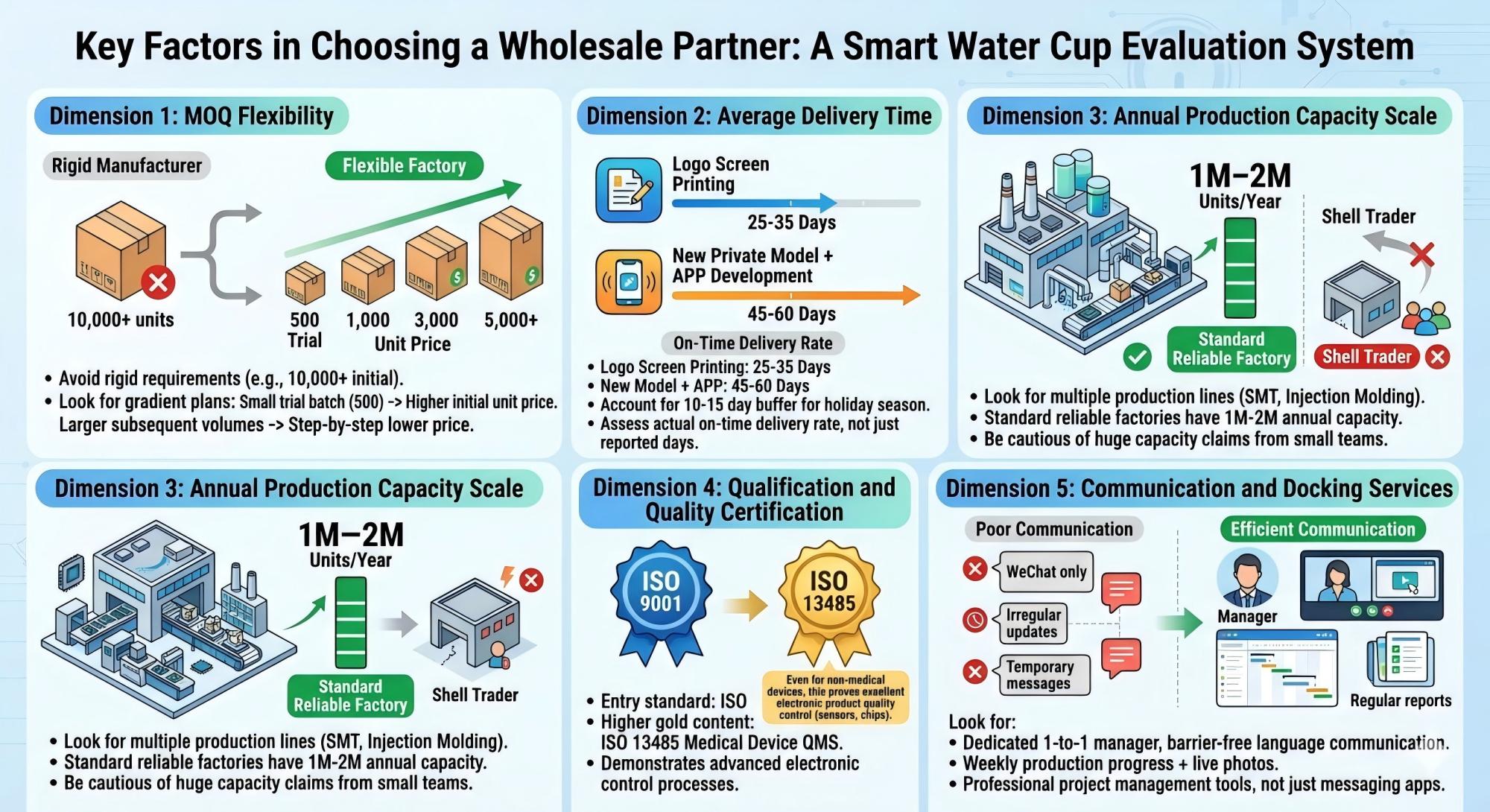
The procurement team needs a set of well-organized evaluation standard systems when screening suppliers of wholesale smart water bottles and negotiating wholesale cooperation. The following five core evaluation dimensions are sorted out, which are also the key to determining whether long-term stable cooperation can be achieved.
Dimension 1: MOQ flexibility
Fully customized OEM orders, including exclusive color matching, logo printing, and customized packaging; the industry’s regular order quantity is generally 3000. However, a truly flexible and reliable factory will make a gradient order plan: first, try 500 orders in small batches, and the unit price is slightly higher; the larger the subsequent volume of goods, the lower the unit price step by step.
Dimension 2: Average delivery time
The normal delivery time of the existing OEM order with LOGO screen printing is 25-35 days from the confirmation of the design draft to the delivery. If you want to open a new private model and develop a dedicated APP, the delivery time will be extended to 45-60 days. In order to catch up with the holiday gift season in the third quarter, the overall delivery time should be reserved for another 10-15 days.
Dimension 3: Annual production capacity scale
This one can best distinguish between physical factories and shell traders. A professional smart water bottle factory will be equipped with multiple SMT chip production lines for circuit board assembly, as well as multiple injection molding production lines to produce bottle bodies. The annual production capacity is 1 million–2 million, which belongs to the standard strength of moderately reliable factories.
Dimension 4: Qualification and Quality Certification
Entry standards must have ISO 9001 quality management system certification. For intelligent electronic products, ISO 13485 medical device quality management certification has higher gold content. Even if the smart water bottle is not a medical device, this certification is enough to show that the factory’s production quality control process is excellent and it can fully control the production of electronic products with sensors and smart chips.
Dimension 5: Communication and docking services
It depends on whether the supplier has a dedicated one-to-one business manager, and the language communication is barrier-free; Will the production progress and the synchronization of the live photos be sent out regularly every week? Do you use professional project management tools to follow up, instead of just relying on WeChat for casual messaging and temporary communication?
How Do You Verify Smart Water Bottle Quality and Compliance?
Qualification, certification, and testing standards are the common language in the B2B procurement circle. But certification is not enough; it must be issued by a formal authority within the validity period, and it must be matched with the market where the product is to be sold; otherwise, it is a piece of waste paper, which is of no practical use.
Which Certifications Matter Most for Global Distribution?
Different countries and regions have different access standards. A smart water bottle that can pass through US customs smoothly may also be detained due to the lack of a specific compliance statement at the EU port.
| Market | Food Contact Material | Electronics Safety | Wireless/EMC | Environmental | Data Privacy |
|---|---|---|---|---|---|
| United States | FDA 21 CFR (food contact) | UL 62368-1 or equivalent | FCC Part 15 | California Proposition 65 if applicable | CCPA (for data collected from CA residents) |
| European Union | EU 1935/2004, LFGB (Germany-specific) | CE (EN 62368-1) | CE (RED Directive 2014/53/EU) | RoHS 3, REACH, WEEE (producer registration) | GDPR (mandatory) |
| United Kingdom | UK equivalent of EU 1935/2004 | UKCA | UKCA (Radio Equipment Regulations) | UK RoHS, UK WEEE | UK GDPR |
| Canada | Health Canada (food contact) | CSA or UL equivalent | ISED (Innovation, Science and Economic Development) | Provincial e-waste regulations | PIPEDA |
| Australia/NZ | AS 2070 (plastics) | AS/NZS 62368.1 | ACMA (RCM mark) | National e-waste schemes | Privacy Act 1988 |
| Japan | MHLW Notification No. 370 | PSE (for lithium battery) | MIC (Ministry of Internal Affairs) | J-Moss (RoHS equivalent) | APPI |
| Middle East (UAE) | UAE.S GSO 2231 | UAE.S GSO IEC 62368-1 | TRA (TRA type approval) | Regional e-waste regulations | Varies by free zone |
How Accurate Are Hydration Sensors, Really? An Engineer’s Take
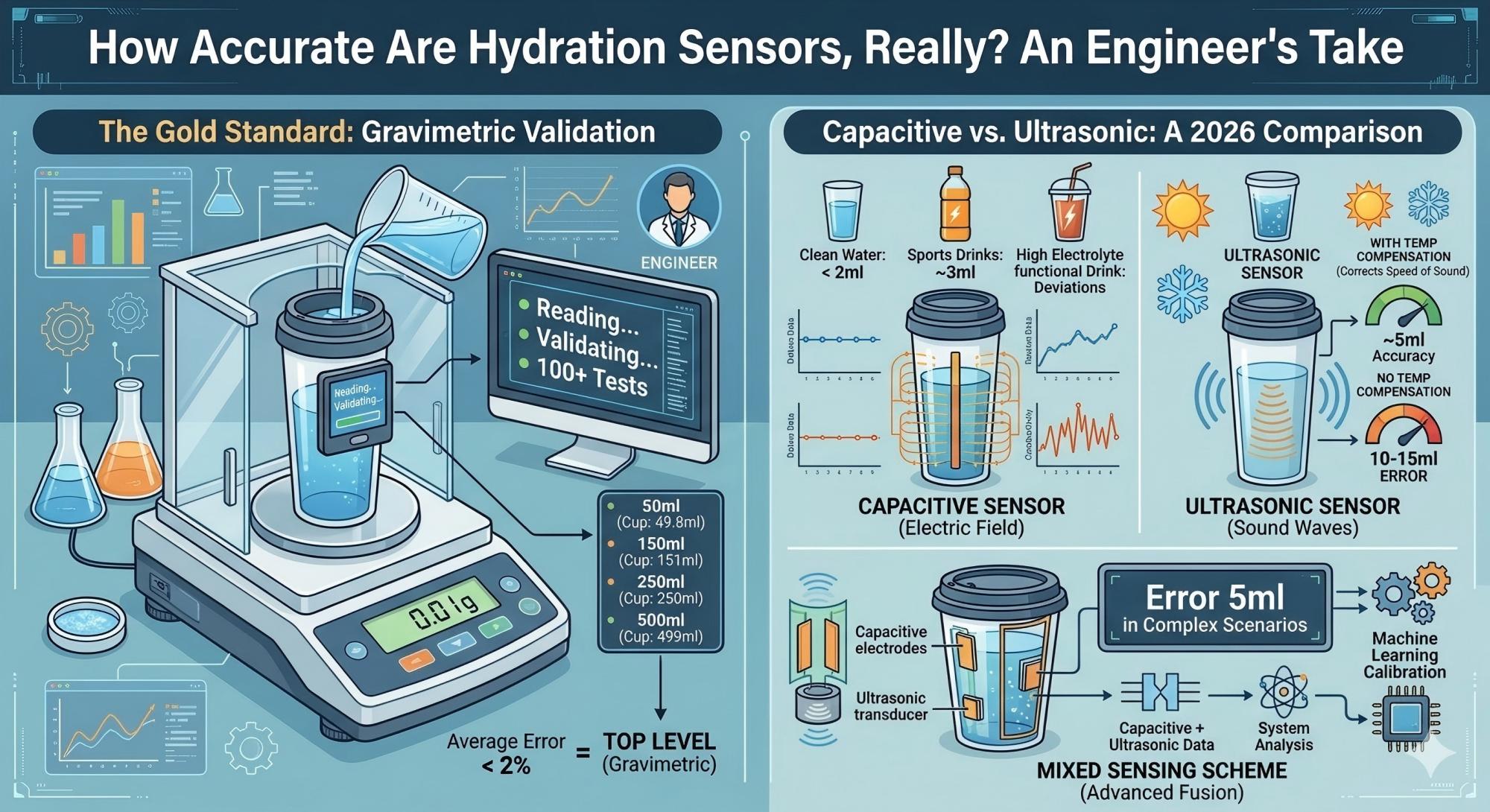
Sensor accuracy is the least professional and most easily fooled piece in the purchase of smart water bottles. On the publicity page, it is always advertised as “high-precision monitoring of drinking water,” but don’t believe these kinds of words; you must check them carefully.
The Gold Standard: Gravimetric Validation
In the laboratory, the general practice of judging the accuracy of sensors is to measure and verify them by the weight method. Put the water bottle on a professionally calibrated electronic balance with an accuracy of 0.01 g so that the water bottle can record data synchronously with its own sensor. Repeat the actual measurement for more than 100 times with different drinking volumes, such as 50 ml, 150 ml, 250 ml, and 500 ml, and compare the reading of the water bottle with the real data of the balance. Only when the average error of the whole range is less than 2% can it be called the top level.
Capacitive vs. Ultrasonic: A 2026 Comparison
In 2026, the Journal of Sensor Research published a measured study and made a horizontal evaluation of two mainstream sensing schemes in the market under real-use scenarios:
- A capacitive sensor relies on the change of electric field caused by the change of water level to measure water quantity. It is very accurate to fill clean water and ordinary sports drinks, but when it comes to functional drinks with high electrolytes and high conductivity, it will disturb the electric field, and the data will easily deviate. Optimum accuracy: 3 ml.
- The ultrasonic sensor emits sound waves and measures the water level by measuring the time difference when the sound waves hit the water surface and reflect back. It is not affected by the conductivity of the drink, but it will be disturbed by the temperature difference, which will change the speed of sound and produce errors. Temperature compensation calibration: the best accuracy is 5 ml; without temperature compensation: the error is directly increased to 10 ~ 15 ml.
The mixed sensing scheme takes pressure sensing as the main measurement data and ultrasonic waves as the secondary check. Once the reading deviation between the two groups exceeds 15 ml, the system will mark the abnormality and automatically correct the calibration through a machine learning algorithm. This combination scheme can stably control the error within 5 ml in various daily complex scenes.
Can Smart Water Bottles Be Sustainable? Addressing the Environmental Question
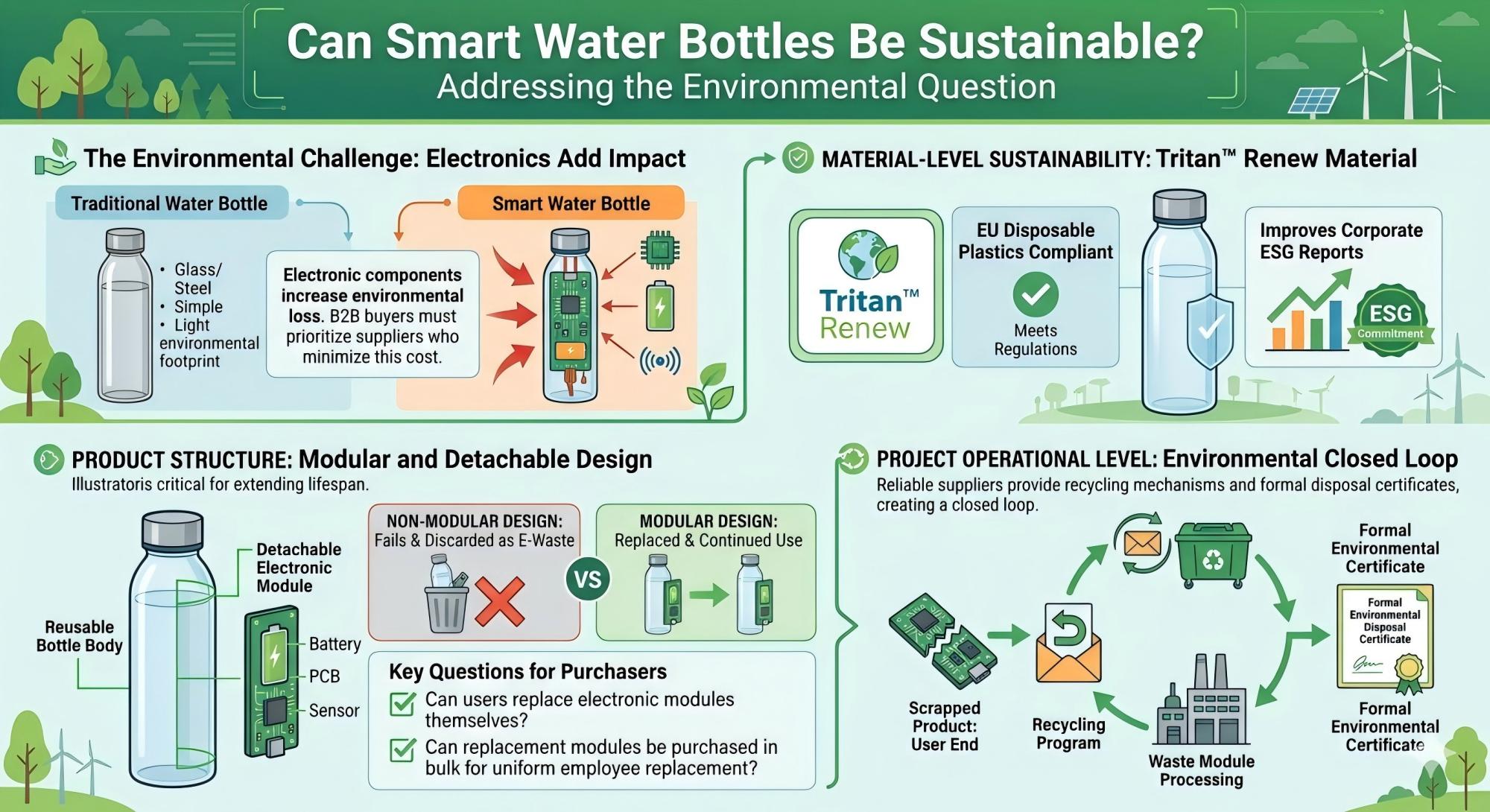
The environmental protection and sustainability of consumer electronics cannot be fooled by a slogan. On the basis of the original pure mechanical ordinary water bottle, the intelligent water bottle adds more electronic components, which in itself will produce certain environmental losses. For B2B buyers, the key depends on whether the supplier has actually taken measures to minimize the cost of environmental protection.
Material level environmental protection: Tritan™ Renew material
For buyers who are bound by EU disposable plastics regulations and corporate customers who have ESG environmental commitments, this material can not only pass the compliance test but also improve the corporate sustainable development financial report.
Environmental protection of product structure: modular and detachable design
The most critical step for smart water bottle manufacturers in environmental protection is whether the electronic module and the bottle body can be separated. Non-modular design Once the battery ages and the sensor fails, the whole bottle can only be discarded as electronic waste.
Purchaser can directly ask suppliers two key questions: Can users replace electronic modules themselves? Can you purchase replacement modules in bulk for employees to replace uniformly?
Environmental protection at project operation level
The International Green Science and Technology Association suggests that smart consumer electronics manufacturers must provide a recycling mechanism for scrapped products. Reliable suppliers will recycle waste electronic modules, do professional e-waste disposal, and issue formal environmental protection disposal certificates, thus truly forming an environmental protection closed loop.
What Are the Emerging Trends Shaping Hydration Tech in Late 2026?
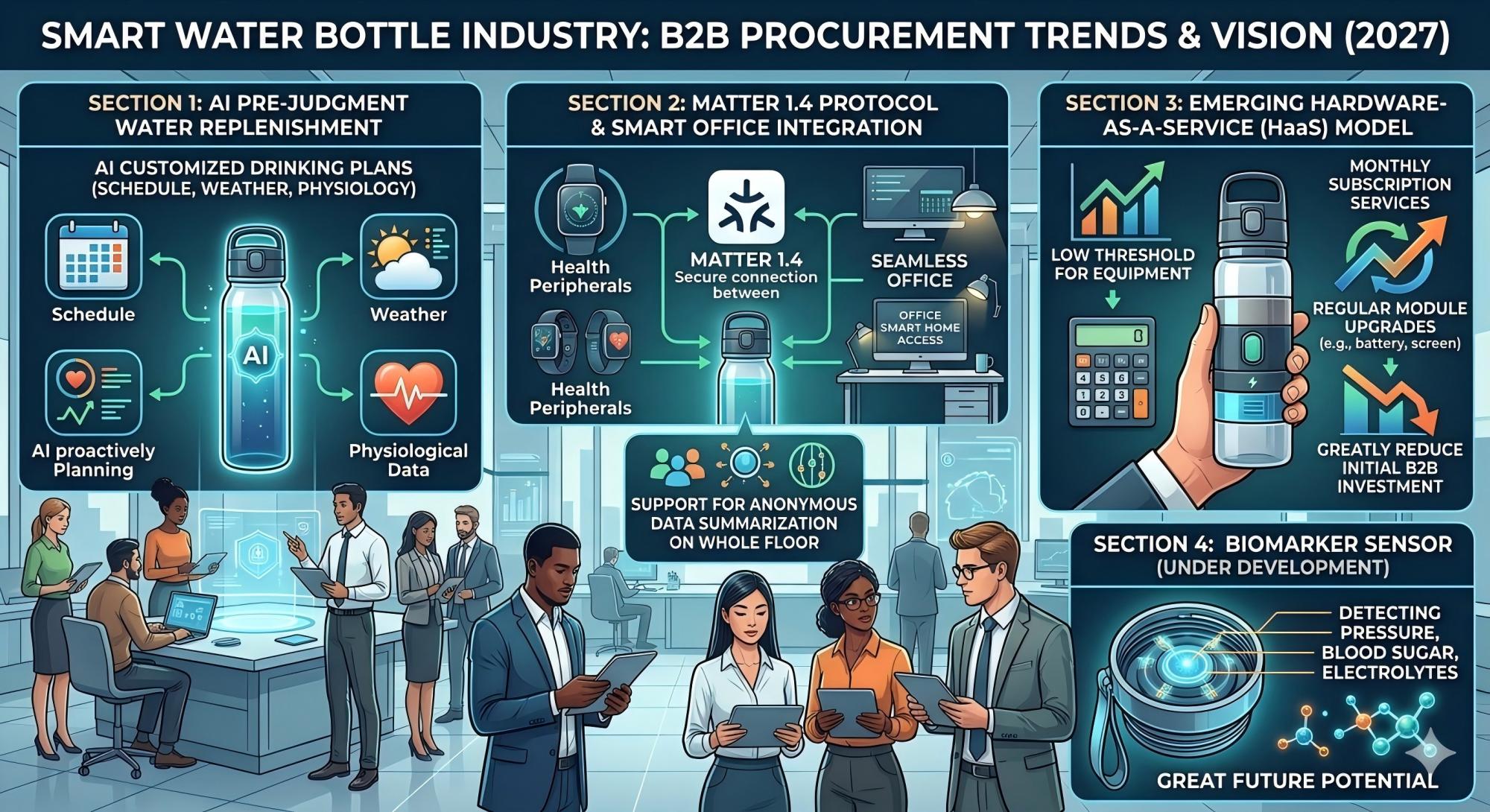
The smart water bottle industry has rapid iteration, and the layout of enterprise procurement for many years needs to look forward to the trend to avoid the technology falling behind quickly.
In 2027, the AI pre-judgment water replenishment will be ushered in, and the drinking water plan will be customized in advance in combination with schedule, weather, and physiological data. Matter 1.4 protocol fully adapts to healthy peripherals, can seamlessly access office smart homes, and supports anonymous data summarization on the whole floor.
The biomarker sensor is still under development, which can detect pressure, blood sugar, and electrolytes, and it has great potential in the future. At the same time, the circular business model of hardware as a service has emerged, with a low threshold for equipment and monthly subscription services, and modules can be upgraded regularly, greatly reducing the initial investment of enterprise procurement.
The smart water bottle category is evolving rapidly. B2B buyers planning multi-year programs should understand what is arriving on the horizon so their current procurement doesn’t lock them into technology that will soon feel dated.
Conclusion: Your Next Move as a B2B Buyer
In the smart water bottle industry in 2026, the products have matured, and they have mature applications in B2B scenarios such as corporate gifts, employee health and welfare, and health technology retail. The technology tends to be stable, the sensing accuracy reaches the professional and practical level, and the customization system can fully meet the brand customization needs of large enterprises. How to lay out the next steps depends on your own position in the industry.
At last, if you want to learn more information about water bottles / tumbler cups / shaker bottles / water jugs and new technologies or customize your own smart water bottles to build a new business, you are at the right place. KingStar is the leading drinkware manufacturer offering one-stop manufacturing service. Welcome to contact us. Send an email to sales@waterbottle.tech or leave online message, and we will reply within 24 hours..
References
Matter Protocol Adoption in Personal Health Devices — Connectivity Standards Alliance (CSA-IOT), https://csa-iot.org/newsroom/transforming-lives-extending-health-span-through-connected-devices/
WHO Guidelines on Daily Water Intake — World Health Organization.
https://www.who.int/tools/compendium-on-health-and-environment/wash
CES 2026: The Rise of AI-Powered Health Wearables — Tech Media Review, with references to CES 2026 showcases and AHA Market Scan.
IEC 62368-1:2023 — Safety Requirements for Audio/Video, Information and Communication Technology Equipment — International Electrotechnical Commission.
https://webstore.iec.ch/en/publication/27412

Specializing in custom manufacturing, quality control and marketing of vacuum-insulated drinkware and coolers.