
Last Updated: 5 November, 2026
For people who appreciate American national parks, a meaningful gift should not only reflect the brand logo, but also fit their love for nature and advocate reducing unnecessary and wasteful living habits. Therefore, environmental protection gifts, especially reusable drinking utensils, are very suitable for outdoor enthusiasts, environmental protection supporters and corporate customers.
Vacuum-insulated stainless steel bottles have daily practicality, durability and customized space, and are suitable for hiking, camping, commuting and various travel scenes; Printed with the theme of the national park, it can also make this gift more personal. As a reliable Insulated Stainless Steel Water Bottle Manufacturer, we are dedicated to bringing these eco-conscious gift concepts to life.
Why Are Eco-Conscious Gifts Important for National Park Supporters?
Environmental protection gifts can put the concept of environmental protection into practice and guide the recipients to develop practical good habits. For lovers of national parks, reusable products will integrate their love for natural scenery into the choice of daily consumption and garbage disposal.
How Does Single-Use Plastic Waste Affect National Parks?
Plastic bottles and other disposable packaging will cause garbage pollution, increase the cost of waste treatment and increase the burden of park facilities. In Grand Canyon National Park, disposable plastic bottles account for about 20% of the total garbage in the park. The National Park Service (NPS) encourages visitors to bring their own reusable water bottles and drink them at water replenishment stations.
The National Park Service’s Green Park Plan also advocates sustainable operation, covering waste reduction, efficient use of resources and sustainable procurement. These goals show that environmental responsibility requires both institutional action and individual consciousness.
Can Reusable Gifts Encourage More Responsible Outdoor Habits?
Reusable water bottles make it unnecessary for the recipient to buy disposable bottled water repeatedly. In the place where there is a safe water replenishment station, it is more convenient to reduce the use of disposable packaging by bringing a sustainable water bottle with you.
However, reusable products themselves are not zero environmental impact. Its environmental performance depends on production, transportation, cleaning, service life and disposal methods after scrapping. The United Nations Environment Programme (UNEP) suggested that the whole life cycle approach should be adopted to evaluate disposable products and their alternatives.
| Consideration | Single-Use Plastic Bottle | Reusable Stainless Steel Bottle |
|---|---|---|
| Intended use | Usually discarded after use | Designed for repeated use |
| Refill potential | Limited | Can be refilled repeatedly |
| Cleaning | Generally unnecessary | Requires regular cleaning |
| Product lifespan | Short | Depends on care and durability |
| Environmental consideration | Repeated packaging and disposal | Manufacturing impact must be balanced against repeated use |
What Makes a National Park-Themed Gift More Meaningful?
National park theme gifts will be more impressive if they are designed to meet the recipient’s preferences. Popular design directions include:
- Landscape illustration: mountains, forests, rivers and canyons.
- Wildlife patterns: corresponding to the animals and plants in a specific area.
- Topographic map patterns: imitating map lines and trail elements.
- Environmental slogan: a short sentence advocating civilized outdoor behavior.
Enterprises need to distinguish between original national park style patterns and the official logo of the National Park Service. Official logos, badges and protected trademarks must be licensed or authorized before use. Without approval, product design must not imply government endorsement.
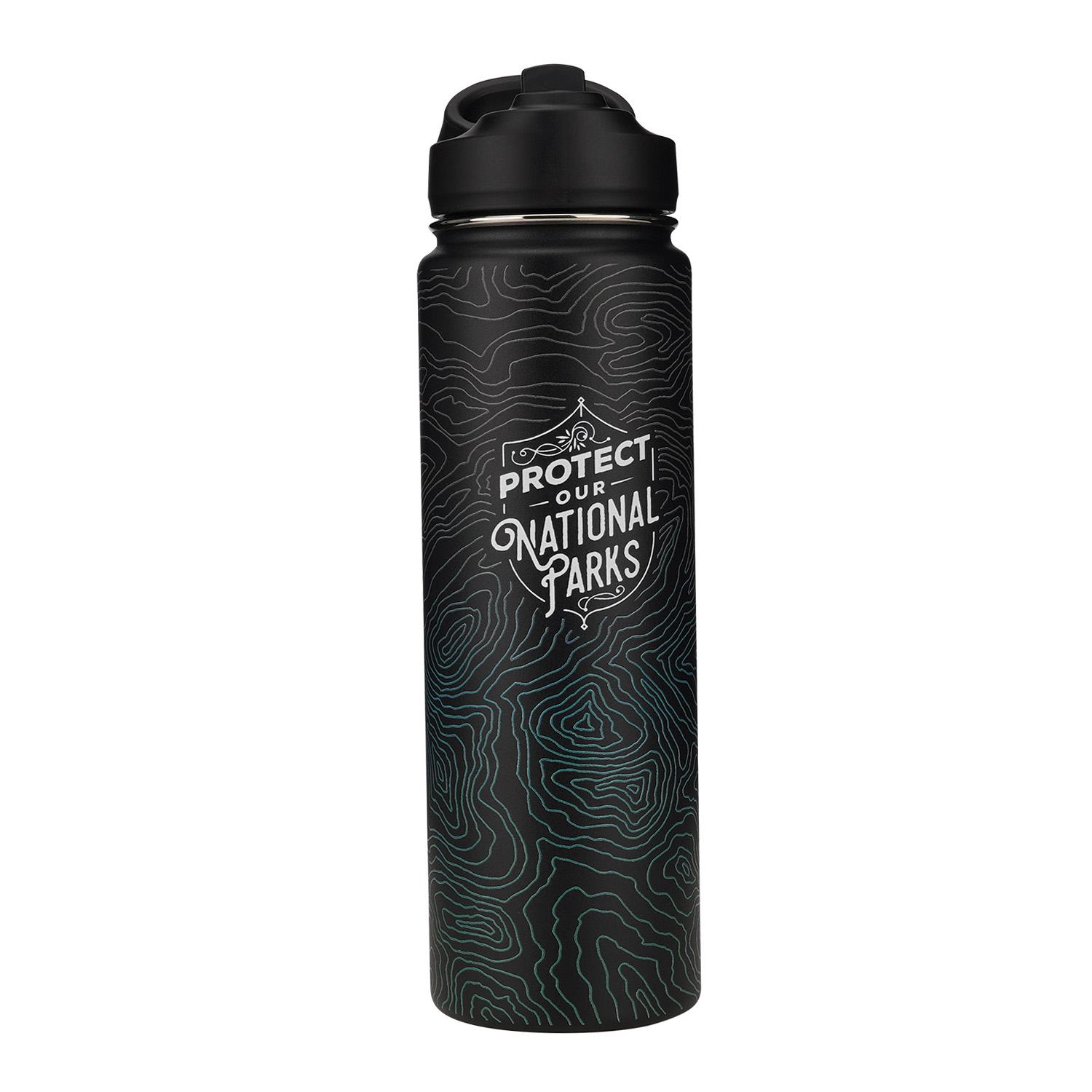
Unit price: $3.96. Please write to sales@waterbottle.tech if you want to order.
What Makes Vacuum-Insulated Stainless Steel Bottles Suitable for Outdoor Gifts?
Vacuum insulated stainless steel water bottle is a practical outdoor gift, which has thermal insulation ability, reusable property and customized space. Its performance depends on the structure, material, design and production technology of the bottle cover. For businesses looking for a diverse product line, explore our wide range of Water Bottles, Tumblers & Mugs, and Water Jugs.
How Does Double-Wall Vacuum Insulation Maintain Beverage Temperature?
Vacuum mug is generally composed of two layers of stainless steel walls, and the interlayer is vacuum. Pumping away most of the air can reduce the heat transfer caused by conduction and convection, thus prolonging the cold or heat preservation time of drinks.
The actual thermal insulation effect is influenced by many factors:
1. Vacuum integrity: once the vacuum layer is damaged, the thermal insulation performance will decrease.
2. Bottle cover structure: heat will be lost through the bottle cover and drinking water port.
3. Bottle shape: the bottle mouth and the overall structure will affect the thermal insulation performance.
4. Use environment: The ambient temperature and the opening frequency will change the final effect.
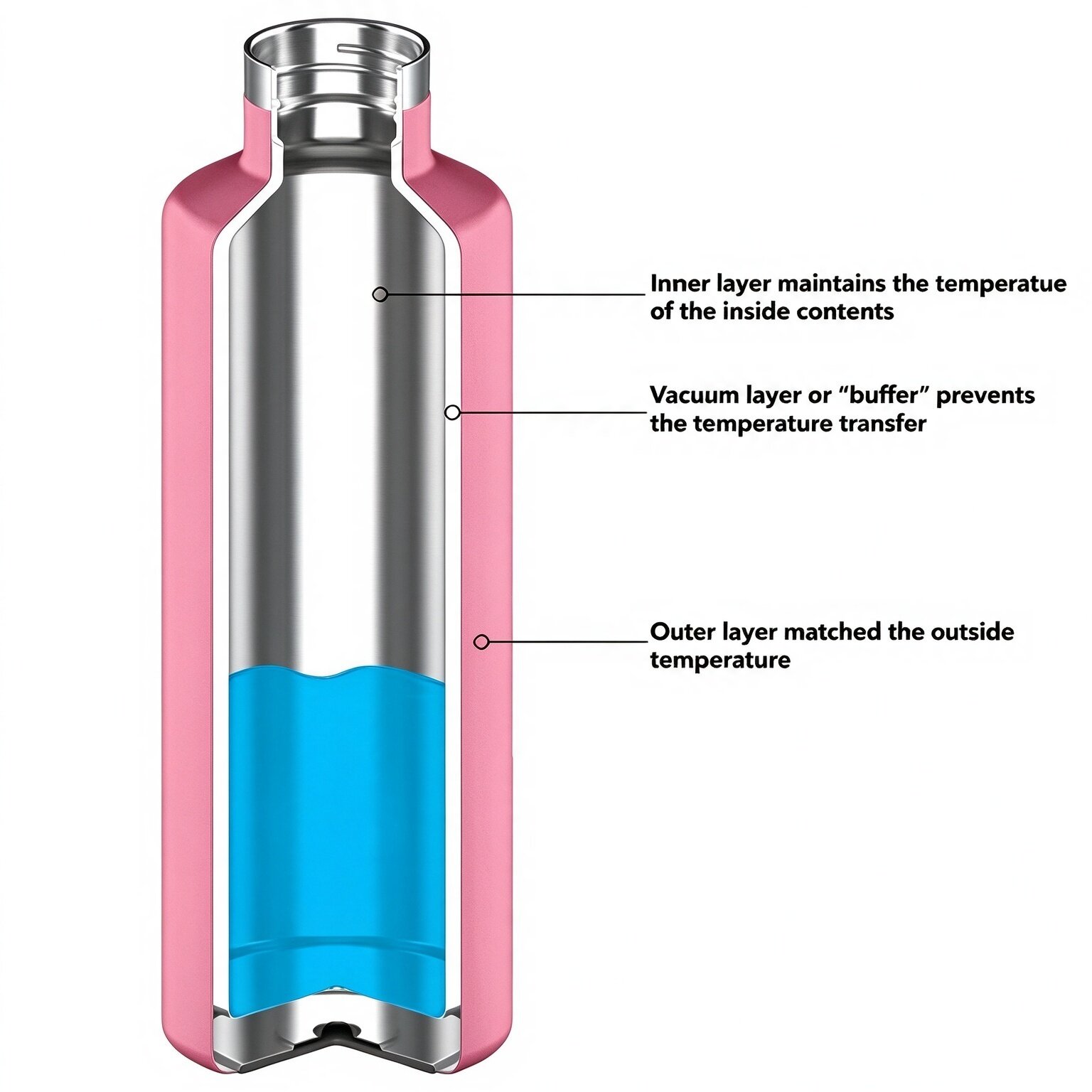
The purchaser should ask for the insulation test report, instead of just watching the propaganda words such as “keeping cold for 24 hours”. A qualified report needs to indicate the test method, initial temperature, environmental conditions and judgment criteria.
Why Is 18/8 SUS304 Stainless Steel Commonly Used in Reusable Bottles?
18/8 stainless steel, commonly known as SUS304, contains about 18% chromium and 8% nickel. It is corrosion-resistant, durable, and can be cleaned repeatedly after processing, so it is widely used in food contact products.
| Bottle Component | Common Material | Main Function |
|---|---|---|
| Bottle body | SUS304 stainless steel | Provides the main structure and beverage-contact surface |
| Lid | PP or other suitable polymer | Provides closure and drinking access |
| Sealing ring | Silicone | Helps prevent leakage |
| Straw | Food-contact polymer or silicone | Supports convenient drinking |
| Exterior finish | Product-specific coating | Adds color, texture, and branding options |
Which Bottle Design Features Matter Most for Hiking and Camping?
The suitable water bottle should be selected according to the user’s activity type and carrying habit. The following functions are worthy of attention:
- Capacity: determines the amount of water that can be carried between two replenishment.
- Self-respect: long-distance hiking will affect the comfort of carrying.
- Bottle cover and sealing structure: to prevent water leakage during transportation.
- The size of the bottle mouth: it is related to the convenience of filling water, drinking and cleaning.
- Grip and external surface treatment: improve grip experience
- Handle ring: easy to carry or carry outside.
A bottle with a larger capacity is not necessarily better. Large capacity is suitable for long-term travel, but the self-weight will increase after being filled with water. Before the purchaser selects the specifications, it is necessary to consider the duration of the activity, the distribution of water replenishment points and user preferences.
For more ideas on choosing reusable drinkware for outdoor activities, explore our guide to Protect Our National Parks: Eco-Friendly Stainless Steel Water Bottles for Outdoor Adventures. It discusses how stainless steel bottles support more sustainable outdoor habits and what features hikers should consider when selecting a bottle for national park visits.
How Should Reusable Stainless Steel Bottles Be Maintained for Long-Term Use?
Regular cleaning helps to maintain the hygiene of reusable drinking utensils and prolong their service life. Users can clean the bottle body with warm water and suitable detergent. The detachable bottle cover and sealing ring should be cleaned separately, and all parts should be completely dried before storage.
Bottle brush can clean the dead angle in the bottle, but don’t use hard grinding tools to avoid scratching the surface. At the same time, please follow the manufacturer’s instructions to confirm whether you can enter the dishwasher and which detergents are suitable. Once the sealing ring is cracked or deformed, it can be replaced in time to ensure the leak-proof effect.
How Can Custom National Park Water Bottles Create More Meaningful Gifts?
Custom national park water bottles combine practical drinkware with visual storytelling. The best designs reflect a clear theme while remaining attractive and convenient for everyday use.
What Design Elements Make National Park-Themed Bottles Stand Out?
Good design needs to take into account both face value and practicality. Landscape illustration is suitable for tourism peripheral products, and topographic map patterns are more likely to attract hikers; The environmental protection slogan water bottle is very suitable for public welfare projects and environmental protection activities.
Before putting into production, enterprises need to define the target population, pattern scheme, LOGO location, color matching and sales channels. This can avoid the problem that the product renderings look beautiful, but the physical finished product is not easy to use.
Which Custom Printing Methods Work Best for Stainless Steel Bottles?
Different decoration methods create different effects. The right choice depends on the artwork, surface material, budget, and expected production quantity. Here, readers can learn about your custom decorating services, such as laser engraving and screen printing.
| Customization Method | Typical Appearance | Suitable Application |
|---|---|---|
| Laser engraving | Etched or marked design | Logos, text, and line art |
| Screen printing | Solid-color graphics | Simple logos and limited-color designs |
| Heat transfer printing | Detailed, colorful artwork | Complex illustrations |
| Powder coating | Colored exterior finish | Custom product appearance |
Laser engraving is useful for permanent markings on suitable metal surfaces. Screen printing can work well for simpler graphics, while more complex artwork may require alternative decoration methods.
What Can Businesses Learn from a Protect Our National Parks 24 oz Bottle?
A Protect Our National Parks bottle illustrates how practical drinkware can carry a conservation-inspired message. A 24 oz format offers a balance between everyday portability and sufficient capacity for many outdoor activities.
The product scheme parameters in the project introduction: the capacity is 24 ounces (about 720 ml), the bottle body is made of 18/8 SUS304 stainless steel, and the bottle cover fittings are made of PP material and silica gel; The estimated size is 77 × 77 × 279 mm, and the diameter of the bottle mouth is 57.2 mm; The heat preservation performance is marked as the maximum cold preservation of the drink for 24 hours and heat preservation for 12 hours.
The above parameters need to be verified against the latest technical documents before release. The scheme embodies three core design principles: practical capacity, clear theme identification and flexible customization support.
No BPA, no phthalate, no lead and other propaganda expressions must be supported by relevant testing documents. The purchaser needs to ask for material declaration and insulation test report before using the scheme parameters as verified product selling points.
How Can Businesses Use Sustainable Corporate Gifts to Strengthen Their Brands?
Reusable drinkware can help businesses create more useful promotional gifts and connect their branding with outdoor activities or environmental campaigns. Its value depends on whether recipients genuinely want to keep and use the product.
Which Organizations Can Benefit from Custom National Park-Themed Gifts?
Different institutions can use national park theme bottles for various scenes:
- Outdoor brands: customers’ gifts and new products around the market.
- Environmental public welfare organizations: raising money for goods and thanking donors for their gifts.
- Tour operators: tourists’ goods, destination souvenirs.
- Enterprise team: employee welfare and sustainable development theme activities.
- Gift dealers: provide customized surroundings for corporate customers.
When it is used for fund-raising projects, the institution shall clearly explain how the sales revenue is used for public welfare projects. If the donation is proportional or fixed, the donation rules need to be open and transparent.
How Does Reusable Drinkware Provide Long-Term Brand Exposure?
Reusable drinking utensils have a longer service life than many disposable promotional gifts. According to ASI’s “2026 Advertising Impression Research Report”, 87% of consumers will keep water bottles with brand logos for practical purposes; More than three-quarters of the respondents said that they use this kind of promotional water bottle at least once a week and will keep it for more than one year. The study estimates that this kind of product can bring about 1300 brand exposures in the whole life cycle.
The above data are survey estimates, and there is no guarantee that every promotional bottle can achieve the same effect. The actual exposure depends on the product quality, design and frequency of users.
In order to improve the probability of long-term retention of water bottles, enterprises should give priority to appropriate capacity, comfortable grip, reliable sealing structure and beautiful decorative effect.
How Can Businesses Make Environmental Claims Responsibly?
The expression of environmental marketing needs to be concrete and supported by supporting materials. The U.S. Federal Trade Commission’s Green Guide reminds businesses not to use broad and unrestricted propaganda words, such as “environmental protection” or “green”, which is difficult to prove.
Enterprises should adopt clear description, not absolute commitment. For example, “reusable stainless steel water bottles support multiple uses” is more rigorous than “100% environmentally friendly water bottles”; By the same token, “advocating the habit of water renewal” can withstand verification better than “zero environmental impact”
Enterprises also need to consider packaging, transportation, product service life and supplier information transparency. Environmental protection propaganda should describe verifiable product characteristics, rather than promise grand environmental protection results in general.

What Should Buyers Consider When Ordering Custom Eco-Conscious Water Bottles in Bulk?
Bulk buyers should evaluate more than unit price. Material verification, product performance, sampling, customization, and production planning all influence the final quality and delivery schedule. When planning large-scale rollouts, it is highly recommended to review your custom packaging options to ensure the unboxing experience aligns with your environmental goals.
Which Material and Quality Standards Should Buyers Verify?
Buyers should request documentation for the bottle body and every component that may contact beverages.
| Verification Area | What to Request | Why It Matters |
|---|---|---|
| Stainless steel grade | Material declaration or certificate | Confirms the specified steel grade |
| Food-contact components | Relevant declarations and test reports | Supports material suitability |
| Lid and gasket | Material specifications and fit checks | Helps ensure reliable closure |
| Leakage | Leak-resistance test results | Reduces spill risks |
| Insulation | Temperature-retention test report | Supports performance claims |
| Exterior finish | Adhesion and wear evaluation | Checks finish durability |
| Finished product | Final inspection records | Helps identify defects before shipment |
For the U.S. market, food-contact compliance should be assessed according to the materials and intended conditions of use. “FDA approved” should not be used as a blanket claim for an entire bottle unless the specific regulatory basis supports it.
How Do MOQ, Sampling, and Lead Times Affect Bulk Orders?
MOQ and production cycle depend on product design, customization requirements and supplier capacity. The project of printing a simple LOGO only on the existing bottle type, the development workload is far less than the order that needs new accessories, custom packaging or special process printing.
The general project flow is as follows:
- Product selection: confirm the capacity, material, bottle cover style and target price.
- Pattern review: Finalize the design documents and verify the authorization of pattern related use.
- Proofing evaluation: confirm the physical object, surface technology and printing effect.
- Customer confirmation: finalize all specifications and parameters before mass production.
- Production and inspection: check the appearance, assembly and product performance.
- Delivery: Allow time for transportation and customs clearance.
The purchaser needs to ask for a written schedule, covering all nodes of proofing, production, inspection and delivery. It is suggested to reserve buffer time to deal with sample modification or transportation delay.
Conclusion
The value of environmental protection gift lies in its deep implication and daily practicality. For people who love national parks, reusable thermos bottles can closely combine their love of natural scenery with their habit of water retention and outdoor activities.
For enterprises, the core is to choose products with verifiable materials, stable performance, beautiful customization effect and pragmatic and compliant environmental protection propaganda caliber. Careful selection of suppliers and confirmation of samples will also help to reduce the quality risk of bulk goods.
KingStar Mold offers custom manufacturing, prototyping, and surface-finishing services for businesses developing custom products. Whether you need support with OEM Manufacturing or complete Corporate Gifting solutions, we are here to help.
Frequently Asked Questions
References
National Park Service. Go Green and Refill Your Water Bottles – Grand Canyon National Park
United Nations Environment Programme. Addressing Single-Use Plastic Products Pollution Using a Life Cycle Approach
Federal Trade Commission. Environmental Claims: Summary of the Green Guides
Advertising Specialty Institute. ASI’s 2026 Ad Impressions Study: Drinkware

Specializing in custom manufacturing, quality control and marketing of vacuum-insulated drinkware and coolers.