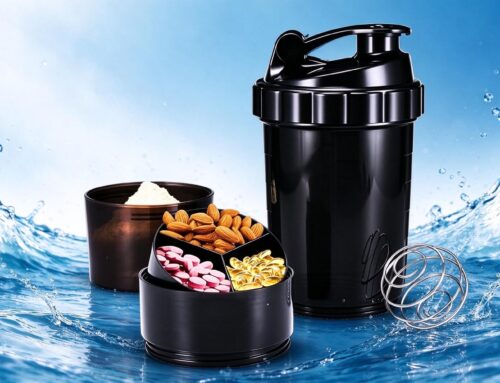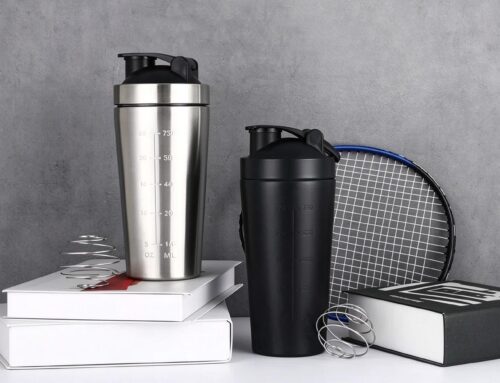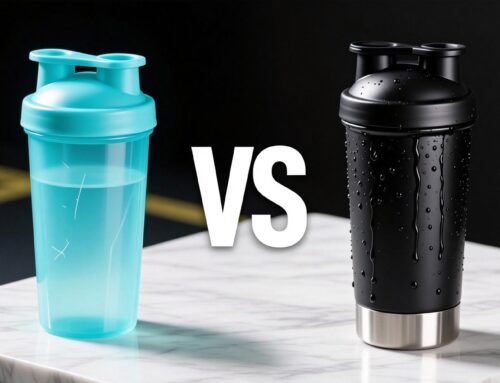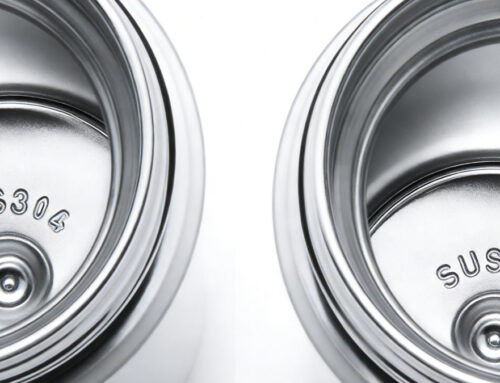
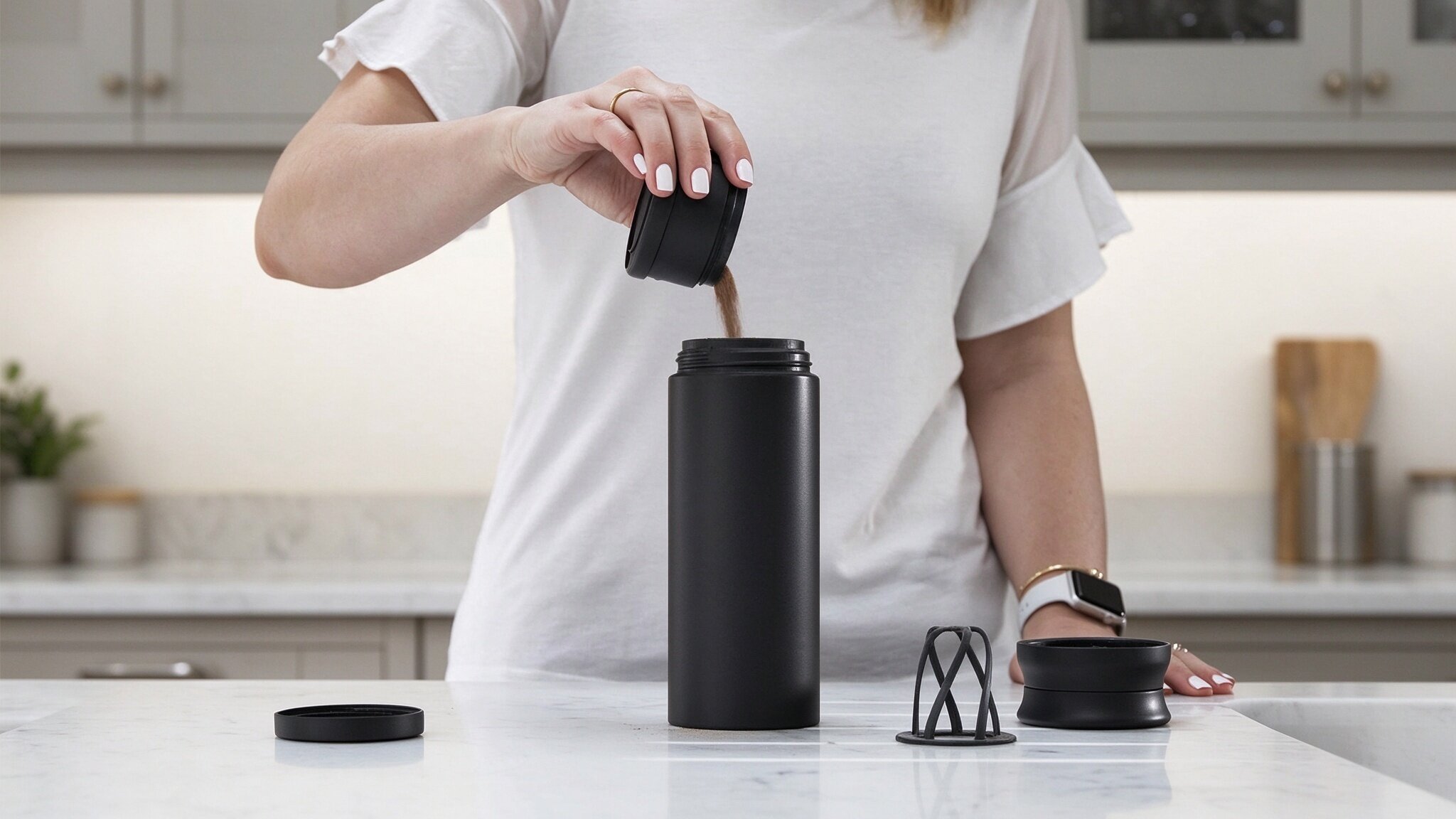
The protein shaker is one of the most homogenized products in fitness accessories: a plastic bottle body, a screw cap, and a metal stirring ball that will clank every time it is shaken. Forme Shaker, a British brand, abandoned this conventional scheme. In 2021, it launched its product on the crowdfunding platform Kickstarter. This rocking cup is made of stainless steel bottle, with a built-in powder bin with a capacity of 35 grams and a silent stirring structure. The crowdfunding goal was achieved within one hour after the project was launched, and 46,740 pounds was raised from 1,016 supporters. So far, the global sales volume has exceeded 1 million.
For brands looking to turn product concepts into commercially viable drinkware, working with an experienced Insulated Stainless Steel Water Bottle Manufacturer can help bridge the gap between product design, manufacturing feasibility, and scalable production.
This paper will disassemble the success of this product, the design points of active choice, and which American brands can learn from and which should not be copied when docking with the OEM of customized protein shake bottles.
What Can US Brands Learn From Forme’s Kickstarter Validation?
The 39-Minute Funding Milestone and What It Actually Proves
Forme’s Kickstarter crowdfunding project reached its fundraising goal within one hour after it was launched, and finally raised 46,740 pounds from 1,016 supporters. On the surface, this seems to confirm the huge demand in the market, but it is not the case. What it really proves is that there is a well-positioned segment of the population-consumers who are willing to pay a premium for a rocking cup that is completely different from traditional fitness accessories, and have a strong will to place an order in advance without seeing the real thing with their own eyes.
The user groups of Kickstarter platform are mostly early adopters who pay attention to design. Reaching the fundraising target quickly can only verify the existence of this niche market that is willing to try new products, but it cannot predict the subsequent performance of products in Amazon or offline channels: in Amazon, buyers will compare mature competing products with thousands of evaluations and lower prices; In offline retail, shelf resources should be allocated by the speed of commodity sales.
Crowdfunding as Minimum Viable Validation, Not a Sales Forecast
For brand builders, the more valuable idea is to take Kickstarter crowdfunding as a minimum feasibility test (MVV). Forme’s 1016 supporters bring three things: the funds for mold opening, the signal that the product concept has won market resonance, and a group of early users who can provide feedback and support product iteration.
But these supporters can’t prove that this product can impress consumers outside the niche group that prefers design on the crowdfunding platform. Brands planning to take the same route should set crowdfunding KPI around the portrait of supporters and the quality of feedback, rather than just staring at the total fundraising amount. If 80% of the supporters belong to the same narrow crowd, then this verification is effective, but it has strong limitations.
How to Set Kickstarter KPIs That Predict Retail Viability
The fundraising goal measures whether the project can cover the cost of mold opening, not whether the product can continue to go offline. In addition to the total amount of funds raised, brands planning to launch crowdfunding should also set up three second-level KPIs: the proportion of supporters who meet the portraits of the target retail customers, the number of comments that take the initiative to leave messages describing specific usage scenarios, and the pre-purchase conversion rate of public domain traffic compared with private domain traffic.
If the project raises 50,000 pounds, but 90% of the supporters are from the founder’s network or single design community, then this market signal is far less optimistic than the book figures. The 1016 supporters of Forme have reference value precisely because the project has generated sufficient natural flow and completed fundraising within one hour-this is a traffic distribution signal, not just a revenue signal.
Why Did Forme’s Product Design Beat Plastic Shaker Bottles?
The Engineering Trade-off Behind a 35g Integrated Powder Chamber
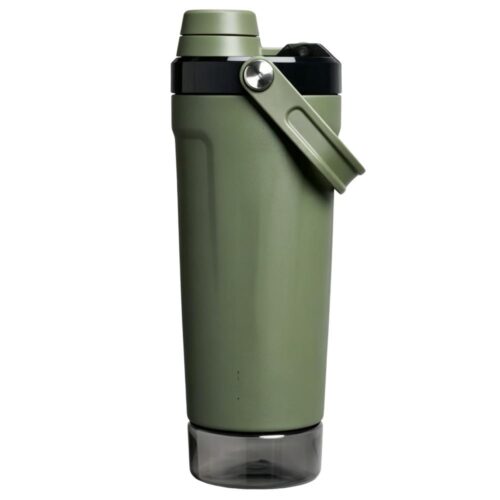
Forme’s iconic design-integrating a 35-gram powder storage bin at the bottom of a 500-ml stainless steel cup, belongs to the scheme that looks simple on the product page and the actual production difficulty is far beyond imagination. The inside of the cup body should accommodate the double-layer vacuum insulation structure, the silent stirring component and the threaded powder storage bin at the same time, all of which are limited to the space with a diameter of 7.5 cm and a height of 25 cm.
From the mold point of view, the cup cover assembly and the powder storage structure need multi-cavity combined injection mold, and the tolerance requirement is extremely high, so as to prevent the powder from escaping into the liquid warehouse. Silica gel sealing rings that separate different compartments should maintain sealing performance after thousands of times of opening and closing. This is the category of work that demands custom injection molding for consumer products with validated material specifications—kitchen-grade stainless steel for the body, BPA-free polypropylene for the structural components, and food-grade silicone for the seals.
Features such as integrated storage compartments can introduce additional design and tooling considerations. Early collaboration on custom molding helps brands evaluate part geometry, assembly requirements, and manufacturing feasibility before committing to full-scale production.
Silent Mixing vs. Metal Whisk Ball: A Perceivable Difference
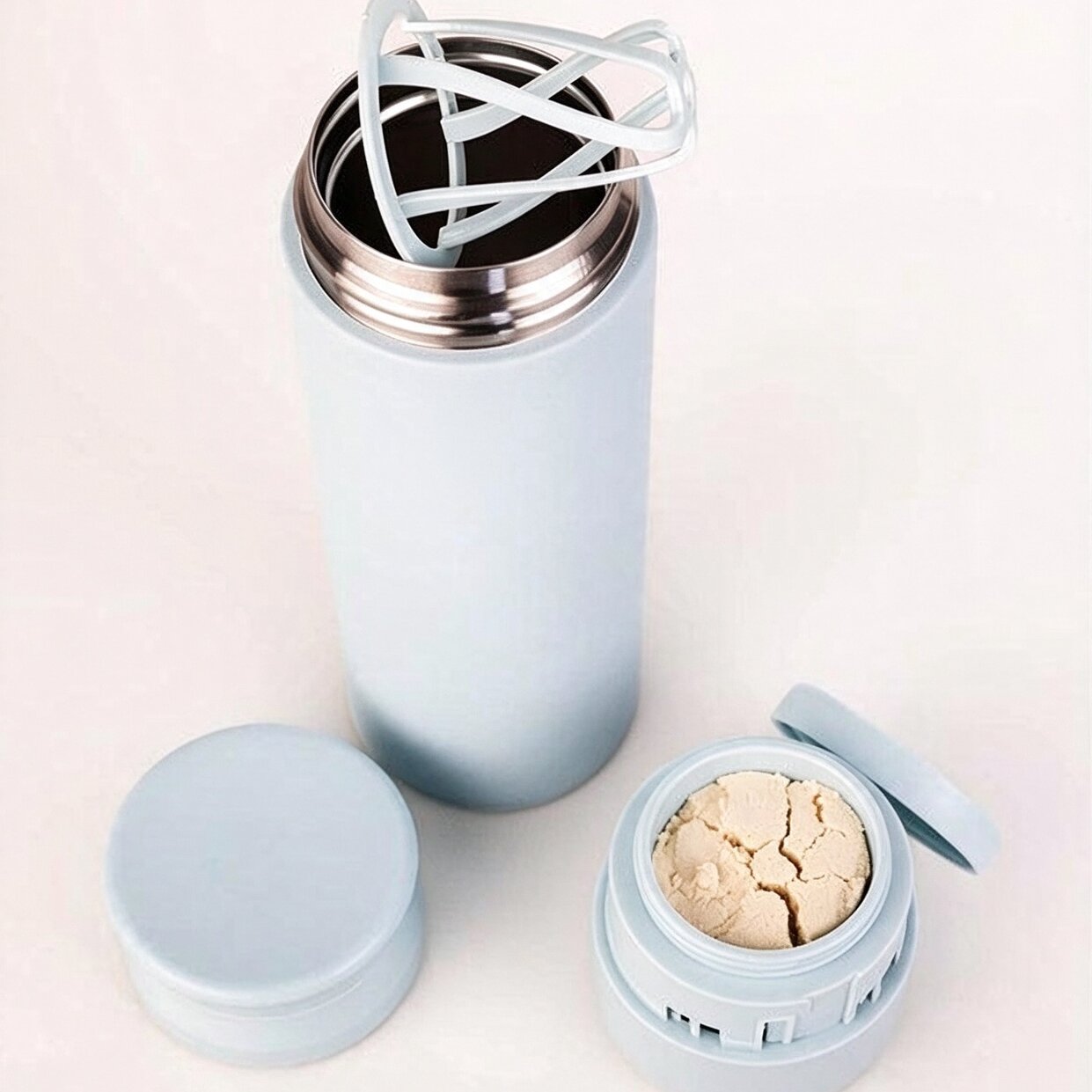
Silent mixing structure is the highlight that Forme has gained the most praise in user evaluation. Some users on Trustpilot commented that it was “much more useful than the ordinary metal mixing ball with a bang when shaking”, and some users mentioned that this rocking cup was “no caking and no noise”.
The gym is a scene that cares about other people’s eyes: shake the cup and others will know that you are drinking protein powder; Silent models will not attract attention. Its engineering difficulty lies in: the fixed mixing structure should create enough turbulence to dissolve the powder without the stirring effect brought by the movable mixing ball. Forme’s scheme relies on a specially designed internal shape to guide the liquid through the powder when shaking.
For brands that intend to develop similar functions, the enlightenment is that the differentiation that users can perceive must correspond to clear and visible use value, not just a statement on the parameter table. Click and read more: Leak-Proof Protein Shaker Design: Engineering Secrets Every Brand Should Know
Where Forme Deliberately Compromised—and Why That’s a Lesson
Forme’s score of 4.2 on Trustpilot does not mean that it has gained one-sided praise. A detailed Samsung evaluation revealed the core point: “The size of the powder storage bin is too small to always hold a spoonful of protein powder; Spoons have different specifications, and it is easy to spill when used, and the experience is very poor. ” The evaluation also mentioned that the inner diameter of the cup body is narrow and it is not easy to clean.
These are not product defects, but the inevitable result of the brand giving priority to portability and appearance at the expense of loading space and cleaning convenience. The enlightenment to the brand is not not not to make trade-offs-any product has trade-offs, but the direction of trade-offs must match the core demands of the target users. Forme’s core customer base pays enough attention to the appearance and mute effect, and can accept only 35 grams of powder storage capacity; Brands for users of high-dose protein powder need to make different trade-offs
| Design Dimension | Typical Plastic Shaker | Forme Shaker (OG) | Manufacturing Implication |
|---|---|---|---|
| Mixing mechanism | Metal whisk ball (audible) | Fixed silent mixer | Requires custom mold for internal geometry |
| Powder storage | None (separate container) | 35g integrated base chamber | Multi-part mold with sealing tolerances |
| Body material | PP or Tritan | Double-walled stainless steel | Vacuum insulation + PP/Silicone components |
| Temperature retention | None | Cold 12h / Hot 8h | Increases weight (475g) and unit cost |
| Cleaning access | Wide mouth | Narrow diameter (7.5cm) | User friction point; design trade-off |
| Retail price positioning | $10–$20 | $40+ | Premium positioning requires perceived value |
How Do You Choose a Custom Protein Shaker Manufacturer?
When evaluating a manufacturing partner, brands should look beyond unit pricing and consider design support, prototyping, material selection, and production scalability. We provides custom consumer goods manufacturing solutions that support product development from design review through production.
Tooling Lead Time, MOQ, and the Pilot-Run Question
The place where many hardware brands stumble is the gap between crowdfunding success and actual product delivery. Aetha Design, the design partner of Forme, has publicly mentioned that this product has undergone “continuous testing and optimization” before going on the market.
For brands planning to develop similar products, the production cycle is not a detail that can be postponed. It usually takes 5-6 weeks to process a complete set of molds for shaking cups composed of multiple parts, and then it will go through the trial mold (T1, T2); After the sample is confirmed, the mass production cycle is about 45 days. If the crowdfunding project promises to deliver the goods within 6 months, it must start the mold opening before the crowdfunding ends.
A pilot run can help identify design or production issues before a larger order is placed. Depending on the product’s requirements, injection molding and rapid prototyping services can support early validation and help teams make more informed decisions about production readiness.
This is the reason why mature brands will lock in production capacity in advance-often before the funds are in place, the related docking between precision molds and production equipment has been started. On the contrary, there will be a delay in delivery, which will destroy the user trust that the crowdfunding project has finally established.
What to Verify Before Signing an NDA With a Shaker Supplier
Shake cup is a product that is in direct contact with food, and has many sealing joints, so there are far more due diligence items to be done than most first-time buyers expected. Before finalizing the supplier, be sure to ask for DFM report, which will point out the potential failure risk points in the current structural design.
Confirm that the silica gel parts for sealing meet the food-grade standards, and there will be no permanent compression deformation after repeated cleaning. The supplier is required to provide the T1 and T2 sample flow in writing, indicating how many rounds of free adjustment are included, and how to charge after exceeding. Finally, verify whether the supplier has the processing experience of stainless steel vacuum insulation components-not just the injection molding ability. The joint position between the stainless steel body of the cup body and the plastic cup cover assembly is the high incidence of leakage problems.
Private Label vs. Full Custom Mold: Which Fits Your Stage?
Not all brands need to invest the same mold cost as Forme. The choice of white brand spot or custom mold should be decided by the stage of brand and differentiation strategy.
For the brand that launches the rocking cup for the first time and only wants to test the market demand, it can choose the white brand stainless steel cup body with ready-made cup cover components to complete the market verification with lower risk. If the brand has locked in unique design differences, such as integrated powder storage bin and self-developed mixing structure, it needs to customize the mold, and rely on the estimated sales volume to dilute the mold investment.
There is also a compromise route: change the spot mold, that is, the white cup body is matched with a custom cup cover or powder storage part. This method can achieve a certain degree of differentiation, and at the same time suspend the full investment in molds, and then invest in a full set of customized development after the sales volume is verified.
| Sourcing Model | Typical Tooling Investment | Minimum Order Quantity | Best For |
|---|---|---|---|
| Stock/private label | None (catalog selection) | 500–1,000 units | Market testing, first SKU |
| Modified stock mold | $3,000–$8,000 | 2,000–5,000 units | Light differentiation, moderate risk |
| Full custom mold | $12,000–$25,000+ | 5,000–10,000 units | Proprietary design, validated demand |

Click and read more about Custom Options: Custom Bottle Tumbler Decorating, Custom Logos of Water Bottles, Custom Water bottle Packaging
Is Crowdfunding Still Viable for US Consumer Product Brands?
The Early-Adopter Bias Problem in Kickstarter Data
Kickstarter’s user base does not represent the American consumer market. This is a self-selected group: compared with ordinary Amazon buyers, they value design more, accept delivery delays more, and are more willing to pay a premium for novel products. Forme’s 1016 supporters are enough to support the cost of molds and start the starting momentum, but for a $40 shake cup, they are only a small part of the target market. If the brand regards the crowdfunding conversion rate as the pre-judgment basis for offline retail and platform natural marketing, the follow-up will inevitably undergo a difficult expected adjustment.
The correct way to interpret it is to look at the direction: if a product can’t attract even 500-1000 supporters who are willing to pre-order, then its differentiation is probably not enough to survive in the market outside the crowdfunding platform.
When Crowdfunding Works—and When It Doesn’t
Crowdfunding is more suitable for products that have differentiated highlights at the visual or experience level and can be clearly explained through videos and product pages. Forme’s silent mixing design and integrated powder storage bin can be visually displayed in short videos. If the core advantage of a product is only low price, or its benefits can only be felt by personal comparison, crowdfunding is often difficult to succeed. A shake cup that is just “a little cheaper than the head brand” has no story suitable for crowdfunding; But there is a story to tell about a rocking cup that can eliminate shaking noise and is not easy to produce odor. This logic also applies to entering the American market: the final winning brand is not necessarily the best crowdfunding page, but the products that users can detect the difference within five seconds.
What the Kickstarter-to-Retail Transition Costs in Practice
The most underreported cost of a crowdfunding-to-retail transition is not tooling. It is the second round of validation. A brand that funded on Kickstarter must rebuild its evidence base for a retail buyer: sell-through velocity data from a limited DTC run, return rates, and a packaging format that survives shipping without damage. Retail buyers do not accept crowdfunding backer counts as proof of demand; they want category-level data and a plan for promotional pricing. The brands that transition successfully are the ones that treat the crowdfunding campaign as the beginning of a two-year retail readiness process, not the end of a launch.
| Validation Dimension | Kickstarter Campaign | Amazon / Retail Launch | What the Difference Means for Brands |
|---|---|---|---|
| Audience profile | Design-sensitive early adopters | Price-comparison shoppers with review-driven decisions | Crowdfunding signals niche demand, not mass appeal |
| Primary success metric | Total pledged / backer count | Conversion rate, review velocity, return rate | KPIs must be rebuilt, not transferred |
| Price sensitivity | Low (pre-order premium accepted) | High (direct comparison with established brands) | Premium positioning needs justification at shelf |
| Delivery expectation | Tolerant of delays | Immediate fulfillment expected | Operational readiness matters more at retail |
| Feedback value | Rich, qualitative (comments, surveys) | Aggregated, quantitative (ratings, returns) | Use crowdfunding for product iteration, retail for scale validation |
For brands planning to expand a successful product line, OEM manufacturing services can help translate product specifications into repeatable production while keeping customization and quality requirements aligned with the brand’s goals.
Vital Proteins, Puresport, and the 50,000-Unit Holy Order
Forme’s C-end retail business is only part of its revenue source. The brand has also set up a parallel B2B channel to create joint-name shake cups for dietary supplement enterprises. Forme official website mentioned that it has reached cooperation with Vital Proteins and Puresport, and received 50,000 orders for the joint project of Holy and Spongebob, including five different designs.
This kind of cooperation is not simple to put a sticker on the cup. The joint shake cup needs customized color matching, accurate laser engraving or printing technology, and the supporting packaging should also meet the unpacking experience standards of the partner brand. For tonic brands, the joint shake cup is not only a saleable item, but also a marketing material; For manufacturers, it is necessary to have the production capacity of small batch custom color matching, and it cannot disrupt the normal production schedule of the main production line.
What Does Forme’s Co-Branding Playbook Teach About B2B Growth?
For brands planning to expand a successful product line, OEM manufacturing services can help translate product specifications into repeatable production while keeping customization and quality requirements aligned with the brand’s goals.
Vital Proteins, Puresport, and the 50,000-Unit Holy Order
Forme’s C-end retail business is only part of its revenue source. The brand has also set up a parallel B2B channel to create joint-name shake cups for dietary supplement enterprises. Forme official website mentioned that it has reached cooperation with Vital Proteins and Puresport, and received 50,000 orders for the joint project of Holy and Spongebob, including five different designs.
This kind of cooperation is not simple to put a sticker on the cup. The joint shake cup needs customized color matching, accurate laser engraving or printing technology, and the supporting packaging should also meet the unpacking experience standards of the partner brand. For tonic brands, the joint shake cup is not only a saleable item, but also a marketing material; For manufacturers, it is necessary to have the production capacity of small batch custom color matching, and it cannot disrupt the normal production schedule of the main production line.
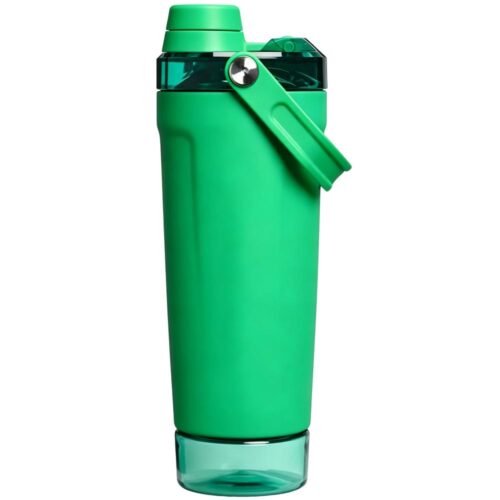


Unit price: $1.72-2.16
Why Supplement Brands Buy Custom Shakers Instead of Stock Models
A stock shaker with a logo slapped on it signals low effort. A custom shaker that matches the supplement brand’s color palette, carries its logo with precision, and arrives in packaging consistent with its DTC experience signals that the brand controls its customer touchpoints. For US supplement brands evaluating a custom shaker program, the relevant question is not “how much does a shaker cost” but “what does a shaker that represents our brand properly cost.” The answer depends on silicone rubber molding for bottle seals and custom color matching, both of which add per-unit cost but are non-negotiable for brands that compete on experience rather than price.
The Minimum Order Quantity Problem in Co-Branded Runs
Co-branding sounds straightforward until a supplement brand asks for 500 units in a custom Pantone color. Most factories cannot run a color change on a production line for a batch that small without absorbing significant scrap cost. The practical minimum for a custom colorway is usually several thousand units per color, which is why co-branded programs often launch with two or three core colors rather than the full palette the brand uses on its packaging. Brands planning a co-branded shaker should confirm the factory’s color-change MOQ before committing to a design with more than three SKUs.
| B2B Co-Branding Requirement | Why It Matters | Manufacturing Capability Needed |
|---|---|---|
| Custom Pantone color matching | Brand consistency across SKUs | Color-controlled PP and silicone molding |
| Logo engraving/printing precision | Premium perception | Laser or pad printing with tight registration |
| Small-batch colorways | Limited edition or partner-specific runs | Flexible production scheduling |
| Packaging compatibility | Unboxing experience | Coordination with packaging supplier |
Conclusion
The case of Forme extracts three reusable strategies. First, use crowdfunding as a verification tool, not as a basis for sales forecast. Relevant data can only reflect whether minority segments are interested, and cannot represent the acceptance of the mass market. Second, choose differentiated selling points that can be visually displayed in short videos and can be perceived when you get started. Silent stirring and integrated powder storage bin meet this standard; Simply flaunting “high-end materials” is not acceptable. Third, joint cooperation is regarded as a growth channel for B2B, and it will consolidate its own C-brand while expanding its business, instead of diluting the brand tonality.
One thing should not be copied is that Forme’s tolerance for the short board of inconvenient cleaning. If American brands are aimed at high-frequency users who often clean shake cups in office sinks, it may be worth sacrificing some of the aesthetic appearance by widening the cup mouth or making it into a detachable mixing structure.
We will encounter this kind of trade-off in every customized water bottle project. A brand that can pass through may not have the most amazing design, but it is clear which trade-offs are acceptable to users and which will directly push users to competing products.
From Crowdfunding to Mass Production: KingStar as Your OEM Partner
Forme Shaker proved that a well-designed stainless steel shaker with built-in powder storage and silent mixing can capture strong market demand. If you are a brand, startup, or crowdfunding creator looking to turn a similar concept into a market-ready water bottle / coffee cup / tumbler / shaker bottle / beer growler / food container, KingStar brings 20+ years of OEM/ODM manufacturing experience in stainless steel drinkware. From custom protein shaker bottle design and material selection (BPA-free, FDA/LFGB-compliant options) to logo customization, low-MOQ trial orders, and packaging, we help you move from prototype to scalable production with factory-direct quality control. → Send email to sales@waterbottle.tech or leave online message for a sourcing consultation.
Frequently Asked Questions
References
Aetha Design. “A protein shaker with built-in powder storage – Forme Case Study.” https://www.aethadesign.com/forme
Research and Markets. “Shaker Bottles Market – Global Industry Size, Share, Trends, Opportunity, and Forecast, 2020-2030F.” https://www.researchandmarkets.com/reports/6102205/shaker-bottles-market-global-industry-size
GII Research. “Shaker Bottles – Global Market Share and Ranking, Overall Sales and Demand Forecast 2025-2031.” https://www.giiresearch.com/report/qyr1862348-shaker-bottles-global-market-share-ranking-overall.html
Kickstarter. “Stats.” https://www.kickstarter.com/help/stats
Poli, C. Design for Manufacturing: A Structured Approach. Butterworth-Heinemann, 2001. Chapter 4: “Injection Molding: Relative Tooling Cost,” pp. 39-74. https://www.sciencedirect.com/book/monograph/9780750673419/design-for-manufacturing
Springer. “Reward-based crowdfunding: A hybrid review of trends, opportunities, and future research directions.” Financial Innovation, 2026. Table 9: Summary of marketing and communication strategies research. https://link.springer.com/article/10.1186/s40854-025-00854-0/tables/10

Specializing in custom manufacturing, quality control and marketing of vacuum-insulated drinkware and coolers.