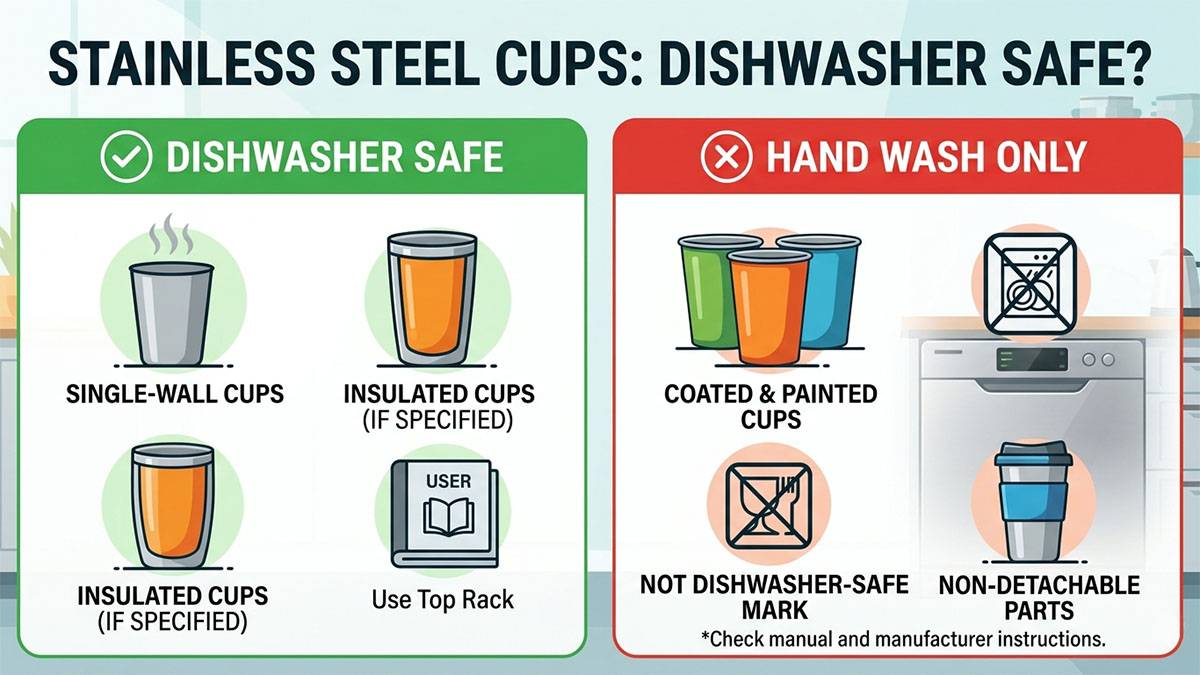
Direct answer: Most single-wall stainless steel cups can be put in the dishwasher. Some double-wall vacuum insulated cups can also be washed in the dishwasher (given that the product manual indicates it’s dishwasher-safe and it is best to place them on the upper shelf with lower water pressure). For cups with a manual not specifying dishwasher-safe, with coatings or paint, or with non-detachable plastic or rubber parts, it is strongly recommended to wash them by hand.
This article helps you distinguish which stainless steel bottles / cups are or aren’t dishwasher-safe and why, while also providing a efficient cleaning procedure.
What Makes a Stainless Steel Cup Safe to Put in the Dishwasher?
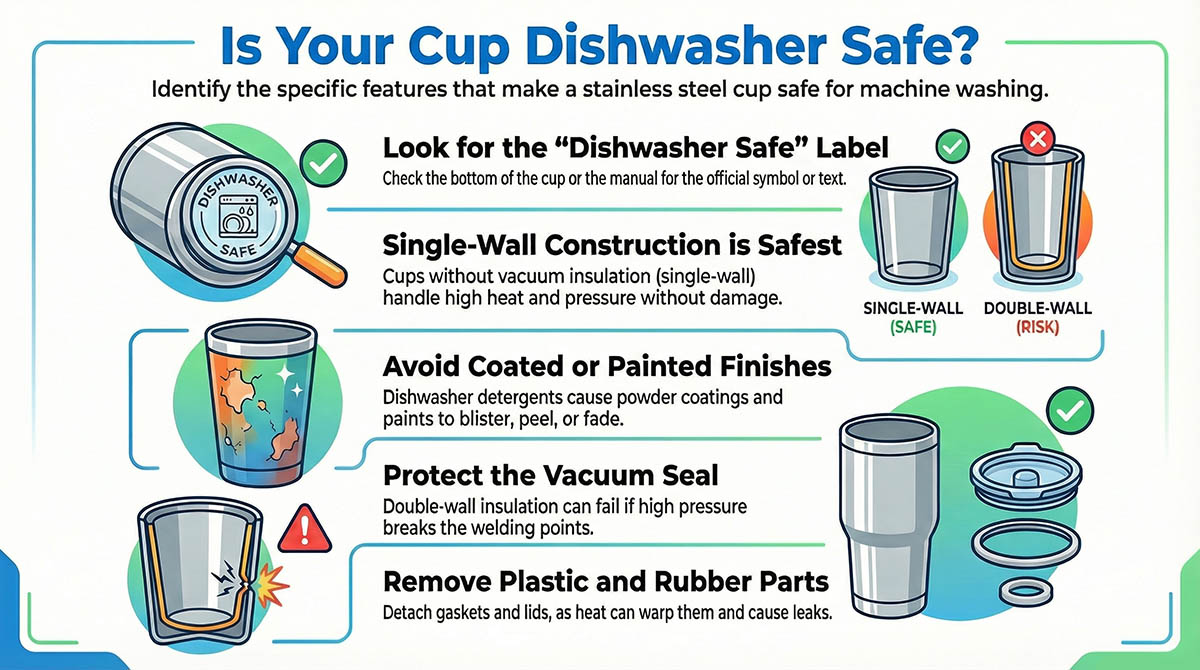
Dishwashers run for 1 to 3 hours at 60 to 75 degrees Celsius (140 to 167 degrees Fahrenheit) with alkaline or enzyme-based detergents. The stainless steel (304, 316, etc.) itself won’t rust or melt. But problems remain elsewhere:
| Component/Feature | Dishwasher Risk |
|---|---|
| Double-wall vacuum insulation | The seal could break if it gets too hot or too much pressure, which would ruin the insulation |
| Copper lining (inner wall) | Combination of chemical detergents and heat may corrode copper and release harmful substances |
| Powder coating/paints | Fading, peeling, and blistering |
| Undetachable plastic/rubber components (expecially rubber gaskets) | Warping, cracking, affecting insulation |
√ It is single-wall, uncoated, with no plastic or rubber parts
√ Or the instructions indicate dishwasher safe
Think twice before washing your cup in the dishwasher:
× It has one or several of the above components or features
× And the instructions don’t state “dishwasher-safe”
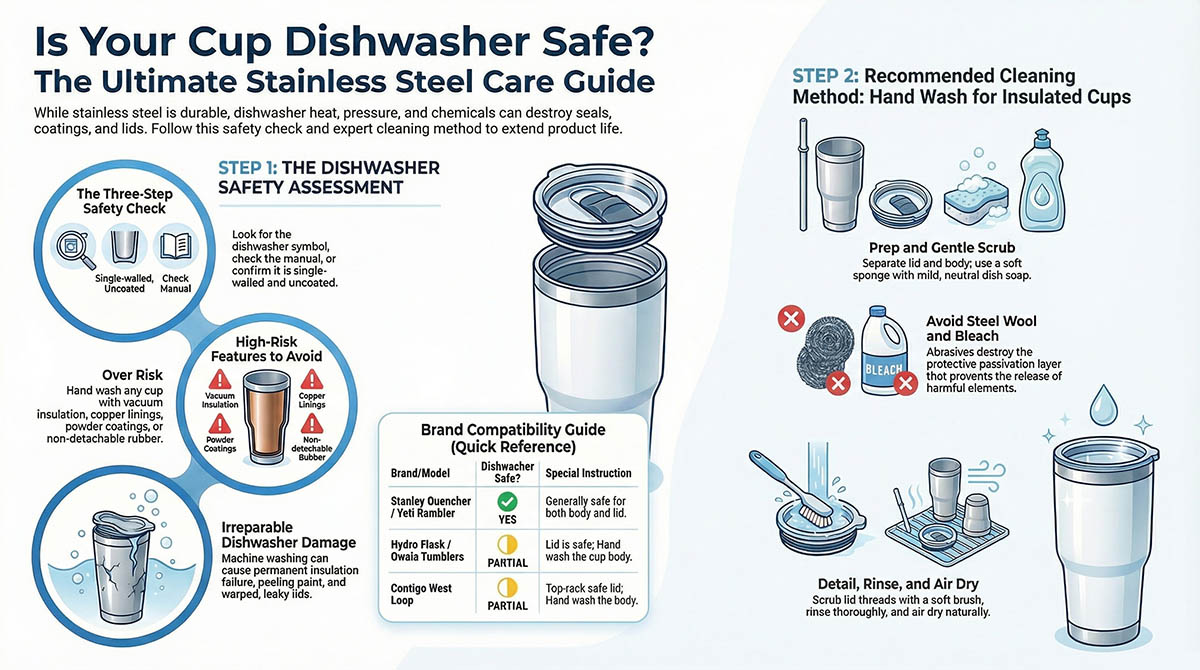
Are These Hot-Selling Cups Dishwasher-Safe?
To save you the trouble of searching, we have listed here some information about whether these popular stainless steel tumblers and bottles are suitable for the dishwasher and the precautions, all from the Amazon product pages or the brands’ official websites.
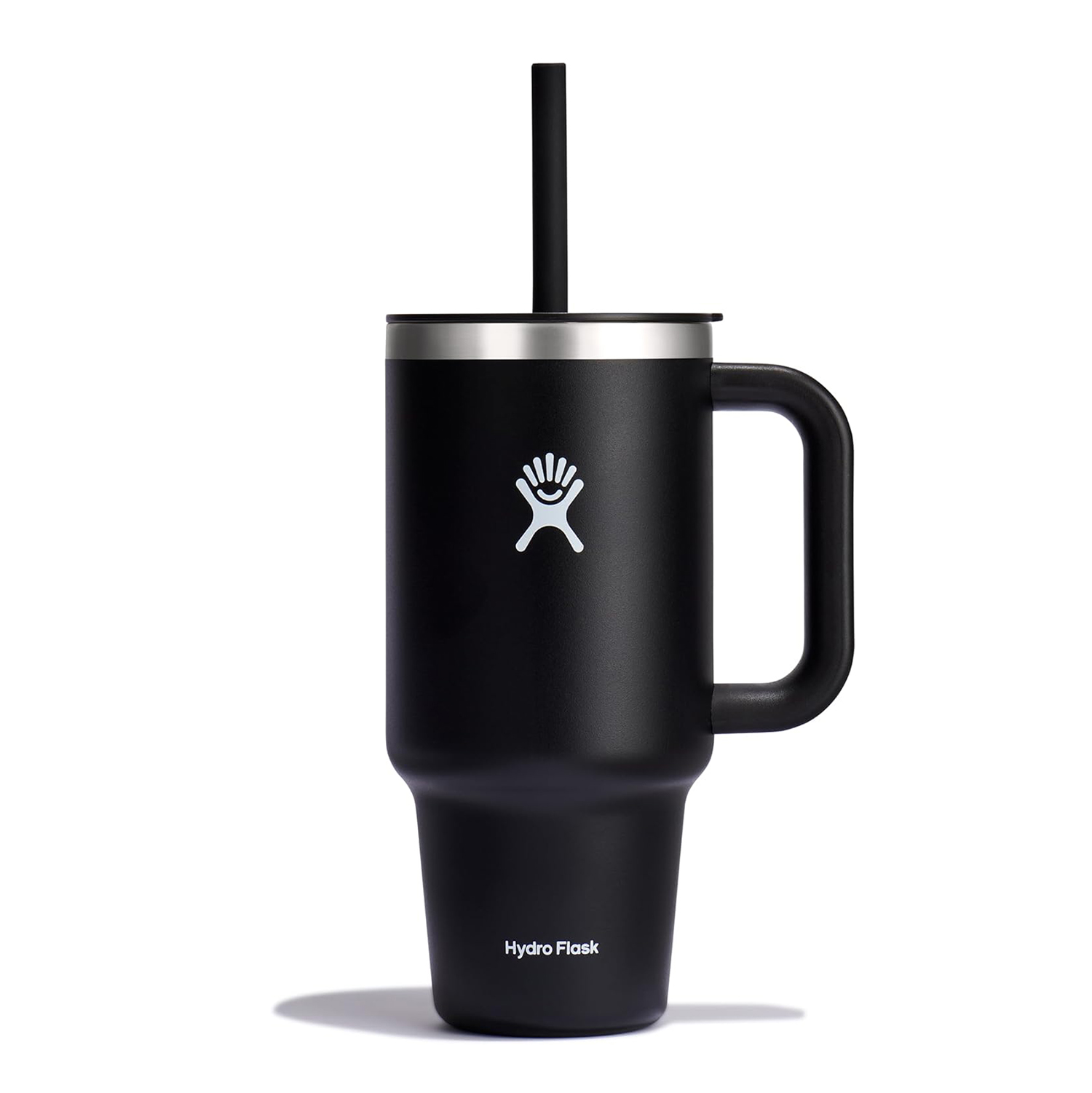
Hydro Flask Travel Tumbler with Handle
Dishwasher-safe cup
Hand-washable straw lid
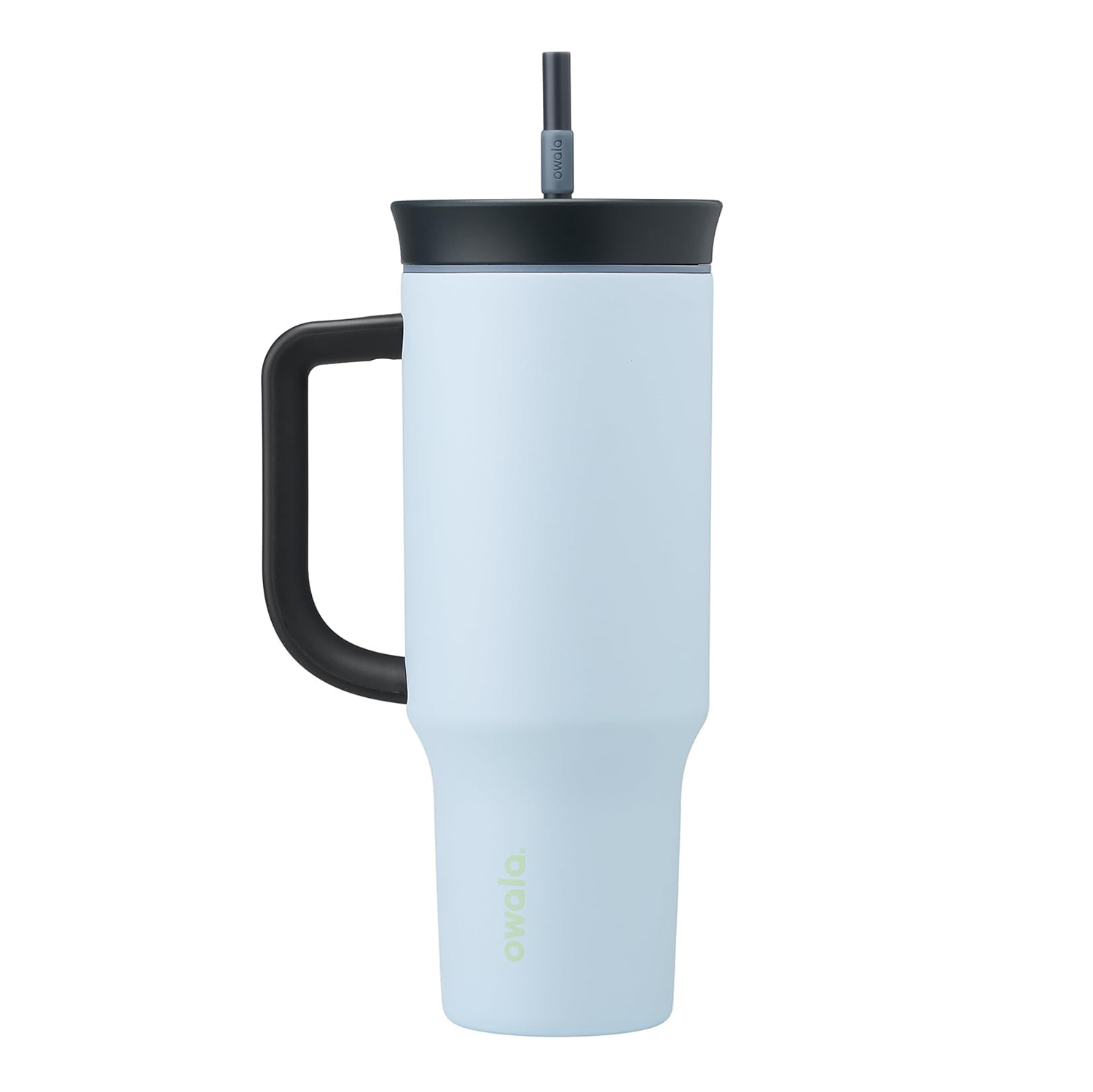
Owala 40oz Triple Layer Insulated Travel Tumbler
Dishwasher-safe lid
Hand-washable cup
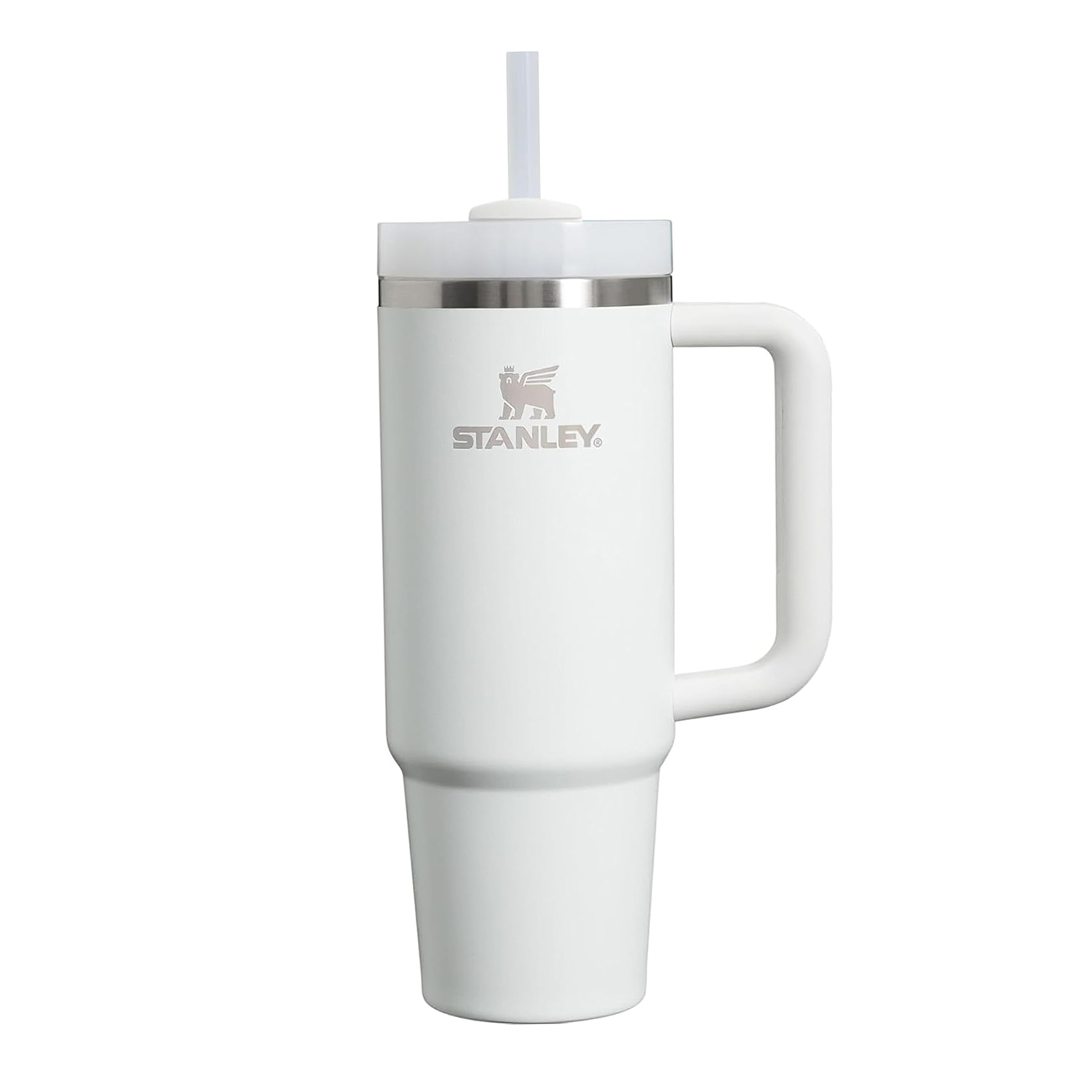
STANLEY Quencher H2.0 Tumbler with Straw and Handle 30oz
Dishwasher-safe
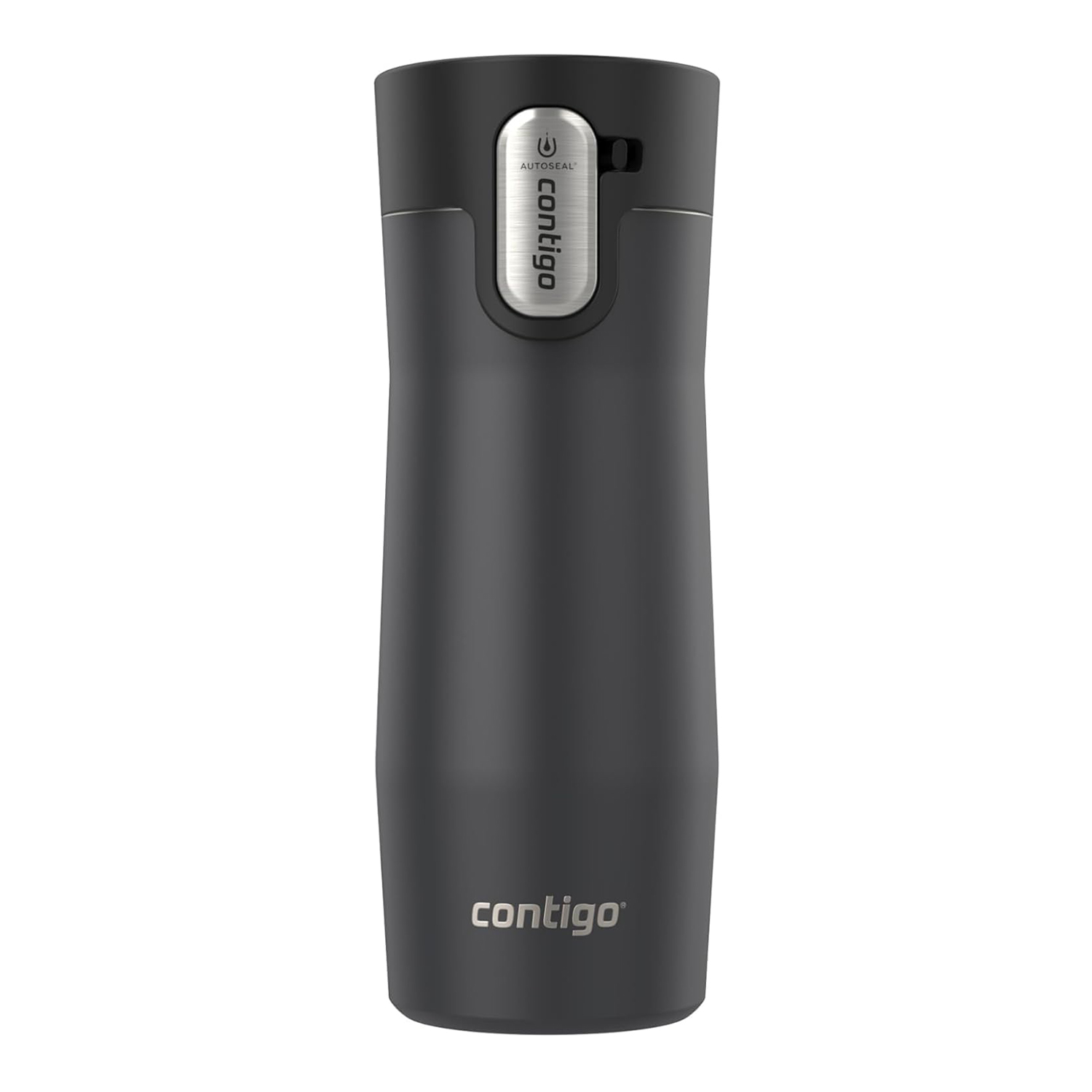
Contigo West Loop 3.0 Stainless Steel Insulated Travel Mug
Top-rack dishwasher safe lid
Hand-washable body
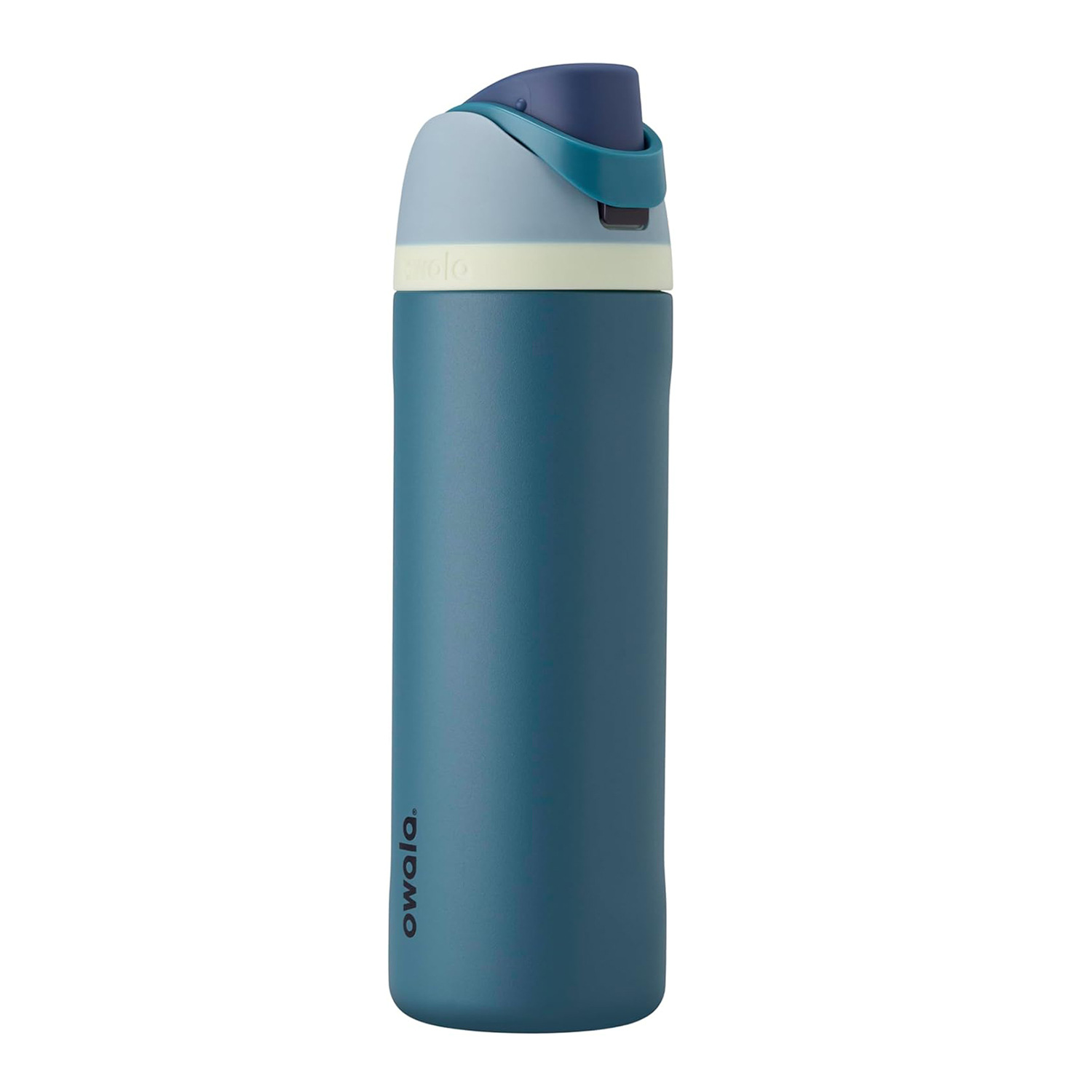
Owala FreeSip Insulated Stainless Steel Water Bottle with Straw
Dishwasher-safe lid
Hand wash cup body
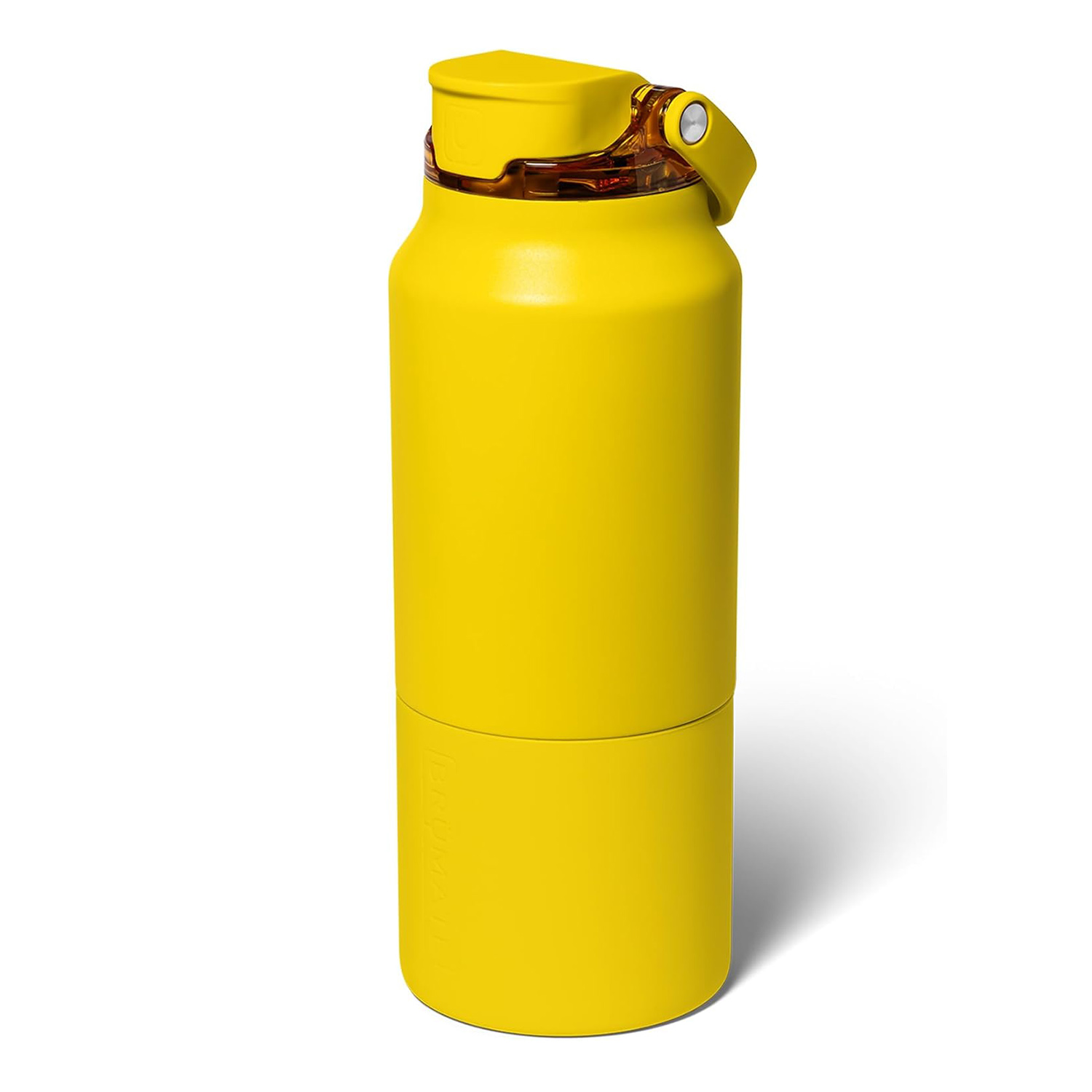
BrüMate Rise 35oz Water Bottle
Top-rack dishwasher safe
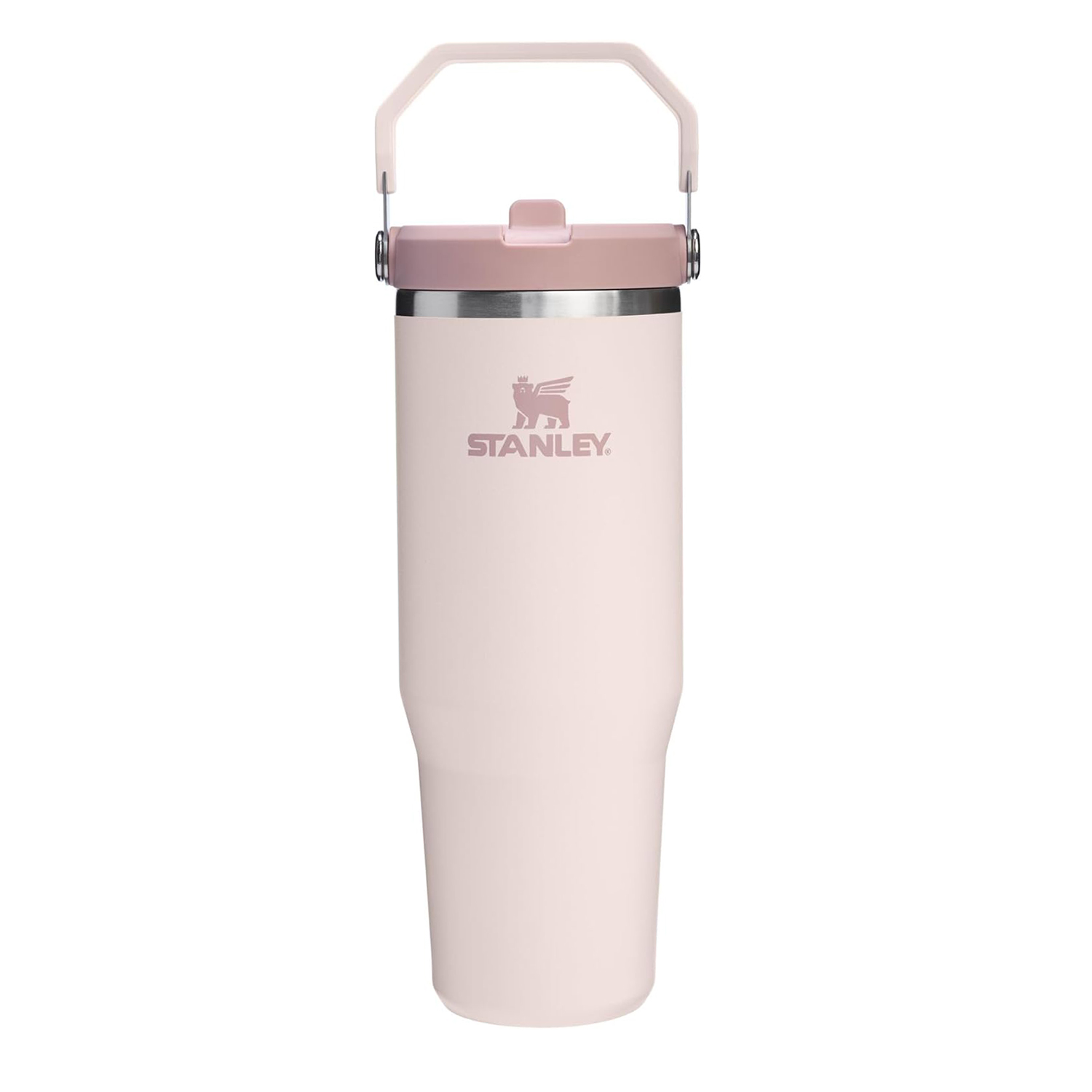
STANLEY IceFlow 2.0 Tumbler with Flip Straw and Handle 30oz
Dishwasher-safe
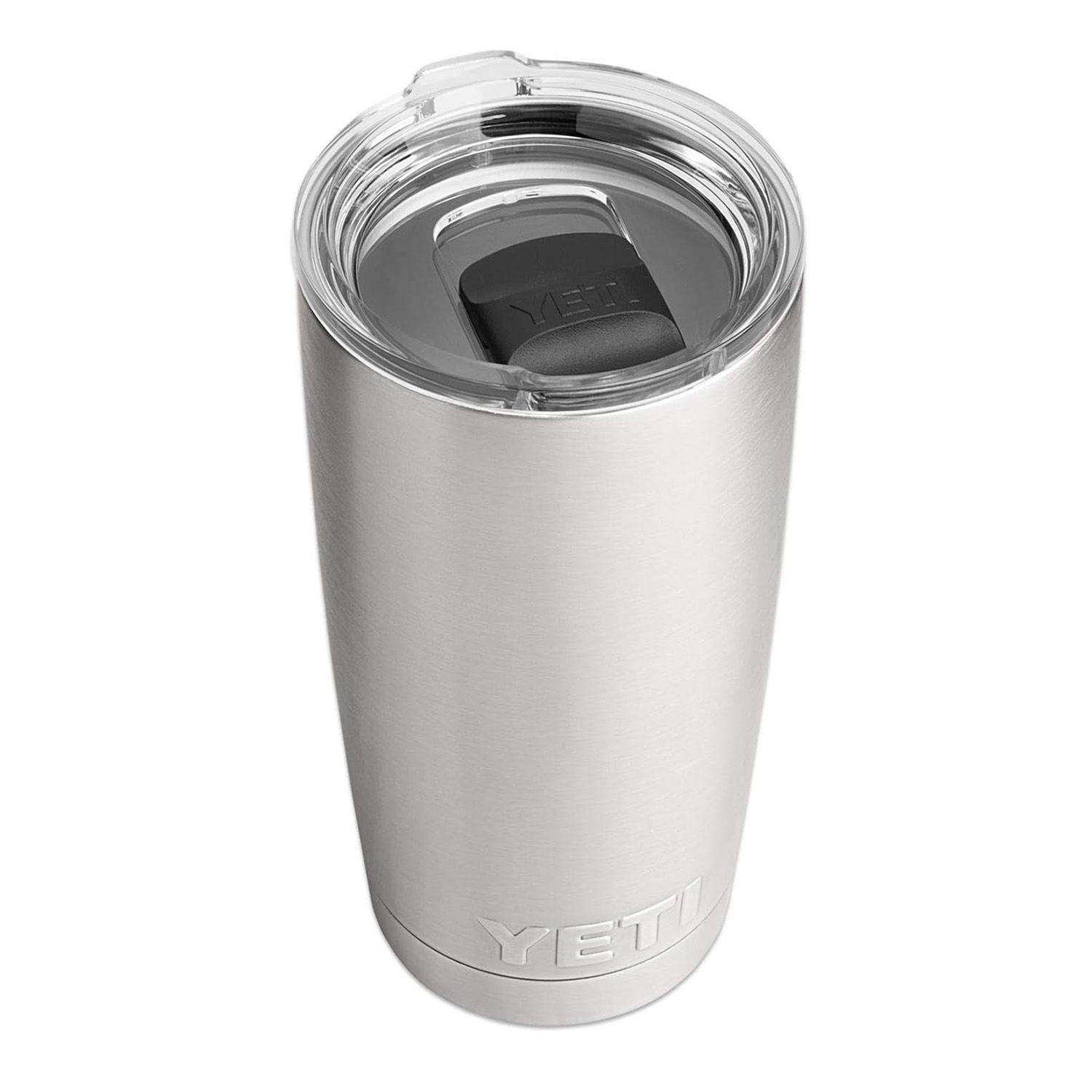
YETI Rambler 20 oz Stainless Steel Vacuum Insulated Tumbler
Dishwasher-safe
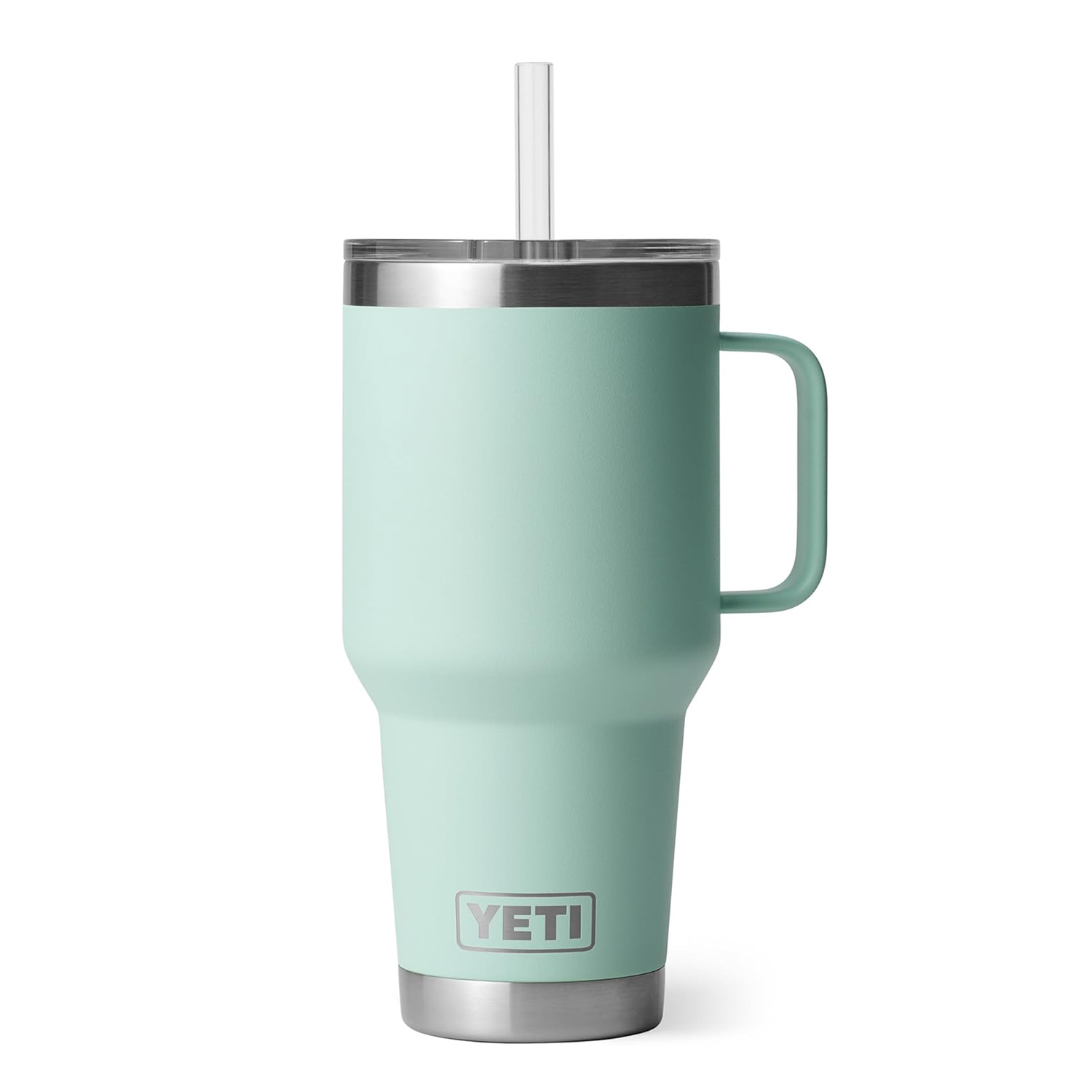
YETI Rambler 35 oz Tumbler with Straw Lid and Handle
Dishwasher-safe
Common Damage Caused by Dishwashers
Even if washed only once, some bottles may suffer from irreparable damage:
- Loss of insulation performance
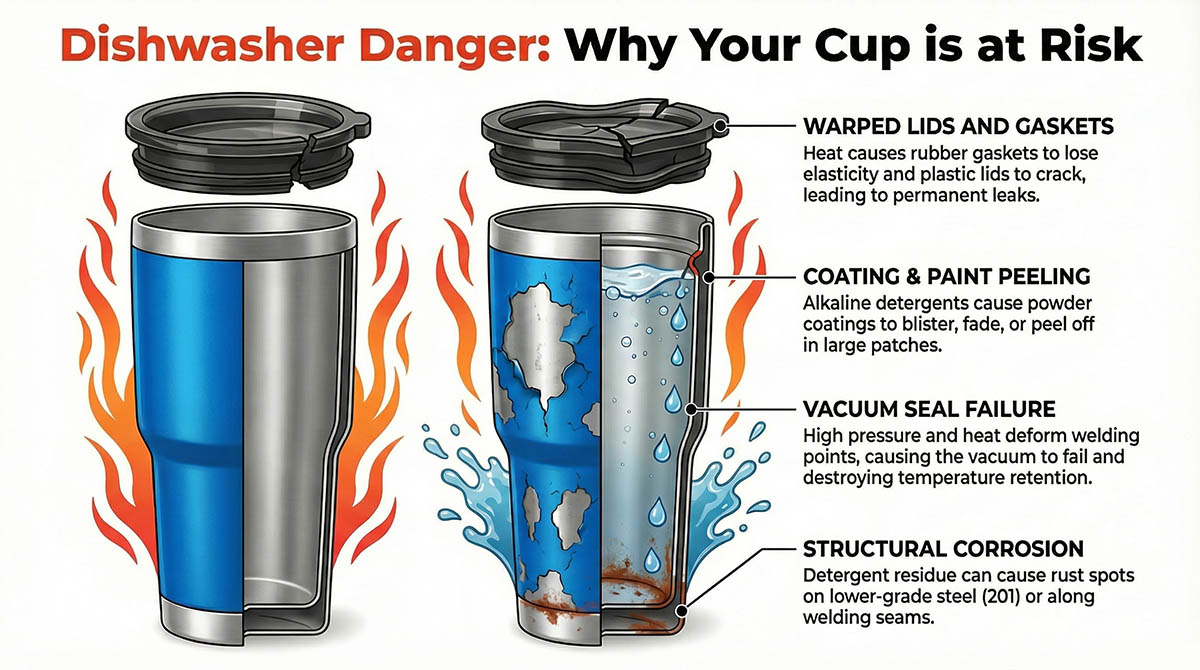
During the manufacturing process of double-walled insulated cups / vacuum flasks / coffee pots / can coolers / food containers / metal hip flasks / water jugs / sports bottles, the air between the two walls needs to be completely removed and sealed to achieve the vacuum insulation effect. The high temperature and high pressure of the dishwasher may cause slight deformation at the welding points or sealing mechanism, allowing air or water to enter, resulting in a permanent decline in insulation performance.
- Blisters, peeling or fading of the coating
Powder coatings and spray paints are prone to decomposition when exposed to alkaline detergents and high temperatures. Small bubbles will appear on the surface, followed by complete detachment in patches, or the color will become lighter and uneven, greatly affecting the appearance.
- Corrosion of the outer layer or welding joints
304/316 stainless steel is highly resistant to corrosion. However, some manufacturers, in an attempt to reduce costs, may use 201 stainless steel for the outer layer of the insulated cup. Under the influence of detergent residues from the dishwasher and moisture, rust spots may form; and some of the cups with poor quality are prone to rust at the welding seams.
- The rubber gasket becomes deformed and sticky
High temperatures cause the rubber to lose its elasticity, harden or become sticky, resulting in the lid being unable to seal properly, causing water leakage and affecting the insulation effect.
- Deformation or cracking of plastic components
The cup lid is usually made of polypropylene (PP) or Tritan. Although it possesses heat resistance to some extent, prolonged exposure to high temperatures during washing may cause deformation, resulting in the lid not sealing properly or the screw threads being damaged. Some of the insulated cups may also feature non-detachable plastic parts that could deform or release harmful substances.
Can Your Stainless Steel Cups Go in the Dishwasher?
Three-step check:
- Check the bottom or body
Look for the dishwasher symbol (a square box with plates and water drops/steam). This confirms manufacturer testing. - Read the manual or packaging
Brands typically state “Dishwasher Safe” or “Hand Wash Only.” - Self-assessment(when you can’t find symbols or specifications on manual)
- Double-wall vacuum structure → Hand wash
- Any coating (powder, paint, gradient) → Hand wash
- Copper or colored inner lining → Hand wash
- Single-wall, no coating, no decoration, no plastic/rubber → Dishwasher OK
Recommended Cleaning Method: Hand Wash for Insulated Cups (Step-by-Step Checklist)
For most insulated cups, hand washing is the safest option. We recommend the following procedure to clean your beloved cup:
- Rinse the cup body and lid separately with warm water to remove any remaining beverages (if the cup was not cleaned in time and the beverage dried into a stain, soak it for about 10 minutes first).
- Dip a soft sponge or cup brush into mild detergent (neutral dish soap, avoiding strong bleach or abrasive powders), and gently wipe the inner and outer layers. Be sure to avoid using a steel wire brush or steel wool: even if there is no coating on the cup body, most stainless steel inner layers are treated with passivation, creating an invisible layer that acts as a protective barrier to prevent the release of any harmful elements, which can be easily damaged with steel wire brushes or steel wool.
- Clean the cup lid: Use a soft brush to clean the threads and crevices (if the sealing ring can be removed, remove and clean it separately).
- Thoroughly rinse: Rinse until all foam disappears and ensure no detergent remains.
- Air dry naturally or wipe dry with a soft cloth.
- Regularly inspect the sealing rings: If they are aged or deformed, replace them immediately.
When Is It OK to Use the Dishwasher for Your Cup?
Ask three questions when you’re not sure whether to use dishwasher:
- Is the cup double-walled vacuum insulated? → Yes → Wash by hand / No → Next question
- Is there any paint or coating on the cup body? → Yes → Wash by hand / No → Next question
- Are there non-detachable plastic components or sealing rings? → Yes → Hand wash / No → Congratulations, you can save the trouble of washing it by hand.
Of course, this is the most stringent method of judgment. If you really don’t want to do the hand washing and the cup quality is acceptable, occasionally using the dishwasher might not cause it to break immediately, but there is a risk of shortened lifespan – after all, it’s your cup, and it’s up to you to decide.
FAQ
Conclusion
The type of insulation, construction, and coatings on your stainless steel cups will determine if they are safe to put in the dishwasher. Cleaning your cups correctly will make them last longer, keep them clean, and keep them looking good.
Need Durable, Easy-to-Clean Stainless Steel Cups?
We manufacture high-quality stainless steel water bottles, jugs, tumblers, etc., supporting laser engraving, multiple capacities, and color options. Every product comes with care recommendations to help business clients extend the life of their gifts.
Contact KingStar, your experienced drinkware and cooler manufacturer, at sales@waterbottle.tech for samples and quotes. Let your branded cups be both aesthetically beautiful and long-lasting.

Specializing in custom manufacturing, quality control and marketing of vacuum-insulated drinkware and coolers.