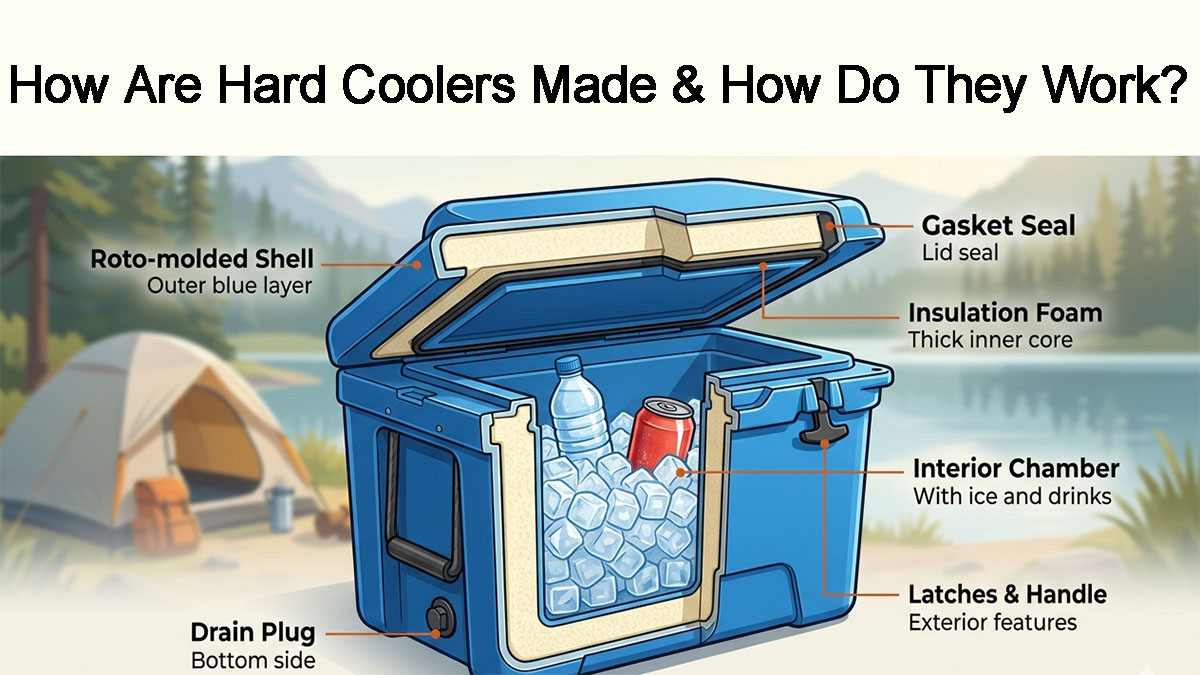
The main job of a hard cooler is to keep heat from moving between the inside and outside as much as possible. To reach this goal, there are two important factors: the manufacturing process affects the strength and durability of the structure, and the insulation system affects how well it keeps cold.
Right now, there are three main ways to make hard coolers: blow molding, injection molding, and rotational molding. Different processes give the product different features, making it better for different uses. The difference in how well insulation works depends on how well the insulation materials, sealing systems, and structural design work together.
This article will explain the technical core of hard coolers from two dimensions: working principle and manufacturing process, helping you understand product differences and make wiser choices.
How Does a Hard Cooler Keep Things Cold: The Science Behind
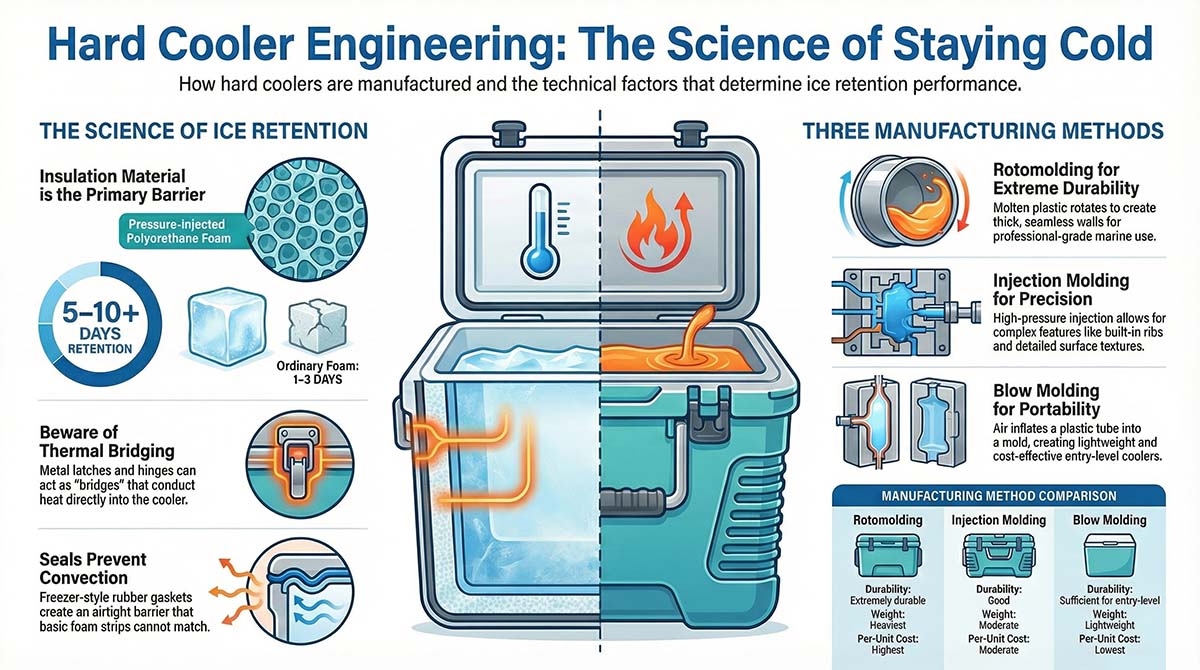
A cooler does not actively cool its contents with electricity like refrigerators. It slows down the heat exchange between inside and outside. It can be regarded as an efficient barrier, separating the cold interior from the warm exterior. There are three main ways of heat transfer: conduction, convection and radiation. The design goal of the hard cooler is to minimize these three heat transfer processes to the greatest extent. Three key components work together to achieve this: insulation layer, sealing and structure.
How Does the Insulation Layer Affect Ice Retention
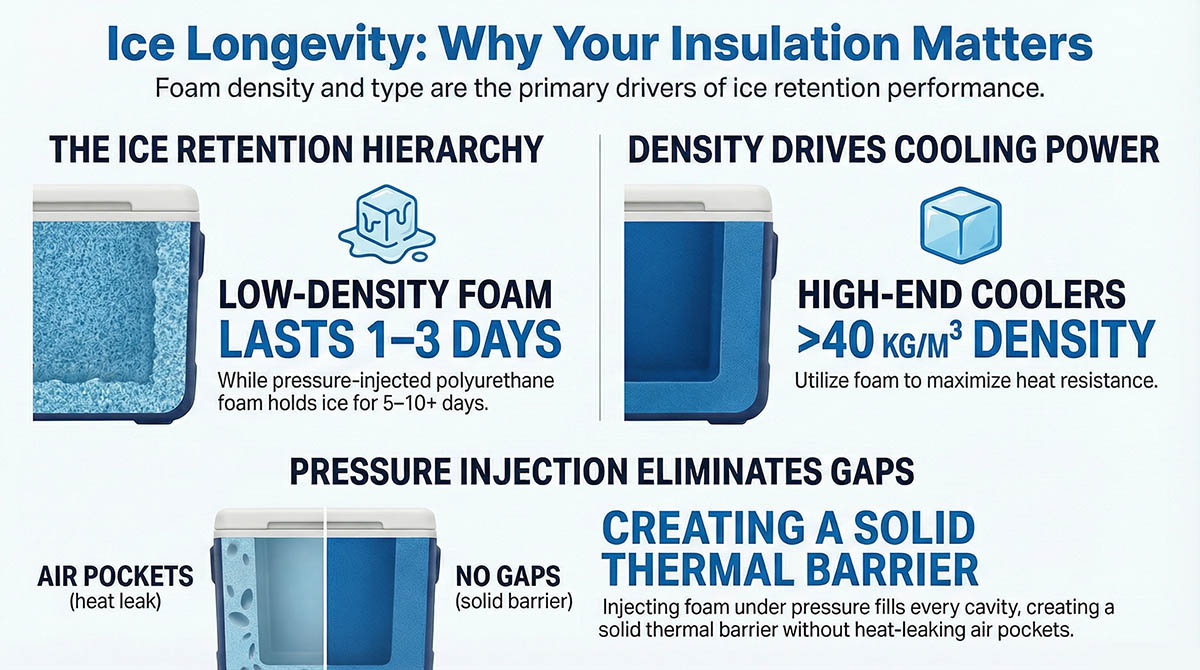
Insulation is the primary barrier against heat transfer. The material and density of the insulation layer determine its effectiveness in blocking heat exchange.
| Insulation Material | Ice Retention Performance | Typically used for |
|---|---|---|
| Low-density Ordinary foam | 1–3 days | Entry-level, lightweight daily-used coolers |
| High-density polyurethane foam | 3–5 days | General-purpose coolers |
| Pressure-injected polyurethane foam | 5–10+ days | High-end, professional-grade marine coolers |
The Seal – Stopping Heat at the Door
If warm air can get inside, even the best insulation will fail. When the lid is closed, air exchange is prevented by the lid seal, a silicone or rubber gasket that runs around the edge.
- Simple rubber strips or thin foam are basic seals: Although they compress sufficiently, they may deteriorate with time or frequent use.
- Freezer-style gaskets: An airtight barrier is created by compressing thick, flexible rubber. These seals, which are frequently found in high-end hard coolers, hold up well even after hundreds of openings.
To guarantee airtightness, high-quality coolers typically use thicker sealing rings and apply some compression when the lid is closed. In order to completely eliminate any possible air leakage points, some high-end products also include extra sealing structures at the hinge and latch positions.
If you’re not sure whether your cooler’s sealing performance is ok, you can do this simple test: close the lid on a piece of paper and try to pull it out. If it slides out easily, the seal is insufficient.
How Cooler Design Minimizes Thermal Bridging
“Thermal bridging”, also known as “cold bridging”, originally refers to the weak links (or areas) in the building’s enclosure structure, where heat can more easily pass through. When materials with good heat-conducting properties are used between the interior and exterior surfaces of the building, it forms a “bridge” for heat transfer. This situation usually occurs in areas where there are voids in the insulation layer, or when components such as beams pass through the building structure. And the parts with good thermal conductivity in the cooler box can also cause this phenomenon to occur. When trying to find a way to penetrate the thick cooler wall, the heat will directly reach these “weak points” and transfer from these high thermal conductivity materials to the interior of the cooler. With improper design or wrong treatment, components such as metal clasps, hinges, and drainage plugs can all become heat conduction paths.
High-end ice chests solve this problem through meticulous design:
- Wrap a layer of thermal insulation materials (plastic, TPU, rubber, etc.) outside the metal parts to block them from directly touching the cooler body.
- Install the latches and hinges on the exterior instead of penetrating the insulation layer.
The Manufacturing Processes: How Hard Coolers Are Made
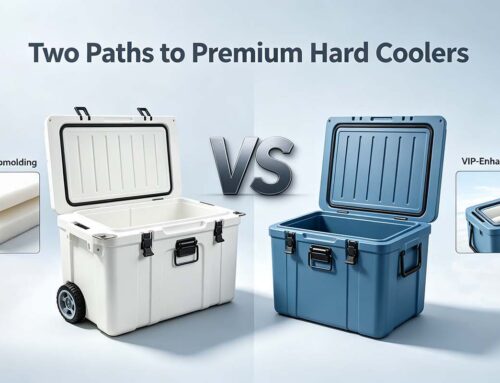
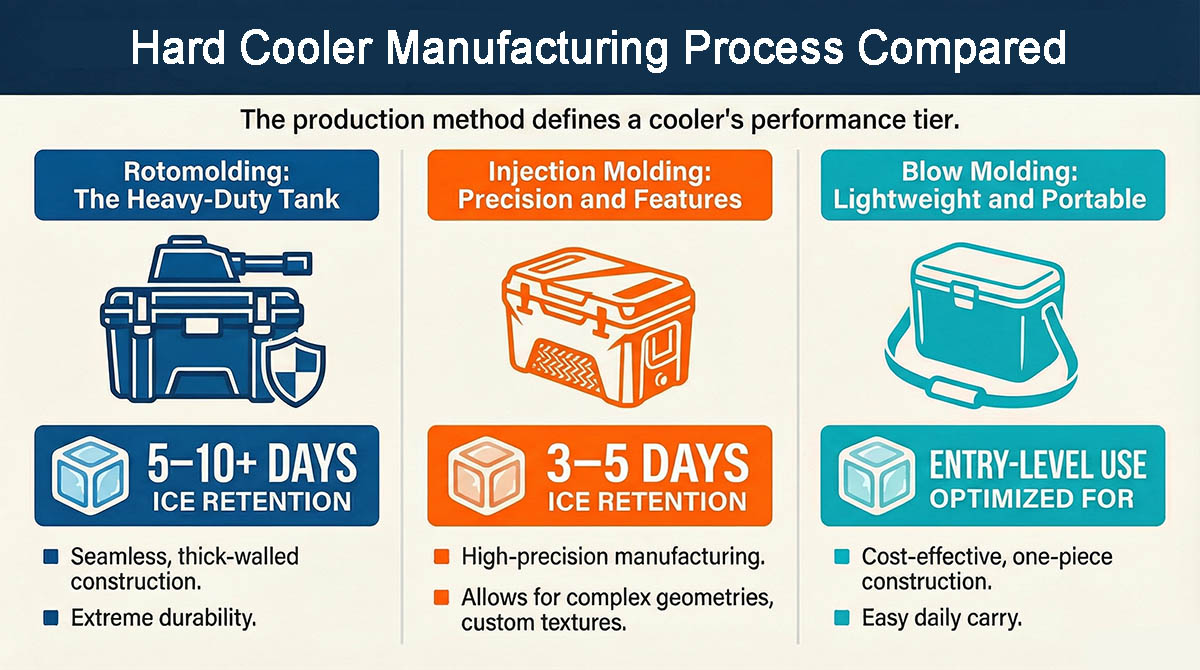
Three manufacturing methods dominate the hard cooler industry: rotational molding, injection molding and blow molding. They each have their own characteristics. There is no such thing as an absolutely “best” process; only the process that is “most suitable” for a particular project.
Rotomolding (Rotational Molding)
The coolers made by rotational molding usually feature the thickest walls and the most robust structures.
The process:
- A hollow mold is loaded with plastic powder (typically polyethylene)
- The mold is heated while rotating on two axes
- The plastic melts and evenly covers the inner surface of the mold under the action of centripetal force
- The mold stops, and the solidified part is cooled into shape and removed
Why choose rotomolding for cooler production
- Seamlessness, meaning no weak points
- Thick & even walls
- Integrated and molded-in design features like handles, cup holders, tie-down slots, etc., without secondary assembly
Typical uses: high-end coolers for construction sites or marine activities.
Injection Molding
Injection molding produces high-precision parts with complex geometries.
The process:
- Plastic pellets are heated to a molten state in an injection machine
- The molten material is injected into a metal mold under high pressure
- The material cools and solidifies
- The mold opens, ejecting the finished part(usually independent inner and outer walls)
- The outer and inner walls are welded together
Why Injection Molding is Suitable for Cooler Manufacturing
Injection molding brings key advantages to cooler design and production, with direct impacts on fit, finish, functionality and cost.
- Delivers the tightes tolerances
- Creates a smooth, high-quality exterior
- Allows greater flexibility for custom in-mold textures
- Easily supports built-in ribs, mounting points and finely detailed surface textures
- Offers faster production cycles than rotomolding, with most parts fully formed and cooled in just 1-3 minutes
- Higher mold cost ($15,000 to $50,000), but per-unit costs stay low at scale
Typical applications: Mid-range everyday coolers, structurally complex multi-functional designs striking a strong balance between performance, appearance and cost.
Blow Molding
Blow molding is the most efficient (both for time and cost) method for producing lightweight, hollow one-piece structures.
The process:
- Plastic is melted and extruded into a hollow tube (parison)
- The parison is placed inside a two-part mold
- Compressed air inflates the parison, pressing it against the mold walls
- The plastic cools and solidifies into the final shape
Advantages of blow molding a cooler
- Optimized material distribution grants it lightweightness and good portability
- One-piece construction with no seams along the body
- Fast cycle times and lower tooling costs makes it cost-effective
- Uniform wall thickness means consistent structural integrity
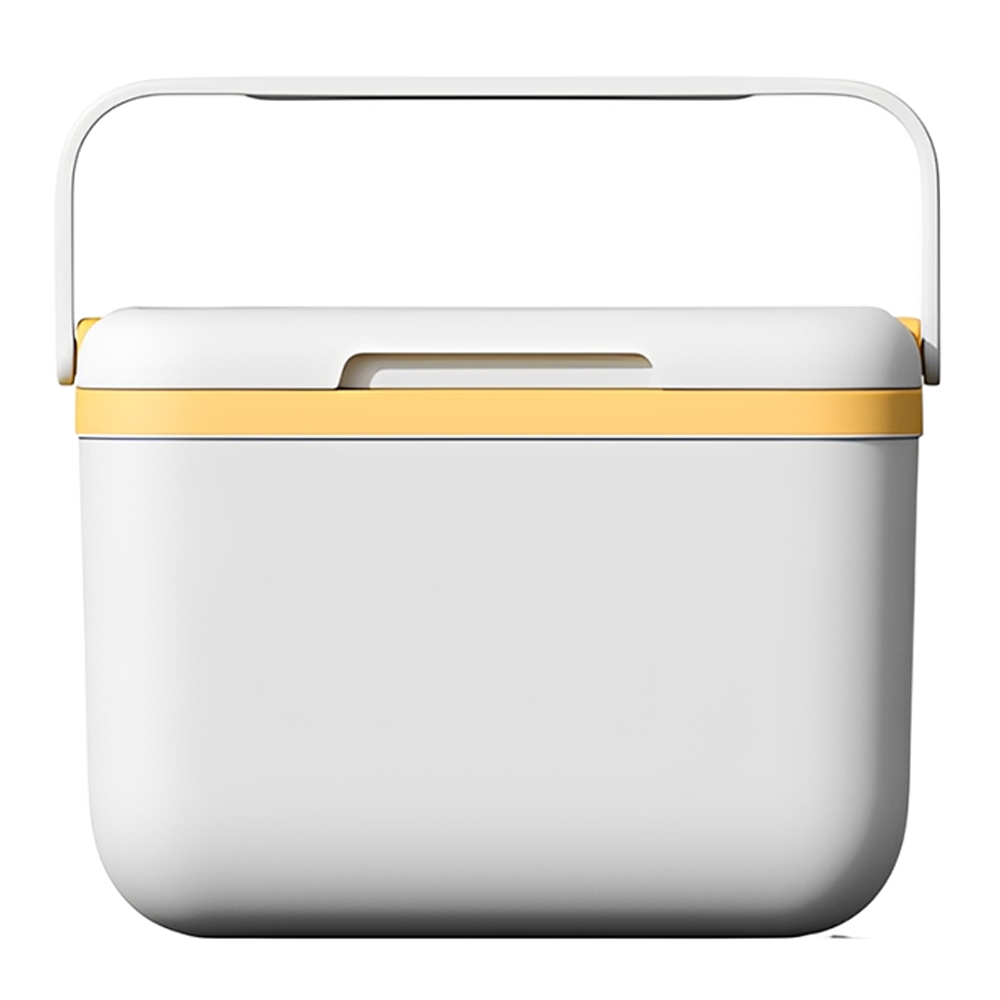
Typical applications: Entry-level portable coolers and promotional/corporate gifts that focus more on portability and cost-effectiveness.
Manufacturing Methods Comparison
| Factor | Rotomolding | Injection Molding | Blow Molding |
|---|---|---|---|
| Process | Powder heated and rotated in mold | Molten plastic injected under pressure | Melted plastic inflated into mold |
| Wall Structure | Thick, uniform(5-15mm) | Variable, can incorporate ribs | Uniform, hollow(2-5mm) |
| Durability | Extremely durable | Good | Enough for intended use |
| Weight | Heaviest | Moderate | Lightweight |
| Tooling Cost | Moderate ($5,000–$20,000) | Higher ($15,000–$50,000) | Lower ($3,000–$12,000) |
| Per-Unit Cost | Highest | Moderate | Lowest |
| Best For | Premium, heavy-duty | Mid-tier, complex features | Lightweight, entry-level |
What Features Improve a Hard Cooler’s Quality
Beyond the manufacturing method and insulation, specific features separate a reliable cooler from a disappointing one.
Hardware Durability
Latches, hinges, handles, and drain plugs endure the most wear. Material choice determines longevity.
| Component | Standard Material | Premium Material |
|---|---|---|
| Latches | Plastic spring-loaded | Rubber T-latches with stainless steel pins |
| Hinges | Pin hinges | Integrated molded hinges or stainless steel |
| Handles | Rope or basic plastic | Molded rubber over-molded grips |
| Drain plug | Simple screw plug | Threaded drain with garden hose adapter |
A well-designed drainage system makes it easy to remove melted ice without tilting the cooler or creating weak spots that could leak.
- Location: Side drains let you drain water easily without having to lift the cooler. Rear or bottom drains, on the other hand, usually require tilting to get water to flow out.
- Size: Larger drains empty contents much faster. For the most efficient drainage, look for drains with a diameter of 1 inch or more.
- Seal: Threaded plugs with rubber gaskets keep leaks at bay consistently. Basic push-in plugs, however, are much more likely to leak or fail over time.
Portability Features
A practical cooler needs more than just good quality and strong performance—it also needs design touches that boost the user experience.
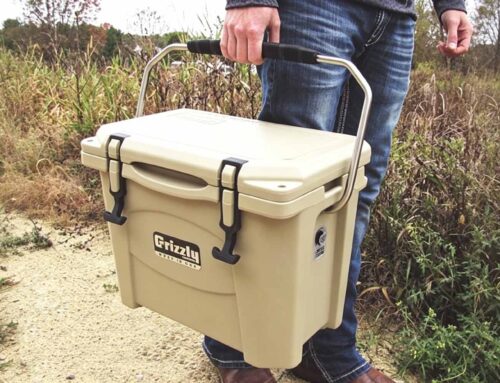
- An ergonomic integrated handle, for instance, makes carrying more stable and comfortable; rope handles, by contrast, lack that stability and can even hurt the user’s hands when the cooler is fully loaded.
- For outdoor enthusiasts, wheels are a must, because carrying a cooler around all day during long trips just isn’t feasible.
- Other integrated functions are more like nice-to-haves, not absolute necessities, but they still make a big difference in user experience. Think cup holders, bottle openers, and foldable cutting boards. However, it should be noted that the design of these integrated functions should not be at the expense of the cooler’s structure and functionality.
How Manufacturers Test Cooler Quality
Manufacturers use standardized tests to verify claims. Understanding these tests helps evaluate competing products.
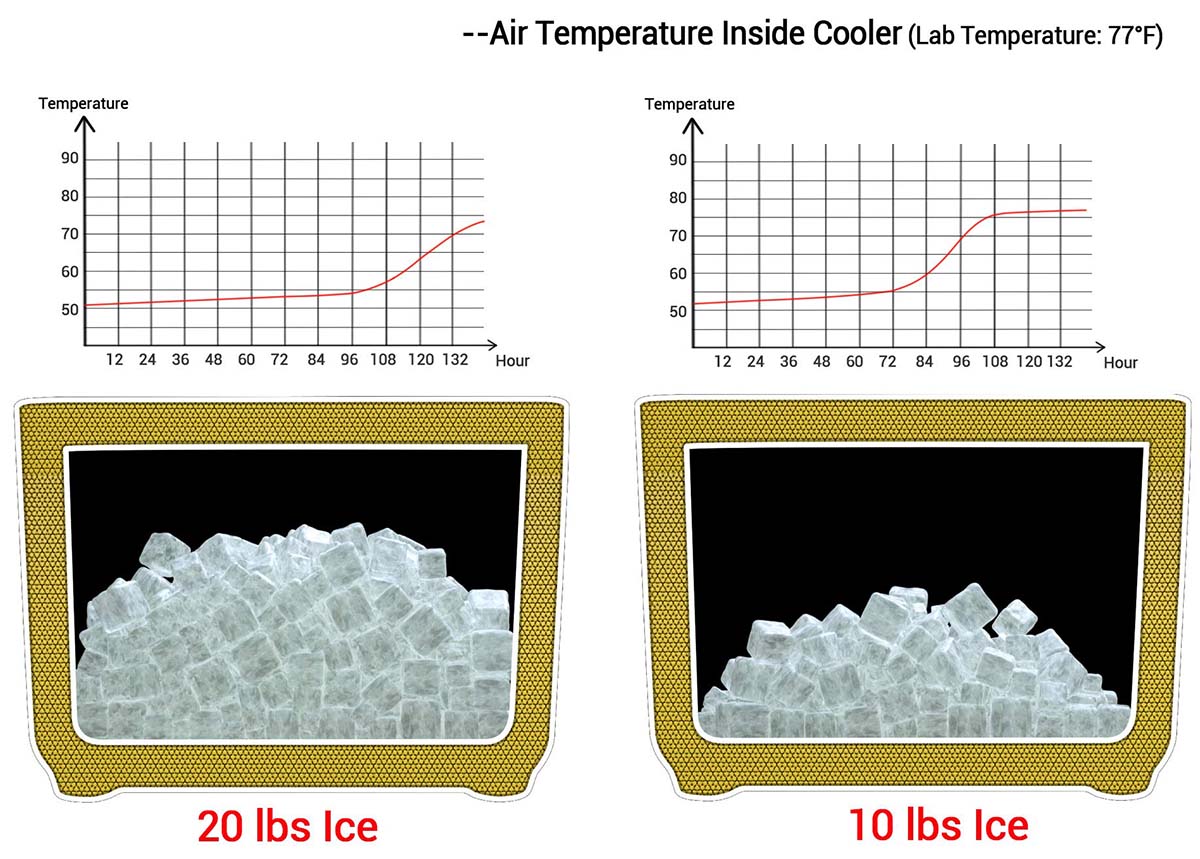
Ice Retention Test
The most quoted performance metric. A standardized test typically involves:
- Ambient temperature of 90°F (32°C)
- Cooler pre-cooled to around 0℃
- 2:1 ice-to-contents ratio
- Limited openings to stimulate actual use(often 2-3 times per day)
- Measured until ice is fully melted
How to read claims: “X-day ice retention” means under controlled lab conditions. The testing conditions may vary among different manufacturers. It is necessary to understand the testing methods before directly comparing the “cold retention days”. And keep in mind that real-world performance varies with environment temperature, ultraviolet intensity, and opening frequency.
Durability Tests
- Drop test: The cooler is dropped from certain heights onto concrete checking for cracks, a lid that comes off, or broken hardware.
- Load test: The lid is put under weight. Premium coolers can hold 250 to 500 pounds without bending.
- Latch cycle test: To make sure they last a long time, latches are opened and closed thousands of times.
- UV exposure test: The material is put in high-intensity ultraviolet light to mimic years of being exposed to sunlight. Checks for signs of cracking, fading, and brittleness.
Common Misconceptions About Hard Coolers
Misconception 1: “Thicker the walls, the better”
Wall thickness matters, but insulation material matters more. A cooler with 1.5 inches of low-density foam may perform worse than one with 1 inch of high-density pressure-injected foam. Density and thermal resistance (R-value) are better indicators than raw thickness.
Moreover, engineers need to strike a balance between wall thickness, weight and capacity. After all, products with thicker walls are usually heavier, and for the same volume, the thicker the wall, the smaller the capacity.
Misconception 2: “I should always buy a cooler that can hold ice for 10 days and more”
Extended ice retention will increase the cooler box’s weight and price. Most of the time, regular camping, picnics and weekend gatherings don’t last for such a long period of time. A cooler with 1-2 days of ice retention is sufficient. You don’t always need to purchase those very expensive, large and heavy rotomolded cooler boxes. The important thing is to match your needs, so that we can select the “most suitable” cooler for you, rather than the “best” one.
Misconception 3: “Metal hardware is always better”
Metal hardware can create thermal bridges that conduct heat into the cooler. Quality manufacturers isolate metal components with rubber or plastic thermal breaks. Poorly designed metal hardware may look premium but perform worse than well-designed plastic alternatives. At present, there are many well developed hard plastics, and the components made from them are almost as durable as metals and do not rust.
FAQ
What is the best manufacturing method for a hard cooler?
There is no single “best” method because each serves a different purpose. Rotomolding produces the most durable coolers with the longest ice retention. Injection molding offers precision and complex features. Blow molding provides lightweight, cost-effective options. Choose based on your or your audience’s intended use.
How long does a hard cooler actually keep ice?
Standard coolers (blow-molded or basic injection-molded) typically hold ice for 1-3 days. Mid-tier injection-molded coolers with quality insulation reach 3-5 days. Premium rotomolded coolers with pressure-injected foam achieve 5-10+ days under controlled conditions. Real-world results vary with temperature, sun exposure, and how often the lid opens.
How do I properly clean and maintain a hard cooler?
Clean after each use with mild soap and warm water. Avoid bleach or abrasive cleaners that can damage seals. For odors, use a baking soda solution or diluted white vinegar. Store with the lid slightly ajar to prevent mold and seal compression. Lubricate latches and hinges periodically(for instance every 1-2 months) with food-grade silicone spray.
Can I customize a hard cooler with my logo or brand colors?
Yes. Customization options include molded-in logos (permanent during manufacturing), screen printing, heat transfer decals, laser engraving on hardware, and metal badge inlays. Minimum order quantities vary by customization method. Color matching to Pantone specifications is also available.
For more detailed information, feel welcome to refer our previous post: How to Build Your Cooler Brand: The Ultimate Guide to Private Label Custom Hard Coolers. It contains everything you need to know about private labeling or OEM a hard cooler for your own brand.
What is pressure-injected foam and why does it matter?
Pressure-injected foam is high-density polyurethane injected into the cooler walls under pressure. It expands to fill every cavity, eliminating air gaps and creating a dense thermal barrier. Coolers with pressure-injected foam typically deliver significantly longer ice retention than those with standard foam.
What size cooler should I buy?
- 20–30 quarts: Personal use, day trips, lunch
- 30–50 quarts: Weekend trips for 2–4 people
- 50–80 quarts: Family camping, 4–6 people, 3–5 days
- 80+ quarts: Group events, extended trips, commercial use
Consider that ice takes up 20-30% of capacity. A 50-quart cooler holds approximately 35-40 quarts of food and beverages with ice. For professionals, 2:1 ice-to-contents ratio would help extend the ice retention to the maximum.
Conclusion
The performance of the hard cooler is determined by the combination of manufacturing techniques, materials science, and engineering design. The three processes of rotational molding, injection molding, and blow molding each have their own advantages and are suitable for different market positioning and usage scenarios; while the differences in cold insulation capabilities stem from the meticulous refinement of insulation materials, sealing systems, and structural details.
Whether you are an ordinary consumer choosing products or a purchasing representative considering customization requirements, understanding these technical principles can help you make more accurate judgments – choosing products that match the usage scenarios instead of blindly pursuing individual parameters.
Are you considering customizing a hard cooler?
If you are planning a brand-customized cooler project – whether for corporate gifts, brand promotions or product line expansion – an experienced cooler manufacturer like us can provide you with professional advice. From process selection, material configuration to customization plans, we assist you in turning your ideas into high-quality products.
Contact our customization team at sales@waterbottle.tech to obtain selection suggestions and customization plans. Looking forward to collaborating with you!
References
[1] Kingspan. (Feb 16, 2023). What is thermal bridging | https://www.kingspan.com/gb/en/knowledge-articles/what-is-thermal-bridging/
[2] KingStar Mold. (Apr 29, 2025). How does a cooler box / ice chest work? | https://kingstarmold.com/how-does-a-cooler-box-ice-chest-work/
[3] Canyon Coolers. (n.d.). Hard coolers: A complete guide | https://canyoncoolers.com/pages/hard-coolers-a-complete-guide
[4] Grizzly Coolers. (Mar 9, 2021). How are coolers insulated? | https://grizzlycoolers.com/blogs/cooler-tips/how-are-coolers-insulated
[5] Thermtest. (Mar 28, 2024). Uncovering the cool science behind modern coolers | https://thermtest.com/uncovering-the-cool-science-behind-modern-coolers
[6] Zhenyou Tech. (n.d.). Polyurethane foam vs EPS foam – a comprehensive comparison | https://www.epsmachinechina.com/is-polyurethane-foam-better-than-eps-foam/

Specializing in custom manufacturing, quality control and marketing of vacuum-insulated drinkware and coolers.