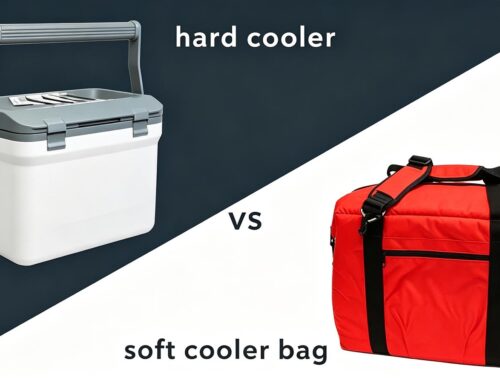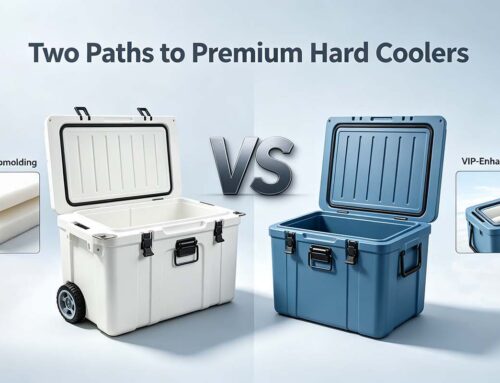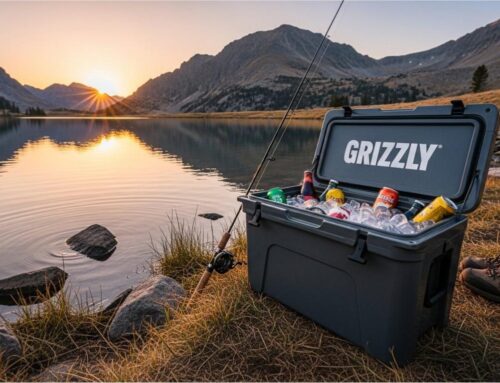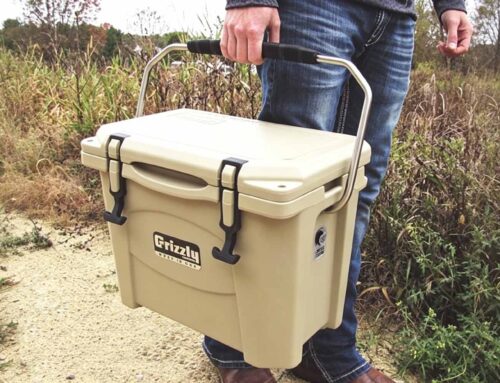
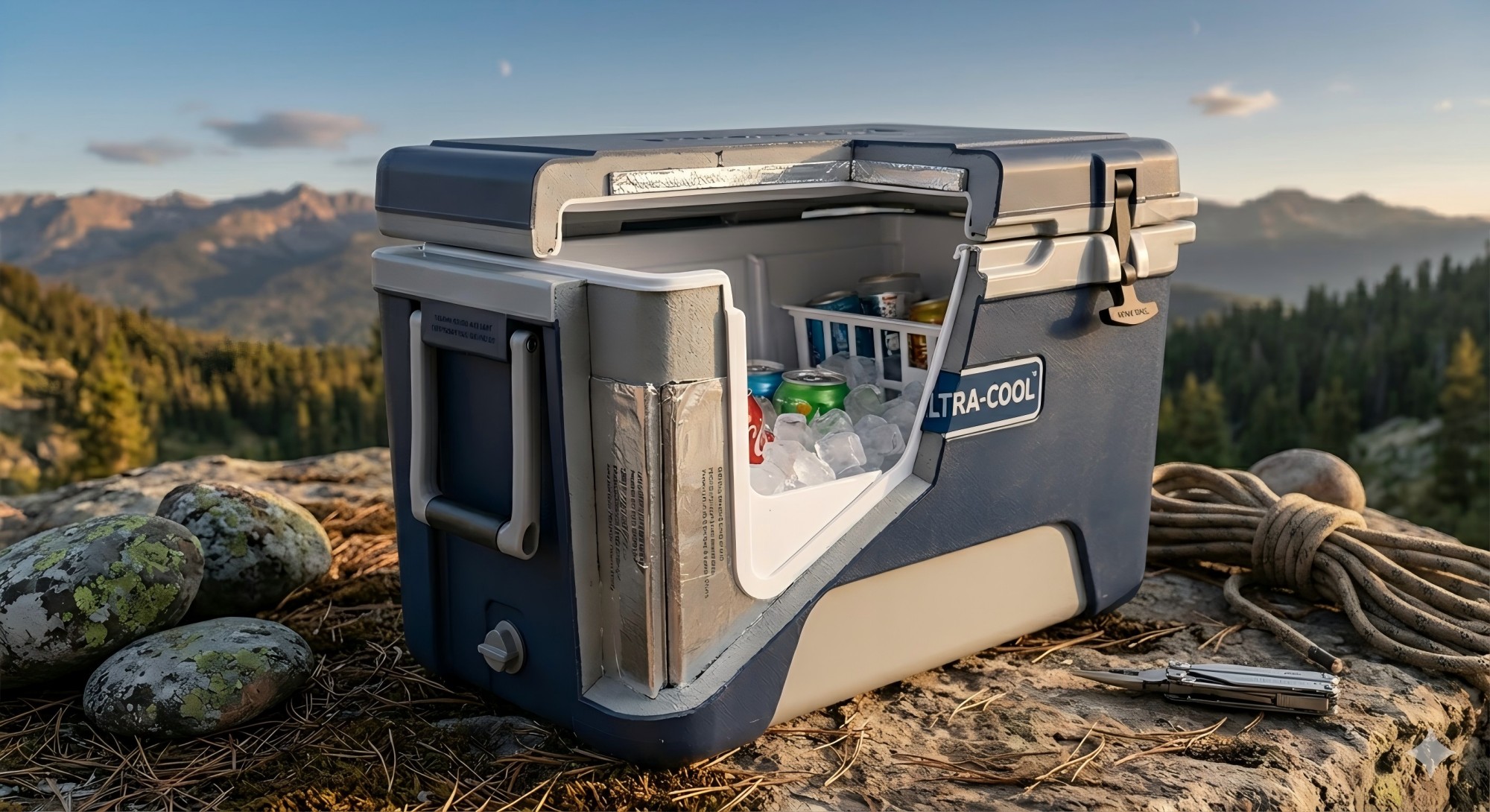
When you buy a high-performance cooler, “how long can the ice block last” is often the core criterion. But many products on the market called “long-term thermal insulation” are actually plain to use. The key to the problem is not how thick the box is at all, but whether the thermal insulation structure inside it is effective or not.
In the past two years, vacuum insulation panels (VIPs) have gradually become an unavoidable core technology in the design of high-end coolers. Compared with traditional thermal insulation materials, VIP relies on the internal high vacuum environment to block the path of heat conduction and thermal convection, and its thermal insulation performance can be 5 to 10 times that of ordinary polyurethane. This article will give you a clear and thorough explanation and provide a reliable and practical technical reference.
What Is the Typical Structure of a Cooler?
To put it bluntly, a cooler is a portable box, jug or bag, which is specially used to keep food or drink cool. It relies on a simple heat insulation design to prolong the melting time of ice cubes as much as possible. The structure mainly pays attention to three things: resistance to manufacture, heat insulation and good sealing. Now coolers have been widely used in camping, fishing and even some commercial scenes. Let’s take a hard cooler box as an example.
Key Components
| Parts | Materials | Functions |
|---|---|---|
| Outer Shell | Durable polyethylene plastic | Constitute the main structure of the cooler and has excellent impact resistance performance |
| Thermal Insulation Interlayer | Polyurethane foam or expanded polystyrene (EPS) | Slow down internal and external heat exchange by locking air and blocking heat conduction |
| Inner Container | Smooth food-grade plastic | It fits the inside of the box, and it is not easy to stain and leave odor. |
| Sealing Strip | High-quality rubber | Realize tight airtight sealing and reduce heat infiltration in the gap |
How Insulation Works Within the Cooler Structure?
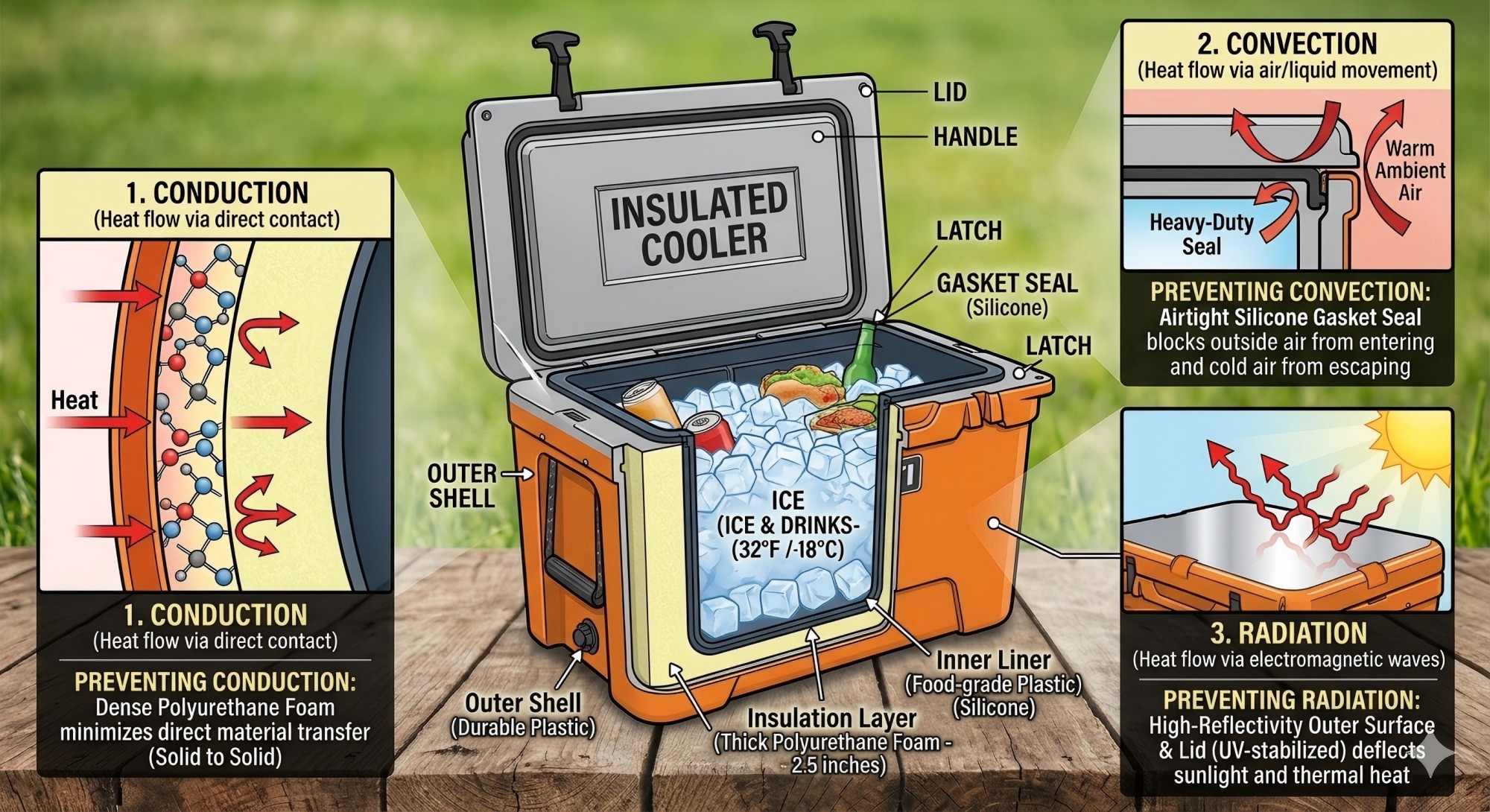
Insulation doesn’t stop heat conduction, but slows down it.
As we all know, the outside heat will continue to drill into the box, and the ice cubes will melt, so temperature control management is the core problem. The insulation layer of the cooler can’t completely keep the heat out, but its real function is to greatly slow down the speed of external heat running in.
How heat enters a cooler?
Heat enters a cooler mainly through three ways: heat conduction, heat convection and heat radiation.
| Mechanism | How It Works | Where It Happens in a Cooler | Impact on Ice Retention |
|---|---|---|---|
| Conduction | Heat travels through solid materials | Outer shell, insulation layer, inner liner | Gradually transfers external heat into the interior |
| Convection | Heat is carried by air movement | Air pockets, gaps, or porous insulation | Speeds up heat circulation and uneven cooling |
| Radiation | Heat transfer via infrared energy without direct contact | Across internal surfaces and air space | Continues even without physical contact, adding to heat gain |
Where is insulation placed?
The thermal insulation interlayer is located between the shell and the inner container. It is not a matter of casual stuffing but a structural thermal insulation barrier. It wraps the side wall, cover, and bottom of the box body to form a closed heat insulation system to jointly resist the invasion of external heat.
However, there are “breakpoints” such as splicing gaps, corner bends and gaps with closed cooler covers, which will destroy the integrity of the thermal insulation system, accelerate the infiltration of heat and greatly reduce the storage time of ice cubes. In a word, the structural design of the insulation layer is aimed at three ways for heat to enter the cooler, with only one goal: to keep the ice cubes for the longest time.
Why Ice Retention Matters in Modern Coolers?
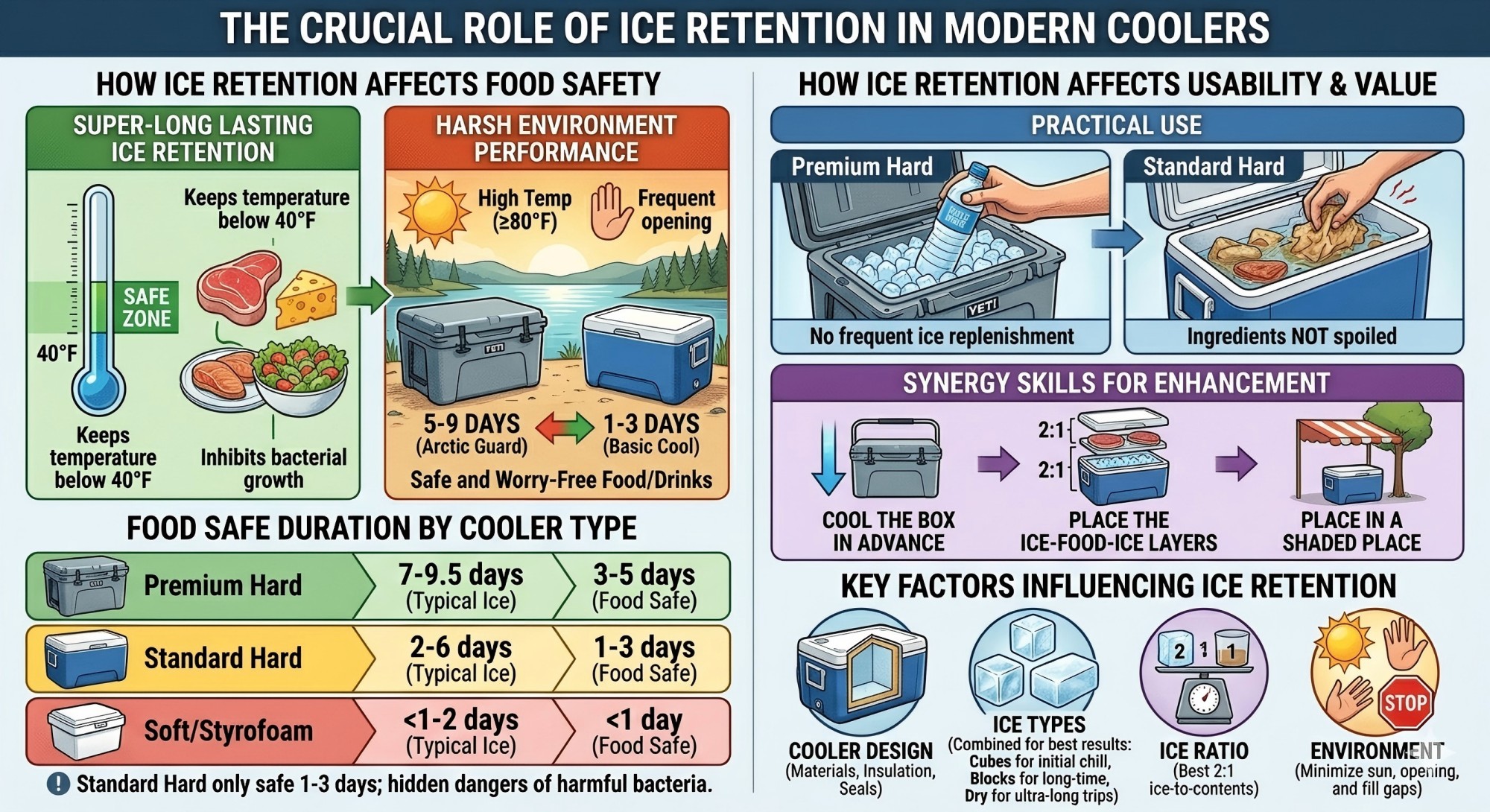
How long can the ice last? Why is it so important? Because the core function of the cooler is not to cool things, but to maintain the low temperature of food and drink for a long time. In practical use, excellent ice retention time means that there is no need to add ice frequently and the ingredients are not easy to deteriorate, which has become the core index to measure the performance of a cooler.
How Ice Retention Affects Food Safety and Usability?
Super-long-lasting ice retention can keep the temperature in the box below 40℉ and effectively inhibit the growth of bacteria in meat, dairy products and salads.
Under the harsh environment of outdoor high temperature ≥80℉ and frequent opening and closing of the lid, the high-quality cooler can still keep ice for 5-9 days. With a 2:1 ice-to-food ratio, long-distance camping, and outdoor travel for many days, the food and drinks are safe and worry-free.
On the contrary, ordinary coolers with short ice retention often fail to keep food fresh for more than 3 days. Even if an extra ice pack is installed, the food can only be kept safe for 1-3 days, which is easy to deteriorate and breed harmful bacteria, and there are hidden dangers in food safety.
And here are some practical synergy skills: cool the box in advance, place the ice-food-ice cubes in layers, and place them in a cooler, then put them in a shaded place to enhance both safety and usability.
And this is how long most coolers in the market can keep food safe.
| Cooler Type | Typical Ice Retention | Food Safe Duration (with proper pack) |
|---|---|---|
| Premium Hard | 7-9.5 days | 3-5 days |
| Standard Hard | 2-6 days | 1-3 days |
| Soft/Styrofoam | <1-2 days | <1 day |
Key Factors That Influence Ice Retention Time
Cooler design: As we mentioned before, different materials, insulation layers, volumes, or seals of coolers can generate different ice retention effects. What kind of coolers you choose, to a very large extent, determines the final thermal insulation effect.
Ice types: There are cubed ice, block ice, crushed ice, and dry ice. And it turns out it’s better to combine types for optimal results: choosing ice cubes for initial chill, blocks for long-time effect, and dry ice for ultra-long trips. Or if you don’t want much trouble, just choose ice water or regular ice cubes.
Ice ratio: The best ratio of ice-to-contents should be 2:1.
Environment: High temperature, direct sunlight, and frequent opening and closing of the lid will accelerate the melting of ice. You can put the box in the shade, open the box as little as possible, and fill the gap in the box with towels or extra ice.
What Are Vacuum Insulation Panels (VIPs)?
Definition & Core Composition
Vacuum Insulation Panel (VIP) is a kind of high-performance thermal insulation material, which is more and more widely used in cold chain logistics, household appliances, buildings, and other temperature-sensitive scenes. It relies on the internal vacuum environment, blocking the way of heat conduction and effectively blocking heat transfer, and its thermal insulation performance is excellent.
| Core Composition | Description & Features |
|---|---|
| Key Material | Ultra-fine < 60nm porous structure, high compression resistance |
| Barrier Film | Multi-layer metal-coated composite film, airtight & heat-sealable |
| Vacuum Structure | Ultra-low pressure ≤0.07PSI, only 1/200 of normal atmosphere |
| Edge Protection | Hot-melt folded edge sealing, reduce edge heat leakage |
The thermal conductivity of brand-new intact VIP is as low as 0.004 W/m・K, and its thermal insulation effect is five times that of ordinary foam thermal insulation materials.
The Working Principles of Vacuum Insulation Panels
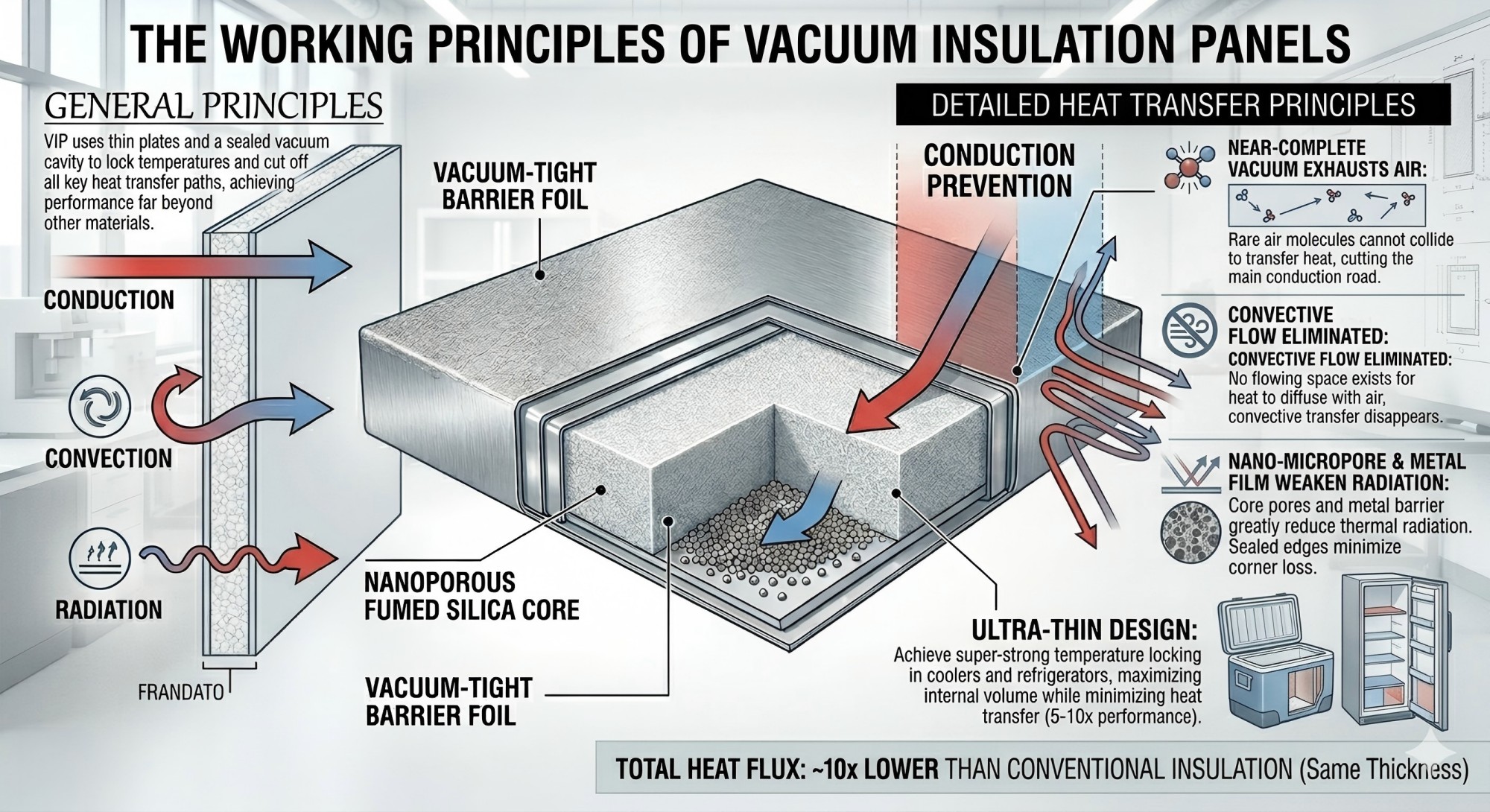
Simply put, the vacuum insulation panel (VIP) is to cut off the air heat conduction path through a sealed vacuum cavity and use an extremely thin board to achieve temperature locking and heat insulation, which is far more effective than other materials or heat insulation layers. To put it in detail, VIP relies on the internal high vacuum environment; no matter whether you are heat conduction, heat convection, or heat radiation, all of them will be stopped.
For conduction: The vacuum environment draws little air from the board so that air molecules are so few that they can hardly touch the opposite side and cannot collide with each other to transfer heat—the main heat conduction road is directly cut off.
For convection: There is no room for air to flow in the board at all, so heat can’t follow the air, and convective heat transfer disappears directly.
For radiation: Built-in nano-micropores and metal barrier films almost block the path of thermal radiation, and with the design of edge sealing structure, even the extra heat loss at the corners is minimized.
Under the same thickness, the thermal insulation performance of VIP is 5~10 times that of traditional foam thermal insulation materials, and the super temperature lock is properly realized. It is especially suitable for scenes with little space but requiring long-term cold preservation—coolers and refrigerators are typical examples.
Comparison between VIPs & Other Insulation
Besides VIPs, common insulation materials include fiberglass, mineral wool, cellulose, spray foam, and rigid foam boards such as polystyrene, polyisocyanurate, and polyurethane.
Compared with vacuum insulation panels, foam materials need to be made thicker in order to achieve the same insulation effect. However, because of their lower cost, simpler processing technology and less fragile, they are still the practical first choice in common scenes such as daily cold storage boxes and building insulation.
| Materials | Thermal conductivity | Thickness needed for same insulation | Durability | Moisture resistance |
|---|---|---|---|---|
| VIP | ~0.004 to 0.008 W/(m·K) | Very low | Fragile if punctured | Good until envelope is damaged |
| Polyurethane foam | ~0.024 W/(m·K) | Low to medium | Good | Good, especially closed-cell |
| XPS / EPS foam | 0.033~0.004 W/(m·K) | Medium to high | Good | Good |
| Fiberglass / mineral wool | about R-3 to R-4.3 per inch | High | Very good | Poor if wet |
What Design Features Maximize Ice Retention in a Cooler?
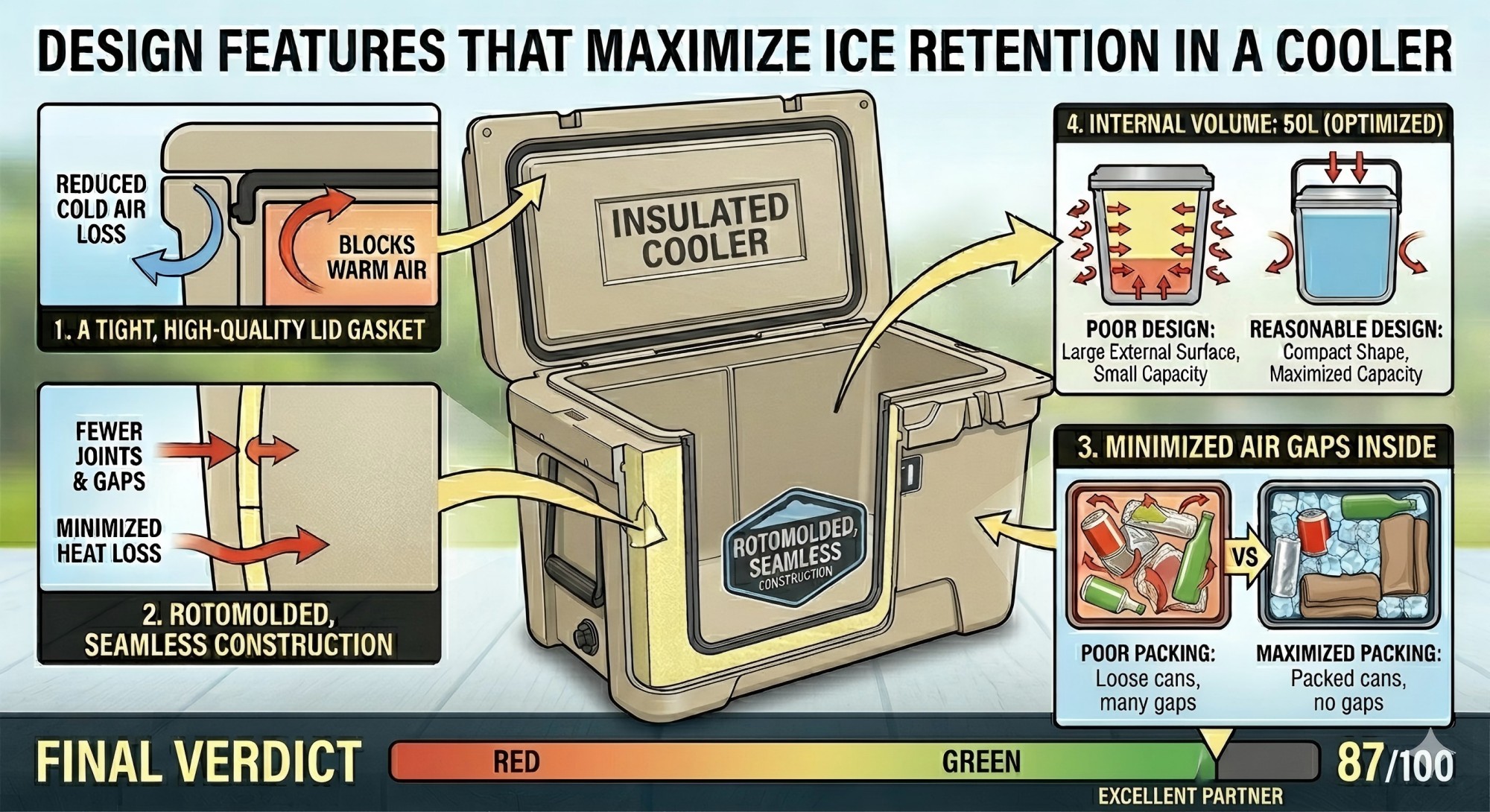
Besides insulation layers, there are other design features that can enhance ice retention in a cooler, such as its lid, gasket, and empty space inside.
A tight, high-quality lid gasket: The sealing performance is better, and the exchange of cold and hot air can be reduced every time the box lid is opened and closed.
Rotomolded, seamless construction: Fewer joints and gaps mean fewer leaks, lower heat loss, and a more durable box structure.
Minimized air gaps inside: Fill the gap with ice cubes, drinks, or towels to avoid stagnant warm air and accelerate the melting of ice cubes.
Reasonable volume shape design: larger internal capacity, smaller external heat dissipation area, and less external heat absorbed by unit storage capacity.
In short, there are three things you must make sure of in order to keep ice long enough: block heat from entering, prevent cold air from leaking, and leave less warm air space inside.
When Should You Choose a VIP Cooler?
When you pay more attention to the thinness, super heat insulation, and long ice retention time of the box, rather than the low price and anti-fall durability, choose the VIP cooler. It is especially suitable for multi-day long-distance travel, cold chain transportation, high-end camping, and all scenes that require thin-walled structures.
These are some scenes suitable for VIP use:
Multi-day long-distance outdoor travel:
VIP can keep food or drinks fresh for a longer time, which greatly prolongs the service time of ice cubes and ice packs.
Limited space:
Ultra-thin VIP can achieve super thermal insulation, and the internal usable volume is larger under the same overall size.
Temperature-sensitive contents:
It is necessary to continuously stabilize the low temperature, not to keep it cold for a short time.
When it is not wise to choose VIP:
Pursuing low cost-effectiveness: Because the cost of traditional foam cold box is lower
Frequent bumping and rough use: VIP material is fragile, and it is easy to damage and leak when falling and squeezing.
Short-distance single-day travel: short-term use cannot reflect the advantages of VIP long-ice protection, and the cost performance is low.

FAQ
What material are your coolers made of? Is it food-grade safety?
The cooler adopts a three-layer composite structure: outer wear-resistant plastic or stainless steel, middle thermal insulation layer, and inner food-grade LLDPE plastic, which does not contain bisphenol A, meets FDA and LFGB food contact safety standards, and can directly store food.
What production processes do you have? What’s the difference?
We provide rotomolding, injection molding, and blow molding.
Rotomolding: seamless, strong and durable, and the ice retention is 5-7 days; Injection molding: precise, exquisite appearance, ice retention for 3-5 days;
Blow molding: light and affordable, with short-term ice retention of 12-48 hours.
What customized services do you support?
Full-dimensional personalized customization is supported: Pan Tong color matching, screen printing/embossing brand LOGO, capacity size, box shape, internal partition, portable handle, universal roller, surface texture, etc. At the same time, new molds can be opened, and an exclusive OEM/ODM customization scheme can be provided.
What are the delivery date, logistics and distribution, and minimum order quantity?
The conventional batch production cycle is about 45 days: 3-5 days for spot samples and 7-10 days for customized samples. Support global door-to-door one-stop logistics transportation and low order quantity; support neutral spot OEM, which is suitable for start-up business cooperation.
How does the factory control the product quality, and what relevant certifications does it have?
Strict quality control testing is carried out from raw materials entering the factory to finished product delivery. It holds a number of authoritative certifications such as ISO9001, BSCI, SEDEX, RoHS, REACH, etc.
Conclusion: Is VIP the Future of Cooler Design?
Vacuum insulation panels are bound to become the mainstream development direction of coolers in the future, especially suitable for high-end small and long-term cold-keeping products.
The reason is very simple: at the same thickness, VIP’s thermal insulation performance far exceeds that of traditional foam. Without increasing the volume of the box, ice retention can be greatly extended, or more internal storage space can be vacated.
At last, Kingstar is an experienced manufacturer in hard coolers, cooler jugs, soft coolers, custom stainless steel drink bottles, tumblers, cups, coffee pots. if you need to consult more professional information about cooler manufacturing or VIP, apply for product samples, or obtain detailed quotations, please send an email to sales@waterbottle.tech, or fill in the online message form below to contact us.
References
Theproperkitchen, 2025, Does Food Stay Good in a Cooler? A Comprehensive Guide, https://theproperkitchen.com/does-food-stay-good-in-a-cooler/
Wikipedia, 2026, Vacuum insulated panel, https://en.wikipedia.org/wiki/Vacuum_insulated_panel
Kingstarmold, 2025, How Are Cooler Boxes Made? https://kingstarmold.com/how-are-cooler-boxes-made/
Insulation, 2025, Vacuum Insulation Panels: High-Performance Building Envelope Insulation, Ideal for Retrofit Upgrades, https://insulation.org/io/articles/vacuum-insulation-panels-high-performance-building-envelope-insulation-ideal-for-retrofit-upgrades/
Tempcontrolpack, 2025, Vacuum Insulation Panels (VIP): Advanced Thermal Insulation for Modern Applications, https://www.tempcontrolpack.com/knowledge/vacuum-insulation-panels-vip-advanced-thermal-insulation-for-modern-applications/

Specializing in custom manufacturing, quality control and marketing of vacuum-insulated drinkware and coolers.