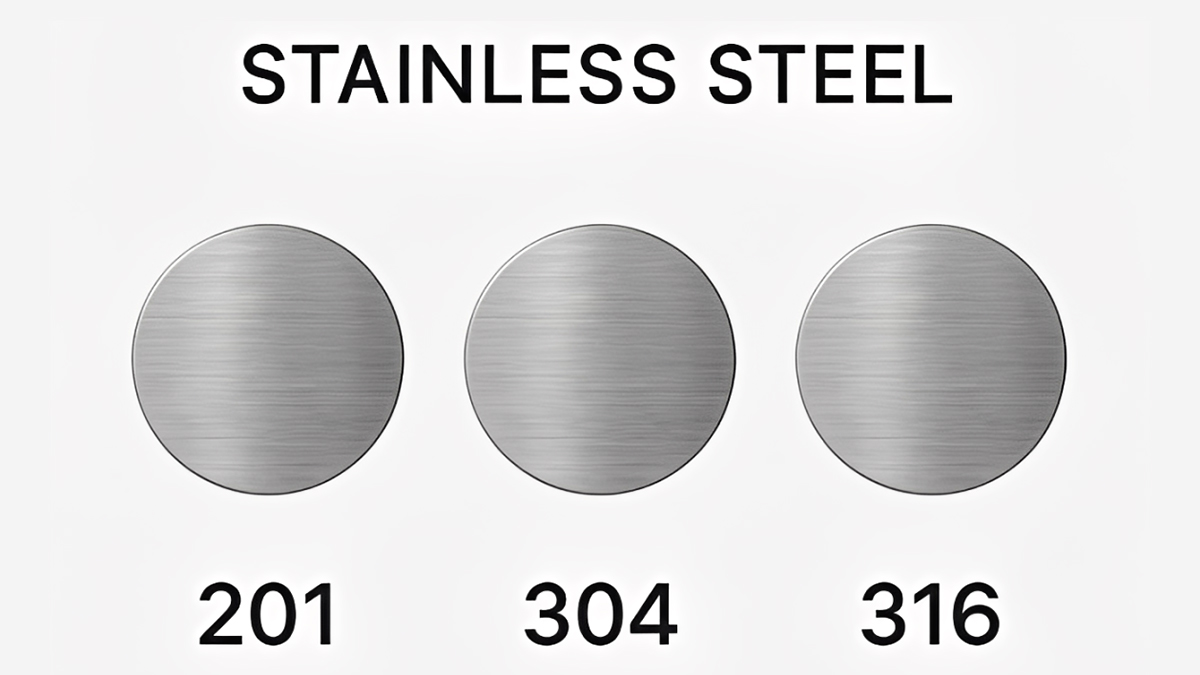
If you purchase stainless steel water bottles in bulk for corporate gifting, hotels, restaurants, gyms, activities, or retail channels, there are three numbers that directly affect the quality of water bottles that you choose: 316, 304, and 201 stainless steel.
What kind of stainless steel you will choose can directly affect the corrosion risk, durability under the real using and cleaning process, and safety hazards, thus undermining the end customers’ evaluation of the products. Choosing the right material can not only save a lot of trouble in the future but also make the comprehensive cost more cost-effective in the long run.
This paper compares three kinds of stainless steel materials and discusses which raw material is the most suitable for corporate gift water bottles. The practical conclusion is clear at a glance:
- 316 is mostly used in high-end models, suitable for salty drinks and harsh use environments;
- 304 is the general main force in the water cup industry, with balanced performance and price ratio, which is safe and reliable;
- The price of 201 products looks affordable, but the corrosion resistance is weak, and it is easy to cause problems when it comes to corrosive liquids.
How Safe Are 316, 304, and 201 Stainless Steel for Water Bottles?
For B2B drinkware, the core of safety is the material properties are stable when they come into contact with all kinds of daily drinks, and it will not cross-taste and change the taste of drinks, and it can be kept clean even after being brushed all year round.
From this point of view, 304 and 316 stainless steels are safe choices. A reasonable chromium-nickel ratio makes them corrosion-resistant and stable in daily water-filled environment.
Standard Chemical Composition Breakdown
In order to understand why these three materials have different performances, we must start with metallographic data. The content of nickel, manganese and molybdenum is the key to distinguishing the quality of materials.
| Stainless Steel Grade | Chromium (Cr) % | Nickel (Ni) % | Manganese (Mn) % | Molybdenum (Mo) % | Nitrogen (N) % | Iron (Fe) % |
|---|---|---|---|---|---|---|
| Grade 316 | 16.0-18.0 | 10.0-14.0 | 2.0 max | 2.0-3.0 | 0.10 max | Balance |
| Grade 304 | 18.0-20.0 | 8.0-10.5 | 2.0 max | — | 0.10 max | Balance |
| Grade 201 | 16.0-18.0 | 3.5-5.5 | 5.5-7.5 | — | 0.25 max | Balance |
Key Element Functions at a Glance
- Chromium (Cr): Forms an invisible protective oxide film to prevent the bottle from rusting.
- Nickel (Ni): Improve the overall corrosion-resistance, durability as well as flexibility, which makes the bottle tough to use and flexible for various shaping.
- Molybdenum (Mo): Only 316 stainless steel contains Mo, which is specially used to resist pitting corrosion caused by salt, coffee, and other acidic liquids.
- Manganese (Mn): 201 steel relies on it to replace nickel to reduce the cost, but its rust resistance is much lower than Ni.
- Nitrogen (N): Strengthen the hardness of the alloy and enhance the structural strength of the bottle.
- Iron (Fe):the main ingredient of the base material, which makes the bottle resistant to falling and bumping.
What Are the Key Performance Differences Between 316, 304, and 201 Stainless Steel?
The Role of Grade 316 in Demanding Scenarios
The reason why 316 stainless steel stands out is that it contains molybdenum, which can greatly improve the corrosion resistance in harsh environment. This feature is particularly critical when the water bottle gets in touch with salty, coastal air, or lots of chloride, or it’s often used to put different acid drinks and washed frequently. Compared to other two grades, 316 material has better durability and corrosion resistance, which can effectively avoid pitting and crevice corrosion.
The Role of Grade 304 as the Industry Workhorse
As the main material in the water bottle industry, 304 stainless steel is often labeled as “18/8.” Its conventional components are 18%~20% chromium and 8%~10.5% nickel. It is a bright spot to adapt to all kinds of daily drinks and frequent uses. The material meets the food contact standards of FDA, LFGB, etc., and the drinks will keep their natural flavor without any metallic odor. Most mass-manufactured water bottles give priority to 304: it is safe, reliable and durable, has high cost performance when purchased in bulk.
Why Grade 201 Demands Strict Caution in B2B Procurement
You need to be really cautious when purchasing 201 stainless steel. Its nickel content is relatively lower in order to reduce costs, but its strength and flexibility are not bad.
There are some problems. Its corrosion resistance is greatly reduced. It is generally believed in the industry that 201 is more prone to rust in harsh environments. Long-term storage of acidic drinks, salty liquids, or in a high-temperature environment will greatly increase the corrosion probability.
Many experts are conservative, so they don’t recommend using 201 to make containers for drinks. Even those who approve the use will only agree to put it into production under strict and limited scenarios. After all, we can’t limit the types of drinks that people put in the bottles and how long they are put in.
Which Stainless Steel Grade Offers the Best ROI for Your Bulk Procurement?
In order to help B2B buyers to make well-informed decisions according to their own budgets, we’ve sorted out the key parameters and made a standard comparison table.
| Decision Factor | 316 Stainless Steel | 304 Stainless Steel | 201 Stainless Steel |
|---|---|---|---|
| Corrosion Resistance | Excellent in chloride-rich and harsh environments. | High and suitable for most beverage applications. | Lower resistance in demanding environments. |
| Beverage-Contact Confidence | Best suited for premium or high-risk use cases. | Standard choice for food and beverage contact. | Not ideal for long-term liquid contact under demanding conditions. |
| Taste / Odor Neutrality | Highly stable and neutral. | Stable and widely accepted. | May be less stable if corrosion develops. |
| PREN | 23.1–27.9 | 18.0–20.0 | 16.0–18.0 |
| B2B Sourcing Cost | Premium | Mid-range / baseline | Lowest cost |
Is It Worth Investing in Premium Stainless Steel Grades Like 316?
Convert the material performance into the purchase cost account, and how to make decisions will be clear at a glance. All in all, 316 stainless steel has higher quality and lower after-sales risks.
And here are three strategies for you to calculate ROI:
Risk Mitigation and Asset Protection (When to Choose 316)
If the distribution channels and target end customers belong to the following categories, upgrading 316 materials is a guarantee, which can reduce the overall use cost in the long run (TCO).
- Coastal and marine scenarios: 316 steel is suitable in cruise ships, coastal resorts, shipping facilities, and yacht clubs because in these conditions, perennial salt fog will quickly corrode ordinary steel.
- High-acid beverage: brands that mainly store cold-extracted drinks, lemon juice, kombucha, and acidic sports drinks for a long time.
- High-frequency harsh use scenarios: industrial and mining sites, high-end outdoor equipment, and water cups have to be repeatedly washed by powerful chemical cleaning agents.
From the perspective of commercial impact: although the price of 316 raw materials is higher, a lot of warranty claims and bad review losses are saved in the later period, and the brand reputation is maintained.
Brand Premiumization and Perceived Value (When to Leverage 316)
The materials’ information is transparent, and it can quickly win the trust of consumers without offline shelves or e-commerce details. High-quality 316 material itself is an excellent marketing selling point.
The “Marine-Grade” Label: positioning high-end cups, focusing on durability, and meeting the needs of hardcore outdoor enthusiasts.
The “Medical-Grade” Label: highlighting cleanliness and safety, suitable for healthy brands, minority gyms, and high-end hotel room spare parts.
A verified “316 Stainless Steel” stamp or laser engraving on the bottom of the bottle justifies a premium retail price point. This allows your business to command higher gross margins that easily offset the initial sourcing premium.
High-Volume Scaling and Maximum ROI (When to Choose 304 Instead)
If it’s not the above conditions that 316 stainless steel is necessary for, we can switch to 304 with lower costs while achieving the same performance.
Corporate gifting: employee gift package, anniversary gift, exhibition gift.
Campus supermarket: cultural creation around campus, students’ daily drinking bottles.
Chain gym: strictly control the price and take the peripheral products that are distributed in large quantities.
304 stainless steel water bottles are a cost-effective choice for daily scenes such as office, campus, and fitness. Easy to adapt to all kinds of ordinary drinks, the cost of single-piece goods can be controlled, and the comprehensive selection of bulk purchases is the best.
Can I Combine Different Stainless Steels in a Single Product?
Mixing different grades of stainless steel seems to be a shortcut to save money, but this scheme depends on process design, not just subjective ideas.
Some products can use two different materials. The inner wall contacts the drinks, so the corrosion-resistant qualified steel is selected; parts that don’t touch liquid, such as the shell, are changed to low-cost materials to control costs.
However, we can’t ignore the risks. Galvanic corrosion is easy to occur, welding is difficult, and the deformation performance of the two steels after heating and stress is also different.
If 304 or 316 inner is welded with 201 outer, the high temperature will cause steel sensitization. Sensitization means that after stainless steel is heated at 425 ~ 870°C, chromium carbide precipitates along the grain boundary, resulting in local chromium deficiency, which makes steel prone to intergranular corrosion.
Therefore, it is impossible to form an antirust passivation film. Intergranular corrosion is easy to occur at the weld position, which will destroy the sealing performance of the vacuum insulation layer over time. In addition, when different metals are stored together, it will trigger galvanic corrosion when it meets wet water vapor.
| Structural Component | Material Combination | Primary Engineering Risk | Long-Term QC Impact |
|---|---|---|---|
| Inner Liner / Outer Shell | Inner 316 / Outer 304 | Low corrosion-related risk; best for demanding environments. | Strong durability and stable long-term performance. |
| Inner Liner / Outer Shell | Inner 304 / Outer 304 | Low risk; common industry baseline for insulated drinkware. | High manufacturing consistency and predictable QC outcomes. |
| Inner Liner / Outer Shell | Inner 304 / Outer 201 | Moderate to high corrosion risk, especially in humid or acidic use. | Greater likelihood of rust-related complaints and higher QC burden. |

Click and read more about Custom Options: Stainless Steel Vacuum Thermos Bottle Testing: World-famous Third-party Testing Companies
How Can B2B Buyers Verify Raw Materials and Audit the Supply Chain?
Sampling inspection of raw materials is essential. In the stainless steel supply chain, quality assurance documents alone may not be reliable, so XRF spectrum or quick on-site inspection are needed for testing.
Three common testing methods:
XRF (X-ray Fluorescence): nondestructive authoritative detection. A hand-held detector can measure the precise element ratio of water bottles in a few seconds, and investigate unauthorized substitution of 201 for 304 on the spot.
Chemical Reagent Screening: The on-the-spot drop test shows that the reagent reacts with manganese. The liquid level turns red and brown in a short time, which is the high manganese material 201.
Destructive Laboratory Testing (ICP-OES): Inductively coupled plasma spectroscopy can accurately analyze trace components, which is mostly used for strict compliance quality inspection and legal evidence.
| Target Market | Regulatory Body / Standard | Core Compliance Metric Evaluated |
|---|---|---|
| United States | FDA food-contact rules + California Proposition 65 | Food-contact safety and chemical migration / exposure risk. |
| European Union | LFGB | Taste/odor neutrality and migration safety for food-contact materials. |
| Global / Corporate | ISO 9001:2015 | Traceability, documented process control, and manufacturing consistency. |
Conclusion
When choosing 316, 304, or 201, the core is to match the materials according to the actual scene of the product: what drinks to pack, the use environment, and the durability standards of brand promise.
Reliable custom water bottle suppliers will implement the advantages and disadvantages of materials into detailed production standards, assist in evaluating the feasibility of OEM customization, and implement quality inspection throughout the process.
If you are going to adjust the product planning of water bottles this year, you may need to change the way of thinking and finalize the material selection scheme with suppliers that suits brands, budgets, and customers. If you want to consult on some questions about materials, OEM customization, or manufacturing processes, please send an email to discuss: sales@waterbottle.tech.
FAQ
References
Link. Springer, 2021, Sensitization of Austenitic Stainless Steels: Current Developments, Trends, and Future Directions, https://link.springer.com/article/10.1007/s13632-021-00724-y
U.S.Food and Drug Administration (FDA): CFR – Code of Federal Regulations Title 21 – Food and Drugs: Part 175 — Indirect Food Additives. https://www.accessdata.fda.gov/scripts/cdrh/cfdocs/cfcfr/cfrsearch.cfm?fr=175.300
European Commission (EC) Food Contact Materials: Regulation (EC) No 1935/2004 on materials and articles intended to come into contact with food. https://food.ec.europa.eu/safety/chemical-safety/food-contact-materials_en
Sucelsteel, 2025, Comparison of Stainless Steel Grades SS201, SS304, SS316, and SS430, https://sucelsteel.com/201-vs-304-vs-430-vs-316-stainless-steel.html

Specializing in custom manufacturing, quality control and marketing of vacuum-insulated drinkware and coolers.