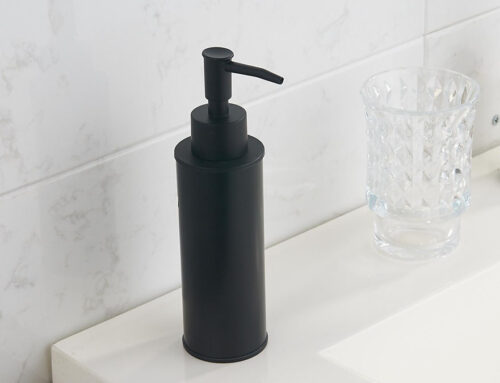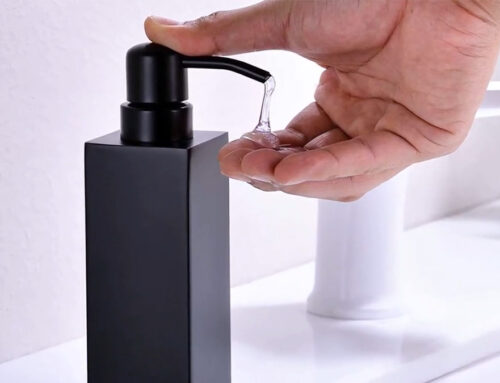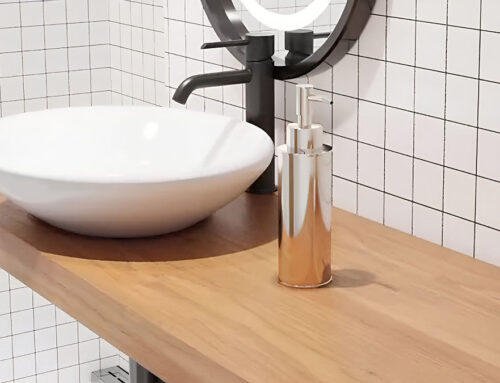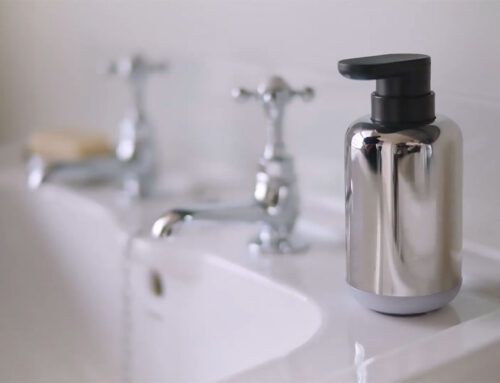
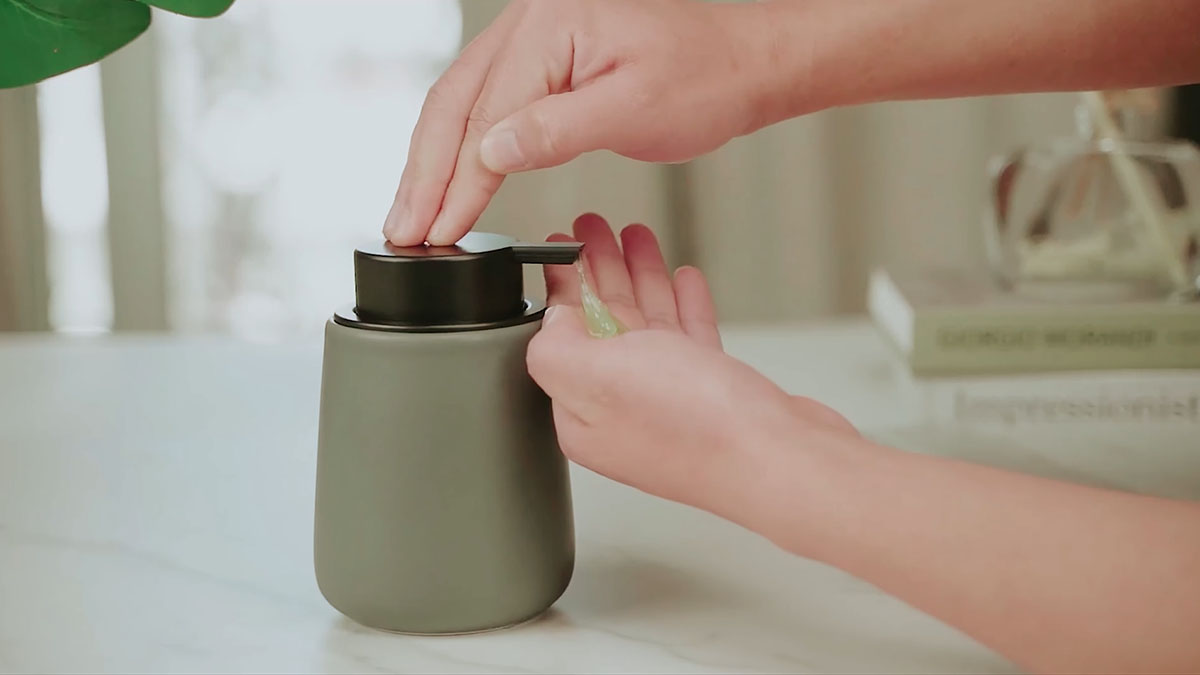
A customized soap dispenser is one of the most cost-effective investments for brands in hotels and residential and commercial fields. Ready-made styles will dilute brand recognition, while customized soap dispensers can strengthen your brand image in every detail.
But where should we start? Which material is the most durable? How to print a logo on metal? How long will the construction period take?
This guide explains all the problems at once. You will know the material, pump mechanics, minimum order quantity (MOQ), delivery time, and how to get a quote. We have also compiled real factory data; production design suggestions; and certification requirements, such as FDA and California Proposal 65, to help you make a sound choice.
Let’s start right now!
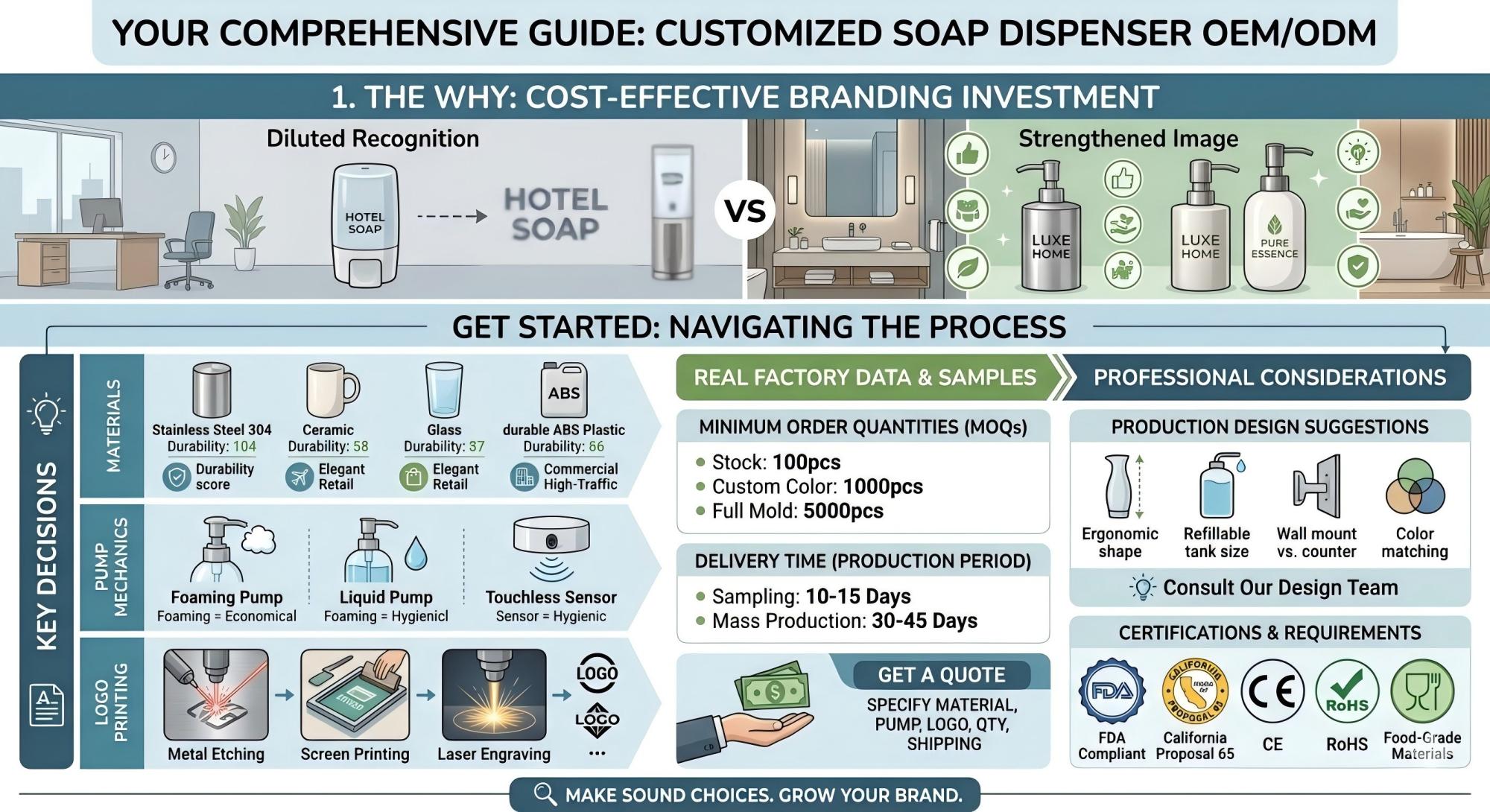
Why Should You Customize Soap Dispensers for Your Brand?
When you walk into a luxury hotel or a high-end spa, you rarely see generic plastic bottles. That is not an accident. Customization directly impacts perceived value, guest satisfaction, and even your bottom line.
The Real Cost of Generic Dispensers: What Brands Lose
The hidden cost of a generic soap dispenser is much higher than the price itself.
Brand image: Inferior and leaky soap dispensers will lower the overall grade. In the hotel industry, the cleanliness of bathrooms and the texture of accessories directly affect the evaluation and reputation of guests.
User experience: Switching to a high-quality customized stainless steel soap dispenser, the experience is obviously upgraded. Guests are very concerned about texture, weight, and durability, and these details determine the high-end feeling.
Operating cost: Generic plastic models are easy to break because of high-frequency use, and frequent replacement will increase labor, logistics, and maintenance costs. A customized stainless steel soap dispenser is more durable and more suitable for long-term commercial use.
| Cost Factor | Off-the-Shelf | Custom | Difference |
|---|---|---|---|
| Per-unit price | 1.50–1.50–3.00 | 3.50–3.50–8.00 | +2.00–2.00–5.00 |
| Replacement rate (12 months) | 15 – 25% | < 1% | Massive saving |
| Brand lift (review score) | Baseline | +0.4 – 0.6 stars | Priceless |
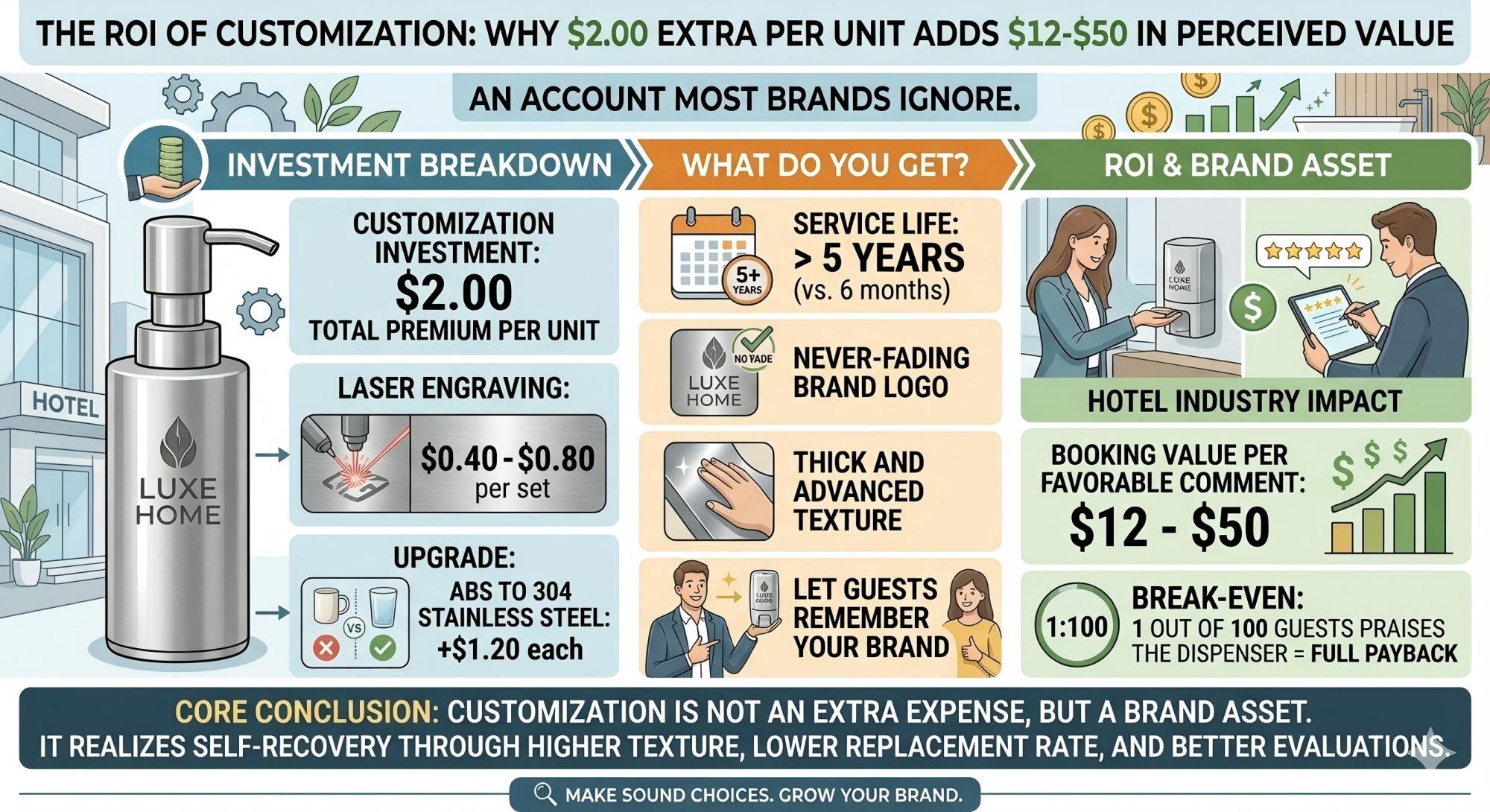
ROI of Customization: Why $1.20 Extra Per Unit Adds $12 in Perceived Value
This is an account that most brands ignore.
When the order quantity is 1000 sets, laser engraving for stainless steel soap dispensers will cost about 0.4–0.8 USD per set. Upgrading from ABS plastic to 304 stainless steel costs about $1.20 each. Total premium: about $2 per set.
What can you get for this $2?
- The service life is more than 5 years (not just 6 months)
- Never-fading brand logo
- Thick and advanced texture
- Let guests remember your brand.
In the hotel industry, a favorable comment will bring about a booking value of about $12-50 in the future. As long as one of the 100 guests is praised by the exquisite custom soap dispenser, the investment will be fully paid back.
Core conclusion: customization is not an extra expense but a brand asset. It relies on higher texture, a lower replacement rate, and better evaluation to realize self-recovery.
What Materials Are Best for Custom Soap Dispensers?
304 Stainless Steel vs. 201 Stainless Steel: The Hidden Difference
Choosing the right material matters a lot. Once the wrong choice is made, the soap dispenser will rust, crack, and appear cheap in just a few months.
| Property | 304 Stainless (18/8) | 201 Stainless | Difference |
|---|---|---|---|
| Nickel content | 8–10.5% | 3.5–5.5% | 304 has higher nickel content |
| Chromium content | 18–20% | 16–18% | 304 has slightly higher chromium |
| Corrosion resistance | Excellent, especially in humid or mildly corrosive settings | Moderate, less resistant in humid or salty environments | 304 is more corrosion-resistant |
| Food-contact suitability | Commonly used for food-contact applications | Less preferred for food-contact or wet-use applications | 304 is the safer default choice |
| Cost | Higher | Lower | 201 is typically more affordable |
Why does 304 stainless steel win?
Because high nickel content can form a stable passive oxide layer, which can repair itself even if it is scratched. Even in the environment of high humidity, like a bathroom and salt-fog coastal hotel, it can really prevent rust.
We did a 48-hour salt spray test on each batch of 304 stainless steel: no rust, no corrosion, and no after-sales claim. Therefore, be sure to ask the supplier to provide the original material certificate to confirm that it meets the ASTM A240 304 standard.
Why Glass and ABS Plastic Often Disappoint in Commercial Settings
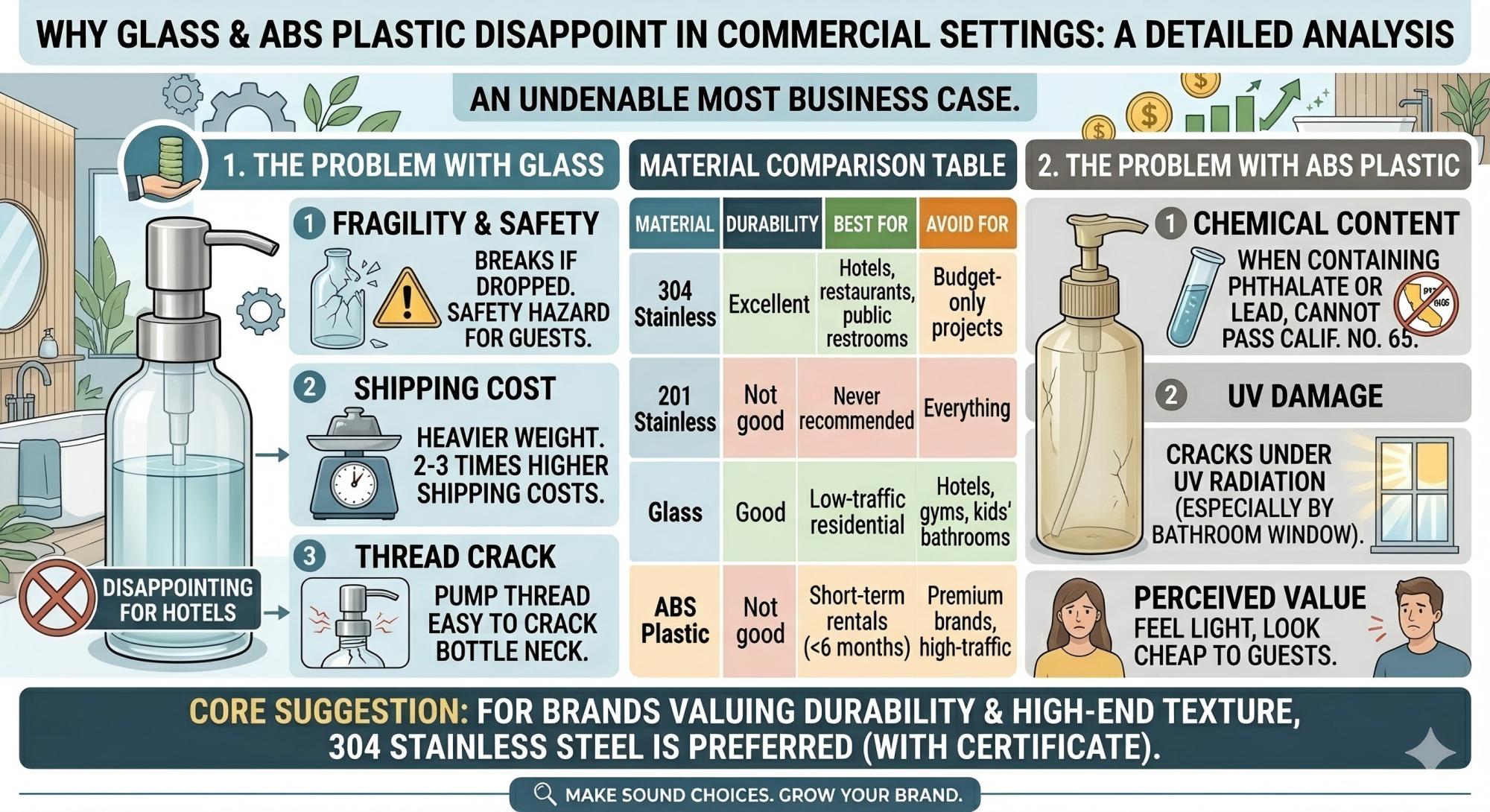
Glass is really beautiful when used in home spas, but it’s totally impossible for hotels to clean and use it. Because it will break when dropped, which has potential safety hazards. And it is much heavier, which will cost 2-3 times more in shipping. And its pump head thread is easy to crack the bottleneck with.
Although ABS plastic is extremely cheap, nearly 70% cheaper than stainless steel, the problem is obvious.
- When it contains a phthalate or lead stabilizer, it can’t pass California No. 65 test.
- It is easy to crack under ultraviolet radiation (especially by the bathroom window)
- Feel light, look cheap to guests.
| Material | Durability | Best For | Avoid For |
|---|---|---|---|
| 304 Stainless | Excellent | Hotels, restaurants, public restrooms | Budget-only projects |
| 201 Stainless | Not good | Never recommended | Everything |
| Glass | Good | Low-traffic residential | Hotels, gyms, kids' bathrooms |
| ABS Plastic | Not good | Short-term rentals (<6 months) | Premium brands, high-traffic |
Therefore, we suggest that for brands that value durability and high-end texture, a 304 stainless steel soap dispenser with an original material certificate is preferred.
How Do You Put a Logo on a Soap Dispenser?
The brand LOGO is your brand promise. The selected engraving process determines whether this promise will fade 3 months later or remain intact in ten years.
Laser Engraving vs. Screen Printing: A Head-to-Head Durability Test
| Method | Durability | Best Surface | Cost per Unit (1k pcs) | Fades? |
|---|---|---|---|---|
| Laser engraving | Lifetime | Stainless steel, brass, aluminum | 0.40–0.80 | Never |
| Screen printing | 1 – 3 years | Plastic, glass, painted metal | 0.15–0.30 | Yes — alcohol/soap wears it |
| Pad printing | 6 – 18 months | Curved plastic surfaces | 0.25–0.50 | Yes — faster than screen |
| UV transfer | 2 – 4 years | Flat metal, glass | 0.50–1.00 | Resists rubbing, not chemicals |
Laser engraving will remove 0.1-0.3 mm of surface material, and the mark will be permanently fixed, indelible, scratch-free, and resistant to chemical corrosion.
For logo printing, visual contrast is very important: brushed stainless steel surface, dark gray or black The logo is clear and eye-catching. On the mirror-polished surface, the same logo is not easy to identify. Before mass production, we will produce a sample rendering for your confirmation.
Factory engineer’s design tips: If the logo has thin lines (width less than 0.5 mm), laser engraving can achieve 1200 DPI high-definition accuracy, but screen printing can’t achieve this delicate texture at all.
5 Logo Placement Mistakes That Ruin Your Dispenser’s Aesthetics
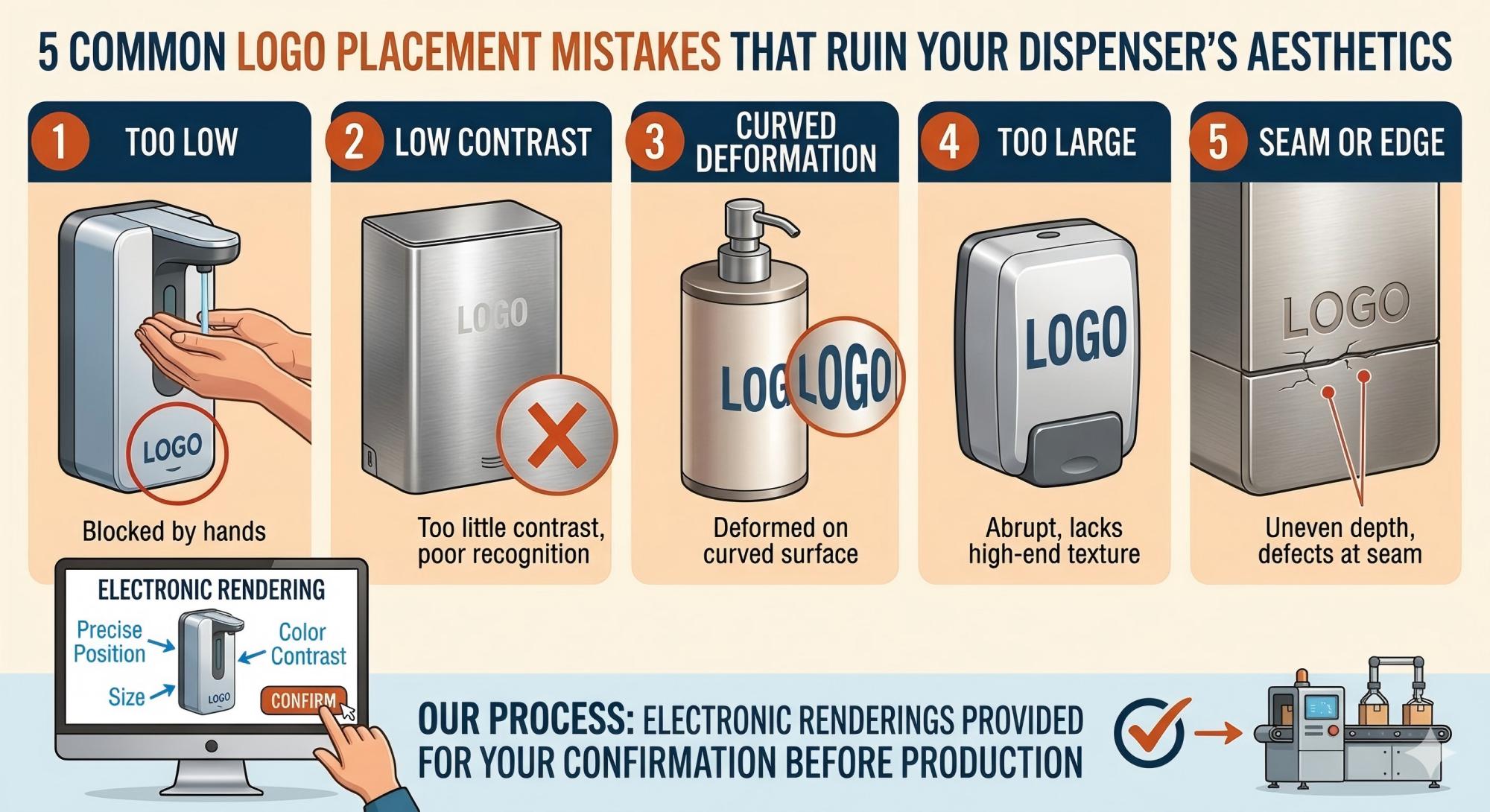
Here are 5 common mistakes that you may make:
- The logo is too low, so it is easy to be blocked by hands when using it, and it is completely invisible.
- Using a light-colored logo on the brushed steel surface is too low in contrast and poor in recognition.
- The position of the curved surface is directly printed without pattern adaptation, and the finished product is easy to deform and go out of shape.
- The logo size is too large, the look and feel are blunt and abrupt, and there is no high-end texture.
- Put the logo on the seam or edge; the carving depth is uneven, and the finished product has obvious defects.
Our customization process is very simple: before mass production, an electronic version of the renderings is issued to indicate the precise position, size, and color contrast of the logo. We’ll start production after you confirm it.
What Is the Minimum Order Quantity (MOQ) for Custom Soap Dispensers
MOQ is the most frequently asked question for minority brands. Tell the truth: it depends on the customization type.
MOQ Breakdown by Customization Type (500 to 5,000+)
| Customization Type | Typical MOQ | Lead Time Added | Best For |
|---|---|---|---|
| Laser logo on existing product | 500 pcs | 3 – 5 days | Startups, crowdfunding campaigns |
| Pantone color match (existing mold) | 1,000 pcs | 10 – 15 days | Boutique hotels, branded residences |
| Custom pump color | 3,000 pcs | 15 – 20 days | Differentiating from competitors |
| New mold / full shape customization | 5,000 pcs | 45 – 60 days | Exclusive product lines |
The “Semi-Custom” Strategy: How Startups Can Launch with Only 500 Units
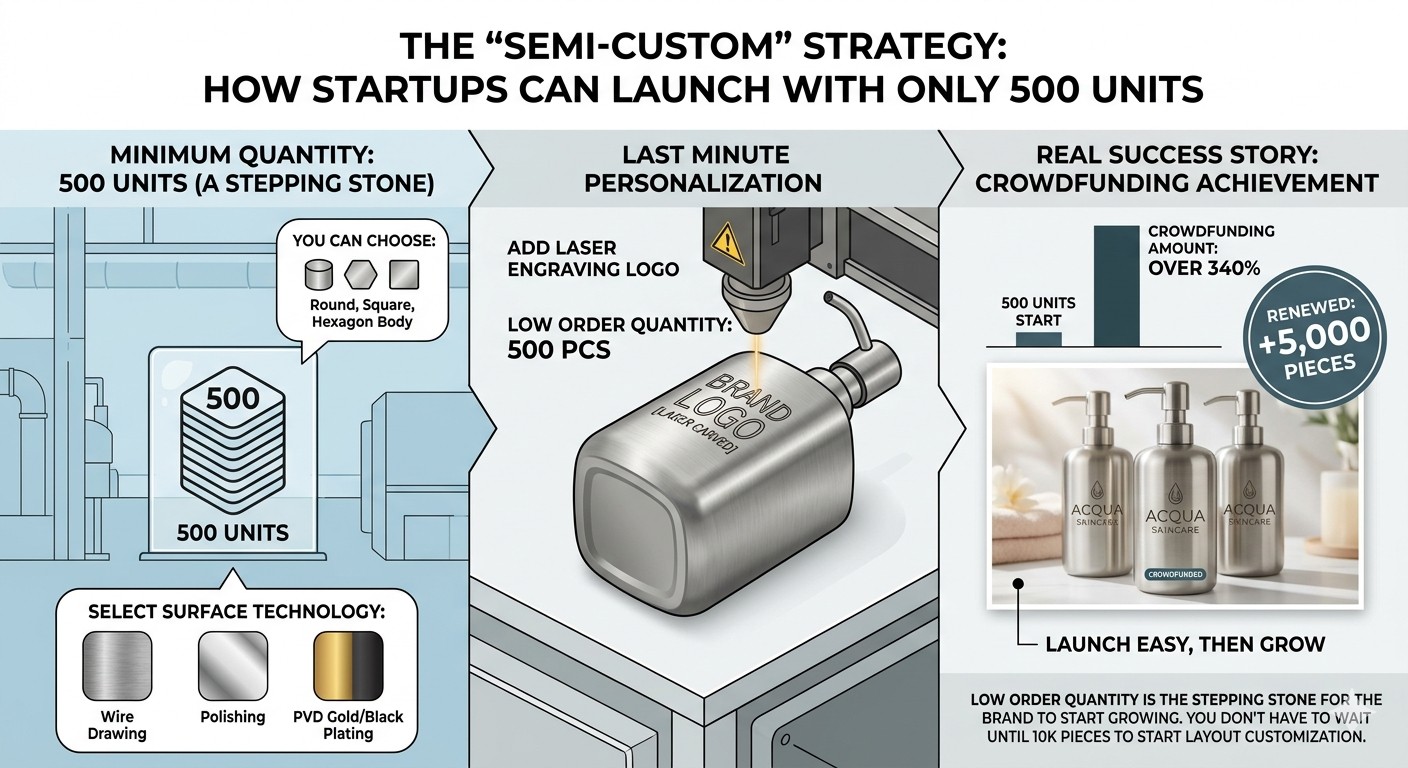
For brands that have not reached the minimum order quantity of 5,000 pieces temporarily, we launch a semi-customized scheme:
You can choose any style from the existing stainless steel bottle body, including round, square and hexagon. Then select the conventional surface technology, such as wire drawing, polishing, PVD gold plating/black plating; finally, add a laser engraving exclusive Logo. The overall order quantity is only 500 pieces.
Share a real success story: there is a skin care start-up brand, and the crowdfunding project only needs 500 soap dispensers. They chose our semi-customized scheme: a 300 ml brushed stainless steel bottle body with their own laser-carved logo. Not only is it easy to meet the minimum order quantity, but the crowdfunding amount is also over 340%. Just four months later, they renewed another 5,000 pieces.
It can be seen that low order quantity is the stepping stone for the brand to start growing. You don’t have to wait until you need 10 thousand pieces to start layout customization.
NDA and IP Protection: Why Your Custom Design Stays Yours
We attach great importance to intellectual property protection. Before providing any design drawings and samples, strictly implement the following guarantees:
- We can sign an NDA (Non-Disclosure Agreement) within 24 hours;
- The mold belongs to the brand;
- Never disclose your product design to any third party.
Ready to open the customization? Contact the sales team immediately to get the exclusive quotation, and we will take you through the semi-customized complete solution step by step.
How Do Different Pump Types Affect User Experience
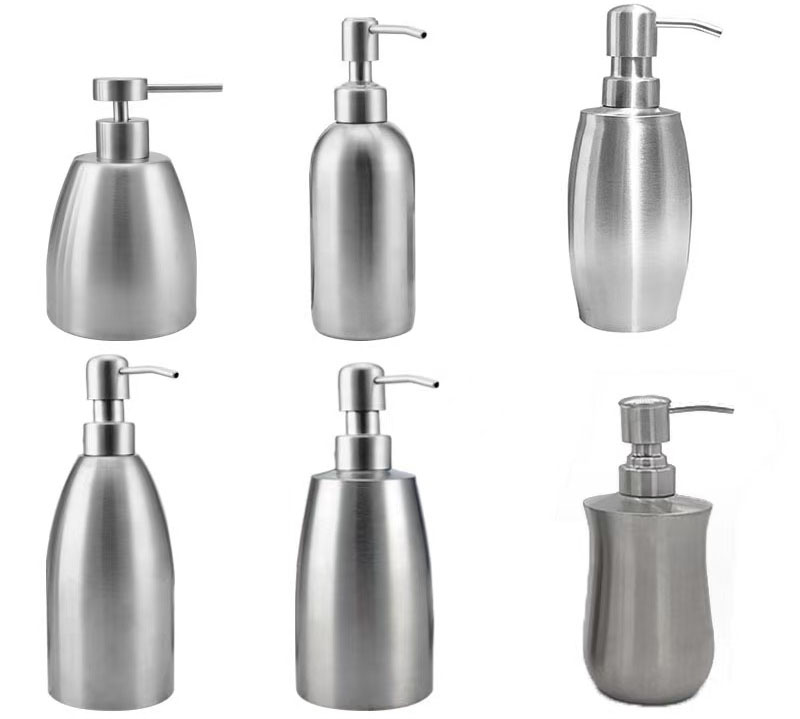
Most buyers only pay attention to the appearance of the bottle, but they don’t know that the pump determines 70% of the user experience. Inferior pumps are easy to leak and jam, and there will be problems of more and less liquid output.
Lotion Pump vs. Foam Pump vs. High-Viscosity Pump
| Pump Type | Soap Viscosity | Output per Stroke | Spring Wire Diameter | Best For |
|---|---|---|---|---|
| Lotion pump | Thin to medium (100–1,500 cP) | 1.5 – 2.0 ml | 0.5mm | Standard liquid hand soap |
| Foam pump | Thin only (< 200 cP) | 0.5 – 1.0 ml + air | 0.45mm | Foaming hand soap |
| High-viscosity pump | Thick (1,500 – 5,000+ cP) | 2.5 – 3.5 ml | 0.8mm | Gels, shampoos, organic soaps |
| Wall-mount pump | Any (bag-in-box system) | Adjustable (2–10 ml) | Heavy-duty | Commercial restrooms |
The Spring Compression Problem
There is a sharp truth that most suppliers will not be honest with you. Here is something that you may not know.
Ordinary lotion pumps are all adjusted according to the viscosity of clear water, and the viscosity range is only 100-500 cp. However, if your soap is thick—such as organic gel and essential oil—and its viscosity exceeds 1500 cp, the spring force of ordinary pumps is not enough at all, and it will not bounce back once pressed.
What are the consequences? In just two weeks, the pump is stuck and can’t be used. Your customers don’t have good using experiences, the product return rate increases, and unsatisfactory reviews increase.
Many people think that the pump head is just an irrelevant accessory. But in fact, the compression ratio of the spring directly determines whether your high-end thick washing liquid can be used smoothly.
Then how do we solve this problem? We will directly measure your actual formula. Just send 200 ml of the stock solution, and we will accurately match the compression ratio of the pump spring, the diameter of the suction pipe, and the material of the ball valve, which completely fits the real viscosity of your cleaning solution.
How to Test Pump Compatibility
| Step | Action | Timeline |
|---|---|---|
| 1 | Prepare 200ml of your actual soap formula | Day 1 |
| 2 | Email our team with viscosity details (or send a video) | Day 1 |
| 3 | We ship 5 test pump samples (different spring strengths) | 3–5 days |
| 4 | Install and pump 100x daily for 2 weeks | 14 days |
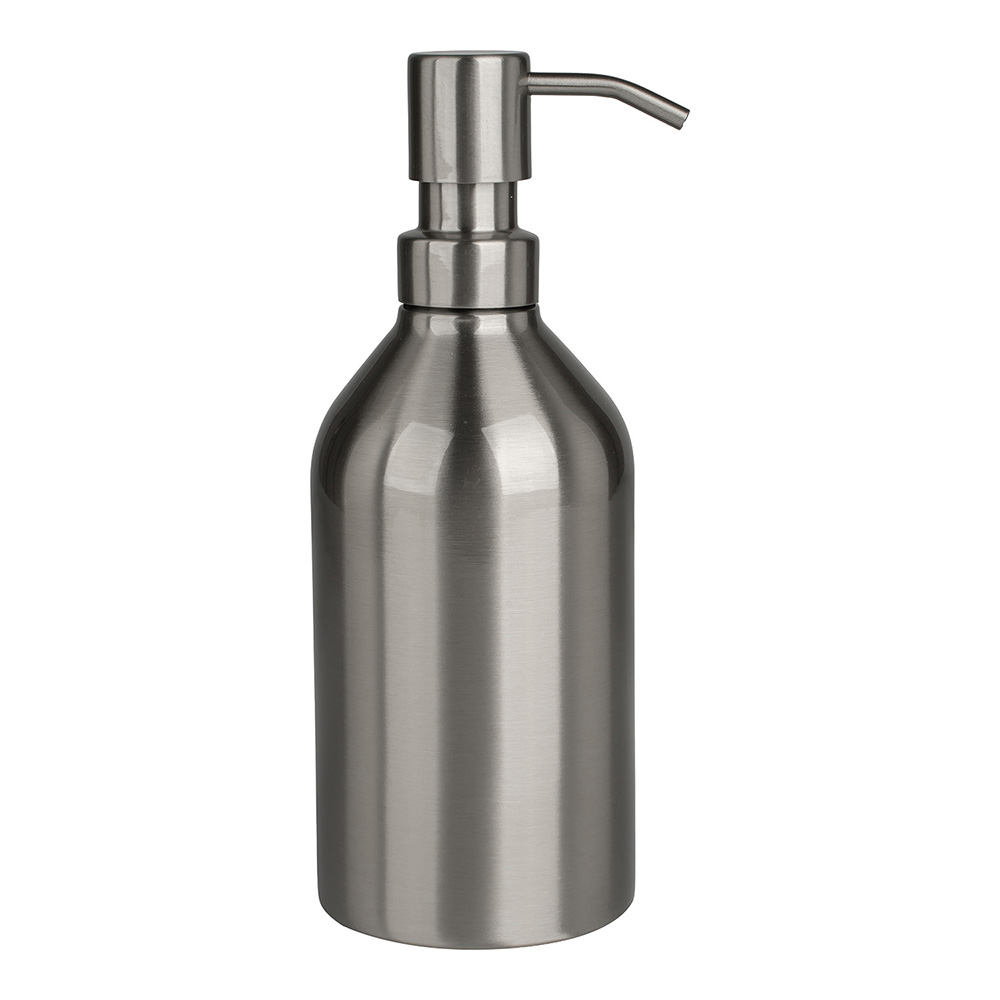
$0.74-4.42 per unit. Send an email to sales@waterbottle.tech.
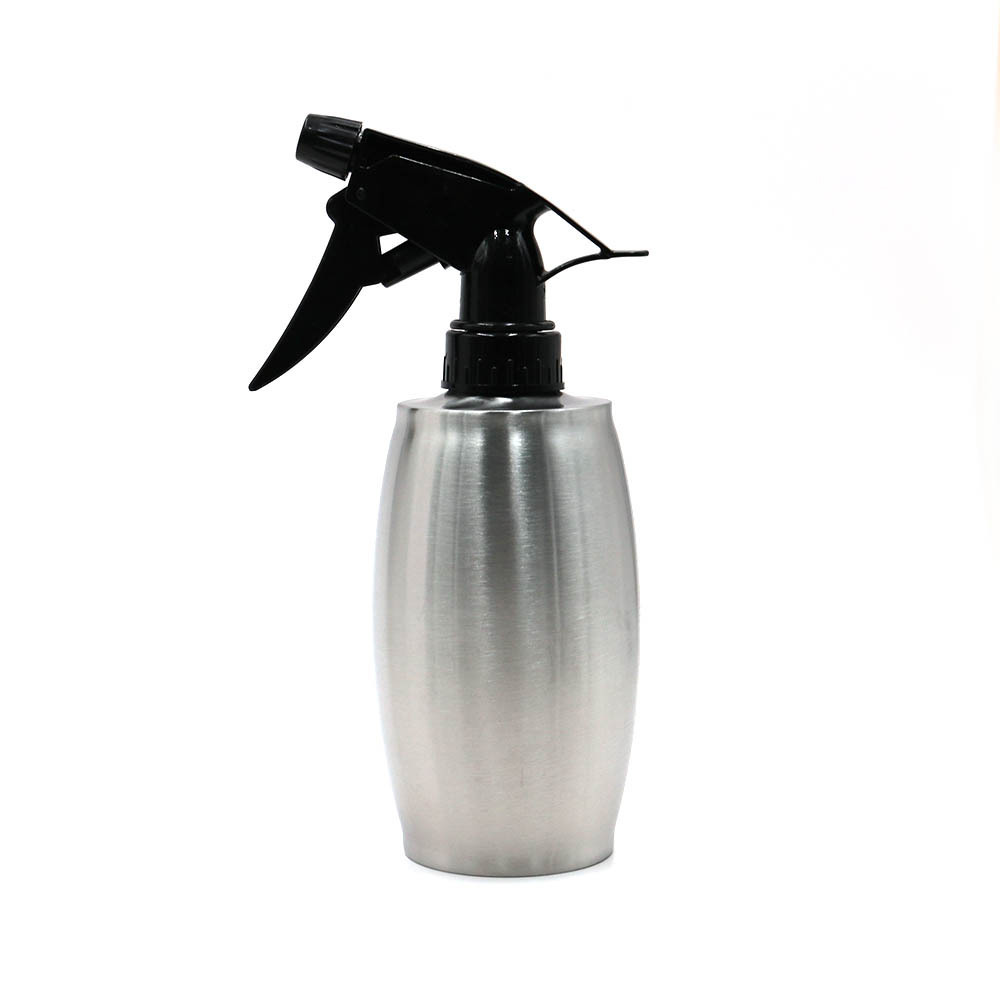
$1.32-2.80 per unit. Send an email to sales@waterbottle.tech
Conclusion: Ready to Start?
Now you have mastered all the key information: material, LOGO technology, MOQ, pump head adaptability, and delivery time. Everything is ready; only action is needed.
If you already have the final design in mind, just browse our soap dispenser wholesale catalog and choose the appropriate basic style. If you are still in the wait-and-see stage, just send your LOGO file (AI or PDF format) and the intended purchase quantity to sales@waterbottle.tech. We will send you the high-definition design draft and preliminary quotation within 24-48 hours, without any binding commitment.
FAQ: Soap Dispenser Customization
References
Grand View Research. Soap Dispenser Market Size Report, 2024–2033. Retrieved from https://www.grandviewresearch.com/
California Office of Environmental Health Hazard Assessment (OEHHA). Proposition 65: Chemicals Listed as Known to the State to Cause Cancer or Reproductive Toxicity. Retrieved from https://oehha.ca.gov/proposition-65
U.S. Food and Drug Administration (FDA). FDA 21 CFR 175.300: Resinous and Polymeric Coatings. Retrieved from https://www.accessdata.fda.gov/scripts/cdrh/cfdocs/cfcfr/CFRSearch.cfm?CFRPart=175
ASTM International. *ASTM A240/A240M: Standard Specification for Chromium and Chromium-Nickel Stainless Steel Plate, Sheet, and Strip for Pressure Vessels and for General Applications*. ASTM, West Conshohocken, PA. Available at: https://www.astm.org/Standards/A240.htm

Specializing in custom manufacturing, quality control and marketing of vacuum-insulated drinkware and coolers.