Choosing between 304 and 316 stainless steel seems to be a simple decision, but in fact, for a long time after the product goes on the market, it will subtly affect the product performance, brand positioning and customer satisfaction. These two materials are widely labeled as food grade, both of which meet international safety standards, and they are also the main materials for cups and pans and food contact products. However, the price difference between 316 stainless steel and the positioning of high-end products often lead buyers to ask the same question: is it really necessary to choose this upgraded material, or is it just to save worry?
I have been deeply involved in the field of stainless steel water bottles, cups and mugs in the global market for more than ten years, and have witnessed all kinds of landing situations in the practical application of this material selection decision. The answer to this question never lies in which material is “superior” in absolute sense, but the core lies in which material is more suitable for the actual use scene of your product, the expectations of consumers and the brand’s business objectives.
Durability: Chemical Resistance Matters More Than Material Strength
At first glance, durability seems to be a problem of material strength. However, comparing 304 and 316 stainless steels, it will be found that the core of the durability difference between them lies in chemical stability rather than physical toughness. From the structural characteristics, there is almost no difference in mechanical properties between the two kinds of stainless steels formed with the same thickness. Whether it is hot coffee when commuting or cold water in a sports bag, their ability to resist depression, impact and daily wear is similar and their performance is equally reliable.
The core difference between the two is mainly reflected in the ability of corrosion resistance. The addition of molybdenum in 316 stainless steel is very low, but it can play a key role, and its ratio is usually between 2% and 3%. The addition of this element greatly improves the tolerance of steel to chlorides, salts and various acids. When the cups and mugs are filled with sports drinks and fruit juices, the surface of 316 stainless steel can remain intact for a longer time in humid air environment containing salt spray or when it comes into contact with strong detergents, and the probability of appearance defects or functional damage is lower.
On the other hand, 304 stainless steel performs very well under normal use conditions. The durability of 304 is more than enough for cups and tumblers which mainly contain mild drinks such as water, tea and coffee in home and office scenes. In most mainstream consumer markets, the theoretical performance advantages of 316 stainless steel are often not truly reflected in daily use.
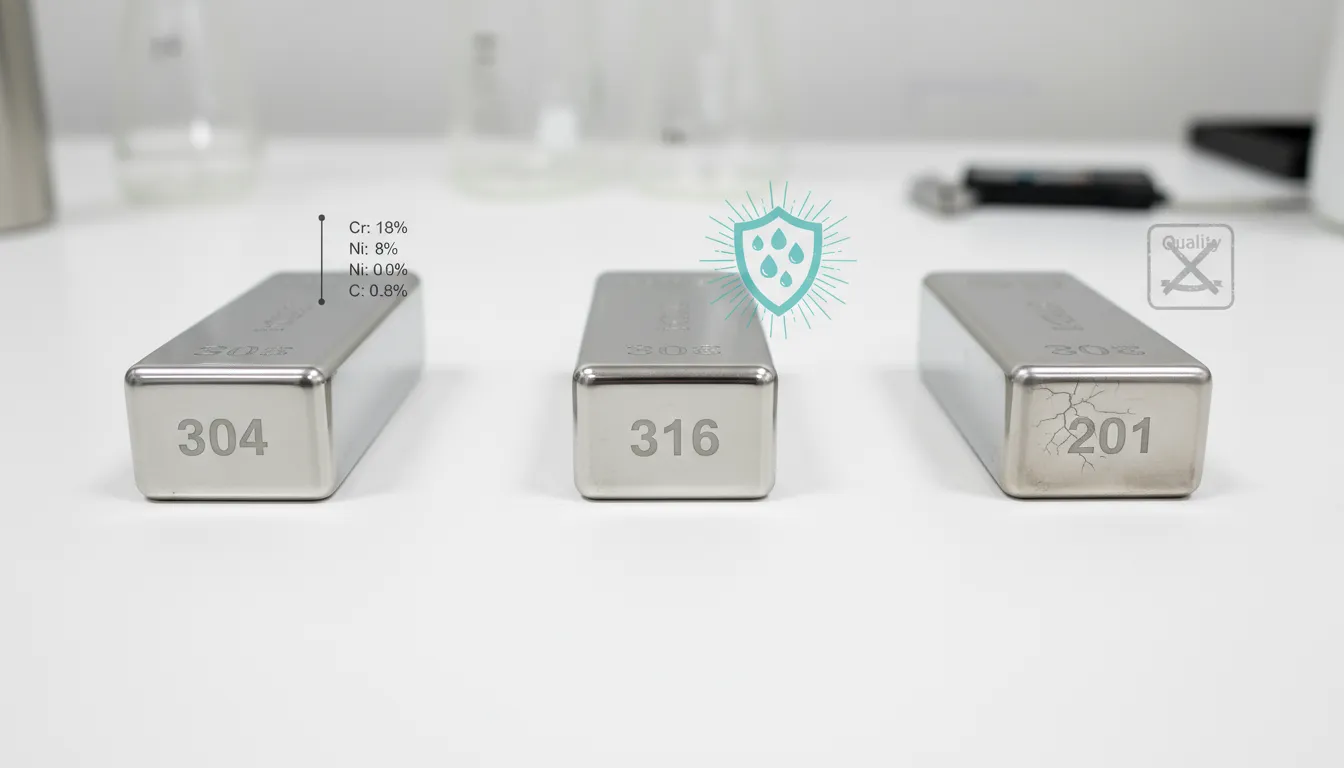
To put the technical distinction into context, the core compositional difference looks like this:
| Property | 304 Stainless Steel | 316 Stainless Steel |
| Chromium | ~18–20% | ~16–18% |
| Nickel | ~8–11% | ~10–14% |
| Molybdenum | None | ~2–3% |
| Chloride Resistance | Good | Excellent |
This small addition of molybdenum is what drives most of the performance gap—and most of the price difference.
Do Both 304 and 316 Stainless Steel Meet Food Safety Standards?
From the point of view of safety, both 304 and 316 stainless steels are clearly classified as food-grade materials. On the premise of compliant production, both products meet the relevant specifications of the US Food and Drug Administration (FDA), the safety requirements of food contact materials in the European Union, and the certification standards of the National Sanitation Foundation (NSF). The safety of these two materials stems from the same core mechanism: a chromium oxide passivation film with stable properties will be formed on its surface, which can not only prevent the substrate from being corroded, but also prevent metal ions from precipitating into the beverage.
For decades, 304 stainless steel has been safely used in various food and beverage contact scenarios. Under normal use conditions, its composition ratio can form a stable inert layer on the surface of steel, which will not react with drinks; As long as the welding, grinding and cleaning processes are done well in the production process, there is no health hazard to consumers. In fact, the safety performance of a qualified 304 stainless steel cup and kettle has far exceeded the minimum requirements of relevant laws and regulations.
Based on this safety, the safety margin of 316 stainless steel is further broadened. It has better corrosion resistance, and can greatly reduce the already low risk of metal ion precipitation even in harsh use scenarios such as chlorine-containing water, acidic drinks and frequent high-temperature storage. Because of this, 316 stainless steel is widely used in medical, pharmaceutical and shipping industries. These scenes have hard requirements for the stability of materials, and there is no room for compromise.
But what needs to be viewed objectively is that, as far as the core use of drinking water is concerned, the safety difference between the two is an incremental improvement rather than a qualitative leap. Consumers who use 304 stainless steel products will not face potential safety hazards; The core value of 316 is only to add a layer of peace of mind to the products in harsh use environment or positioning high-end categories.
What’s the Cost Difference Between SS304 and SS316?
The most obvious downside of 316 stainless steel is cost. The added molybdenum and higher nickel content typically push prices 15 to 30 percent above 304. For manufacturers and brand owners, that premium directly affects margins, retail pricing, or both.
In many cases, this higher cost delivers little tangible benefit to the end user. A bottle designed for daily hydration at work or school will rarely encounter the conditions that justify 316’s enhanced corrosion resistance. Paying more for material performance that never gets tested can quietly erode competitiveness without improving customer satisfaction.
There is also a subtle marketing challenge. To the naked eye, 304 and 316 look identical. Justifying a higher price requires education, storytelling, and trust—elements that work well in premium segments but add friction in mass-market channels.
From a production standpoint, 316 can also be slightly less forgiving during forming and fabrication due to its higher alloy content. While not a major obstacle, it can influence efficiency in complex designs or high-volume runs.

Click and read more about Material Options:
Choosing Between 201, 304, and 316 Stainless Steel: When 201 Is the Right Option for B2B Custom Bottles
Evaluating 201 Stainless Steel: Pros and Cons for Bulk Water Bottle Manufacturing
Why B2B Buyers Prefer 316 Stainless Steel Over 304 and 201 for Bulk Custom Water Bottles
Conclusion
One of the most common misconceptions in the industry is that 316 is always the “better” option. In reality, material selection should follow environment and use, not hierarchy. Excellent cleaning practices, smooth surface finishes, and consistent quality control often have a greater impact on hygiene and longevity than upgrading the alloy alone.
For most everyday drinkware applications, 304 stainless steel offers an optimal balance of safety, durability, and cost efficiency. It meets all regulatory requirements and performs reliably in normal conditions. For specialized or premium products exposed to harsher environments, 316 earns its place.
The smartest material decisions aren’t driven by marketing labels or price tags. They’re driven by a clear understanding of how the product will actually be used—and by aligning performance with what your customers truly value.
As a professional drinkware supplier, we focus on customizing materials (304/316 stainless steel) according to different requirements to create products. We offer both immediate shipment options and batch customization services. If you need personalized solutions, please feel free to contact us via sales@waterbottle.tech or through our contact page.